The Sun and the Moon together: clarity beside doubt
What happens when the brightest and the most uncertain trump sit side by side? A calm look at how the pairing is built and how it can be read.
By TaronicaPublished
In short
- The sun and moon tarot pairing puts two neighboring trumps together: one of open daylight, one of uncertain night.
- It is an interpretive combination, not an old tradition, so it is best read as a question about clarity and doubt.
- The useful part is the contrast in imagery, order and light, which gives you something concrete to look at.
What is the sun and moon tarot pairing?
The sun and moon tarot pairing is a combination of two Major Arcana cards, the Sun and the Moon, read together as a contrast between what is plainly visible and what is still uncertain. It is not a fixed formula from the history of tarot. It is a way of reading that arises when two cards with opposite light happen to fall next to each other.
The Sun is traditionally read as clarity, warmth and openness. The Moon is traditionally read as illusion, doubt and a more intuitive, less certain way of seeing. These keywords are common convention, and different readers weigh them differently, so treat them as a starting vocabulary and not as a rulebook.
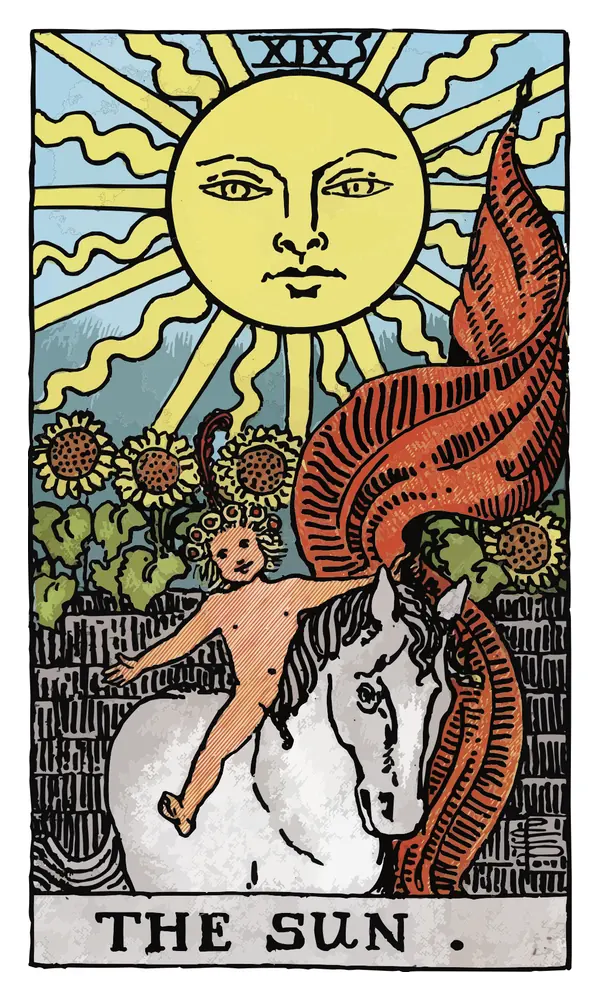
The Sun
The Sun, the nineteenth trump of the Rider-Waite-Smith deck, shown in full daylight.
Read about The Sun on Tarot Told Me (opens in a new tab)What makes the pair interesting is that the two cards are built almost as mirror images. One shows a scene in which everything is lit and nothing hides. The other shows a scene in which the light is borrowed, indirect, and open to misreading.
How are the two cards ordered in the deck?
In the standard Rider-Waite-Smith numbering, the Moon is XVIII and the Sun is XIX. They are neighbors in the sequence of trumps, with the Moon first and the Sun after it. The Victoria and Albert Museum records its Moon card as "XVIII The Moon".
That order is worth noticing. The Moon comes before the Sun, so in the sequence the uncertain night is followed by the clear day. Many readers like this arrangement because it resembles ordinary experience, where confusion often comes before understanding.
Still, it helps to keep the claim modest. The numbering is a feature of a particular deck and its tradition, and other historical decks arrange or number their trumps differently. The idea that the Sun "answers" the Moon is an interpretation laid over the numbers, not something the numbers prove.
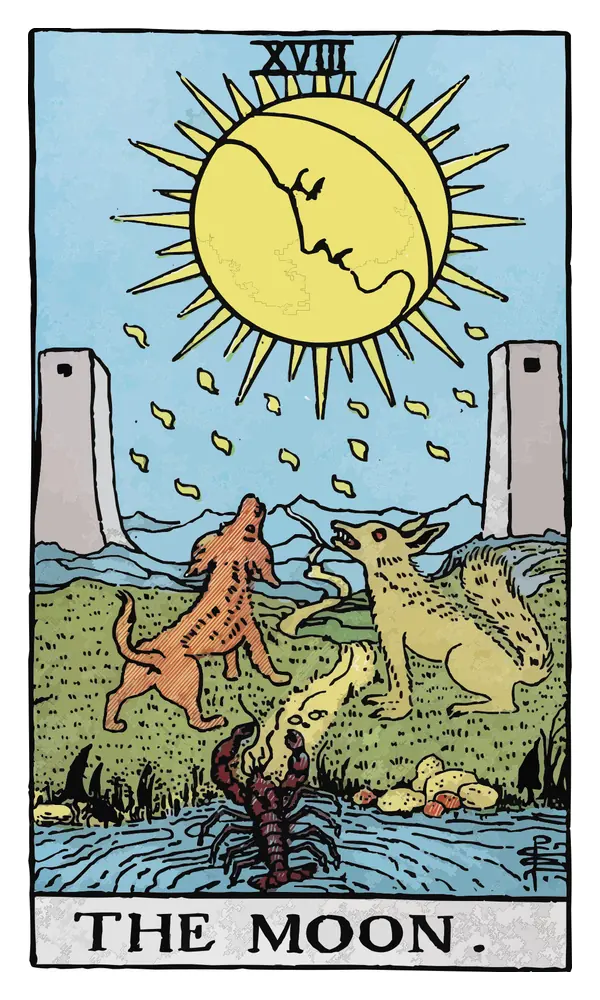
The Moon
The Moon, the eighteenth trump of the Rider-Waite-Smith deck, with its two dogs, towers and winding path.
Read about The Moon on Tarot Told Me (opens in a new tab)What does each card show in the Rider-Waite-Smith deck?
The Rider-Waite-Smith deck was designed by Pamela Colman Smith, who was commissioned in 1909 by Arthur Edward Waite to create a 78-card pack, according to the V&A. Smith was an artist, illustrator and writer who had worked at the Lyceum theatre. Her images are the ones most readers have in mind when they speak of these two cards.
The V&A describes the Moon card as two dogs howling at a bright yellow moon, with a path running between two towers and into the mountains. A pool in the foreground, from which a crayfish crawls, is part of the usual picture as well. The scene is dim, and the path leads somewhere you cannot fully see.
The Sun card, in the same deck, is commonly described as a child on a white horse beneath a large sun, with sunflowers behind a wall. Nothing in the frame is in shadow. Where the Moon shows a path, the Sun shows a place already reached.
Why do clarity and doubt belong in one reading?
Clarity and doubt are not opposites in the way they first appear. Doubt is often what makes a person look more closely, and clarity is often what remains after the looking is done. Reading the two cards together invites you to treat them as stages of one process and not as two rival verdicts.
Say you ask about a decision that feels half-formed, and the Moon and the Sun appear together. One way to read it is that there is a part of the situation you can already see plainly and a part that still feels uncertain. The pairing gives you a reason to separate the two instead of blending them into a single mood.
Doubt is a question that has not yet found its daylight.
This is a reading, not a ruling. If you prefer to see the cards as simply contradictory, that is a legitimate way to work too, and it often produces sharper questions.
How do the symbols and colors contrast?
The two cards use their palettes to say different things. The Sun is dominated by warm yellows and oranges, with a sky that offers no cover. The Moon uses cooler, dimmer tones, with a pale yellow disc that gives light without warmth.
| Feature | The Sun | The Moon |
|---|---|---|
| Light source | A large, direct sun | A moon, light that is reflected |
| Mood of the scene | Open, unguarded | Hushed, uncertain |
| Path or boundary | A wall, with the view beyond it clear | A path between two towers |
| Animals | A horse | Dogs, and a crayfish |
| Number in the deck | XIX | XVIII |
A second, subtler contrast is about distance. The Sun brings the viewer close to a single figure. The Moon pushes everything back, so that the towers and mountains seem far away.
Symbols & colors
Tarot color meanings: what the palette of the cards suggests
Yellow, blue, red, green, white and black each carry traditional associations in tarot art. Here is how those associations work, with examples from the cards.
· Taronica
Does the order of the cards change the reading?
It can, and this is where the pairing becomes practical. Many readers treat the card on the left, or the one drawn first, as the starting point and the other as the direction of travel. That is a convention of reading, not a law, so you are free to adopt a different one as long as you decide it before you look.
With the Moon first and the Sun second, the sequence can be read as doubt giving way to clarity. With the Sun first and the Moon second, it can be read as a situation that looked clear and then raised questions. Neither reading is a prediction. Each is a different prompt about where your attention might go.
If the two cards fall in separate positions of a larger spread, their relationship comes from the positions around them. That is the subject of the general guide to card combinations.
Card combinations
How to read tarot card combinations
Tarot card combinations are read as a phrase, not as two separate answers. Here is a three-step method built on suits, numbers, and images, with a table of suit pairs.
· Taronica
What does the pairing look like in a spread?
In a simple three-card layout, the Moon and the Sun can occupy any two positions, and the third card then acts as a hinge. Say you ask about a project you have started and the cards are the Moon, the Sun and a card of your choosing between them. You might read the middle card as the point where the uncertainty is addressed.
In a two-card draw, the pairing is cleaner and more stark. The question becomes which part of your situation is already clear, and which part still deserves patience. It is a more modest question than whether things will work out, and it is the one the imagery actually supports.
If you also want to compare the Sun with a card of a similar mood, the next article sets out how the Sun and the Star differ. For the other half of the night imagery, the one after it looks at the Star and the Moon.
Card vs card
The Star vs the Sun: hope and joy compared
The Star and the Sun are both gentle, positive trumps, yet they sit in different light. Here is how their images, numbers and traditional readings separate hope from joy.
· Taronica
Card combinations
The Star and the Moon together: hope in uncertain light
What does it mean when the Star and the Moon land in one spread? Here is how the two neighboring cards are built, what they share, and how the tradition reads them as a pair.
· Taronica
How to work with the Sun and Moon pair step by step?
A short routine can keep the reading grounded. Take two or three minutes with the cards in front of you and go through the steps in order.
- Write down the question in one sentence, and keep it about your own choices.
- Look at the Sun and name one thing in your situation that is already plain to you.
- Look at the Moon and name one thing that still feels uncertain or unverified.
- Ask what kind of information would turn the uncertain item into a clear one, and who or what could supply it.
- Decide on one small, reversible step, and leave larger decisions for later.
If the uncertainty concerns health, money, legal matters or safety, the right next step is a conversation with a qualified professional and not a card.
Tool on Tarot Told Me
Three-card spread
Draw a three-card spread and see where the Sun and the Moon land among the positions.
What are the limits of this combination?
The first limit is historical. The research behind this article found no authoritative source for a traditional meaning of the Sun and the Moon together, so what is offered here is a reading, not an inheritance. Earlier decks, such as the Marseille type or the Visconti-Sforza cards, were not checked for this article, and their imagery for these trumps differs from Smith's.
The second limit is the one every combination shares. Two cards can only offer a frame, and the sense you take from it depends on your question, your deck and your own judgment. A card knows nothing about your situation, and a pairing cannot decide it for you.
Used with that in mind, the sun and moon pair is a good exercise in separating what is seen from what is assumed. It asks little of you except to look at both halves of a situation honestly.
Questions to hold while looking at the pair
- What in my situation would I be comfortable explaining in full daylight?
- What am I treating as certain that I have not actually checked?
- Which doubt is useful, and which one is only habit?
Frequently asked questions
No. It is an interpretive pairing, not a documented historical tradition. The two cards are neighbors in the Rider-Waite-Smith order, which makes the contrast easy to notice, but the combined reading is a modern habit of readers.
In the standard Rider-Waite-Smith numbering, the Moon is XVIII and the Sun is XIX, so the Moon comes first. Other decks can number or order their trumps differently.
Not in any rule of tarot. The two cards can be read as stages, as a contrast, or as two parts of one situation. Which of these you choose is part of your reading and not a property of the cards.
No. It is traditionally linked with doubt and illusion, but also with intuition and the unconscious. Readers differ on how they weigh these, so it helps to say which sense you are using.
It is not well suited to that. The imagery speaks about visibility and uncertainty, so it fits questions such as what is clear and what is still unclear better than a verdict.