The Star vs the Sun: hope and joy compared
The Star and the Sun are both gentle, positive trumps, yet they sit in different light. Here is how their images, numbers and traditional readings separate hope from joy.
By TaronicaPublished
In short
- A comparison of star vs sun tarot is really a comparison of quiet hope and open, daylight joy.
- The Star is trump XVII and is set at night with a kneeling figure, while The Sun is trump XIX and shows a child beneath a blazing sun.
- Neither card is better than the other, and seeing them side by side shows how tarot builds mood from setting, number and gesture.
What separates the Star from the Sun in tarot?
In star vs sun tarot, the main difference is mood and setting: The Star is traditionally read as hope and quiet renewal, while The Sun is read as clarity, vitality and open joy. Both are generally treated as favorable cards, which is why they are so easily confused. The gap between them is less about whether things are good and more about where the story stands.
One way to put it: the Star is what remains when the worst is over and the light has not fully returned. The Sun is what it looks like when the light is simply there. The first is a promise held in the dark, and the second is something already in plain view.
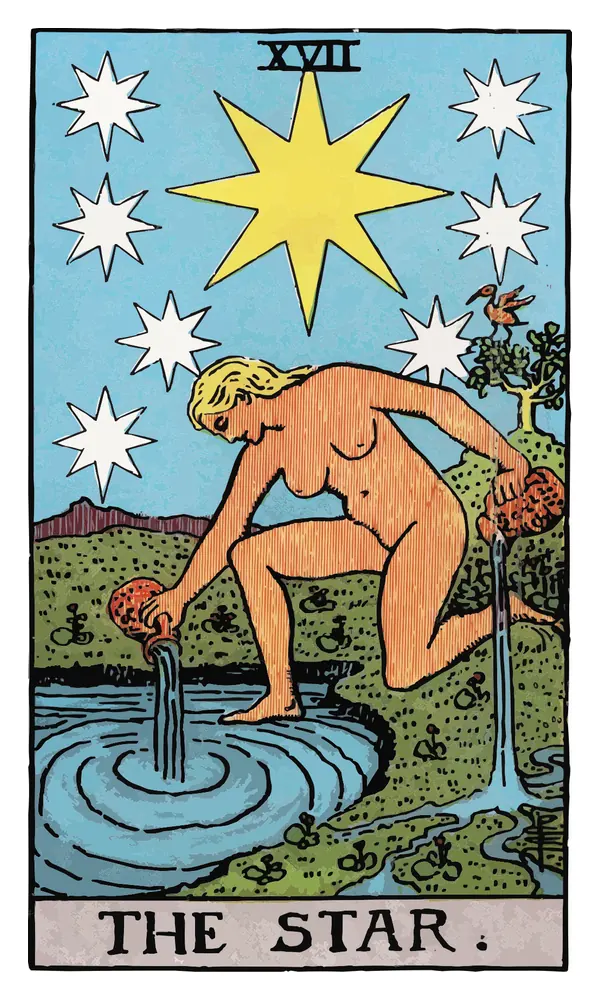
The Star
The Star, trump XVII: a kneeling figure pours water under a large star in a night sky.
Read about The Star on Tarot Told Me (opens in a new tab)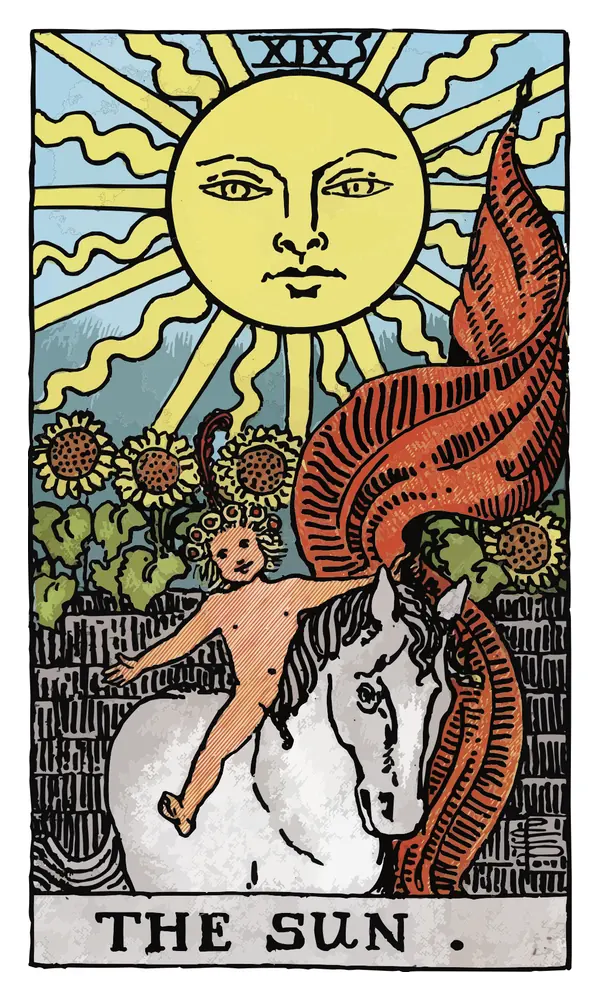
The Sun
The Sun, trump XIX: a child on a white horse beneath a radiant sun, with sunflowers behind.
Read about The Sun on Tarot Told Me (opens in a new tab)This article stays with the cards themselves: their images, their places in the sequence and the language of the tradition. It does not offer single-card meanings or predictions, and the comparison is a way of seeing how the deck is built.
Where do the two cards sit in the Major Arcana?
The Star is numbered XVII and The Sun is XIX in the Rider–Waite–Smith deck and in most traditional decks. Between them stands the Moon, trump XVIII. The three form a short run that many readers treat as a passage from open night, through uncertainty, to full day.
- The Star
- The Moon
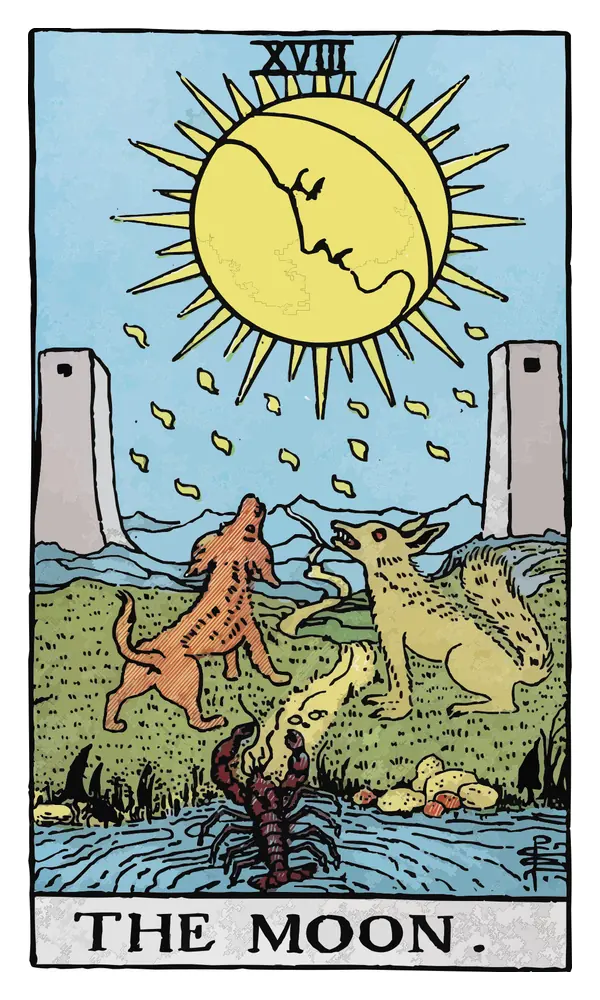
- The Sun
The order matters because the Moon is the card in between. A reader who knows the sequence sees that the Star comes before the dim, uncertain landscape of the Moon, and the Sun comes after it. That gives the Star a different job from the one it might have if it stood alone.
Numbering is not identical in every historical deck. Early Italian decks, for example, did not always keep the same order as the later standard one. If you work with an older or unusual deck, check its own numbering before relying on the sequence described here.
How do the images differ?
In the Rider–Waite–Smith version, a woman kneels with one foot on the water and one on land. She pours one jug into a pool and the other onto the earth. Above her is one large yellow star, surrounded by smaller white ones.
The Sun is built differently. A naked child sits on a white horse beneath a radiant sun, with sunflowers behind a wall. The child holds a red flag and is usually read as innocence and freedom.
A few contrasts stand out when you lay the pictures next to each other:
- The Star has one figure who is bent and attentive, while the Sun's figure sits upright and open.
- The Star's sky is dark and spangled, and the Sun's sky is bright and almost empty.
- The Star's gestures are pouring and tending, whereas the Sun's are riding and holding up a banner.
- The Star is partly about balance between water and land, and the Sun is about full exposure.
None of this proves a meaning, but it does explain why readers describe one card as calm and the other as exuberant.
What does Waite say about each card?
A. E. Waite described the cards in The Pictorial Key to the Tarot, and the text for The Sun is available online at sacred-texts.com. There he calls the Sun the "sun of consciousness in the spirit" and reads the child as simplicity and innocence in the sense of wisdom. Modern summaries link his Sun to attained knowledge, happiness, contentment and vitality.
For The Star, this article leans on the picture rather than on Waite's wording, since his text for that card was not checked for this piece. Some modern writers read it as hope and healing, and describe the woman as standing between two worlds. That is one interpretation among many, not a historical finding.
It is worth remembering that Waite's descriptions were written for a deck drawn by Pamela Colman Smith, and later readers have added a lot of their own language. When you see "the Star means hope" in a book or on a website, it is a tradition of reading, not a rule printed in the deck.
How do night and day shape the contrast?
Tarot uses light as a kind of grammar. A night sky with stars suggests something small but steady, seen only because everything else has gone dark. A full sun suggests nothing is hidden, since everything is lit.
That is why the Star is often described as quiet and the Sun as bright. The Star's light is something you look up toward and follow, while the Sun's light is something you stand inside. In the tradition, hope tends to face forward and joy tends to be present.
There is a practical point here for anyone comparing cards. If a spread shows the Star, the traditional emphasis falls on recovery, openness and a slow return of trust. If it shows the Sun, the emphasis falls on confidence, warmth and being seen clearly. Those are different tones even though both are friendly.
What do the numbers 17 and 19 add?
Numbers give tarot a second layer. Seventeen reduces to eight, and nineteen reduces to ten, a common numerological habit in tarot writing. Readers who like this method sometimes link eight to movement toward balance and ten to a completed cycle, though the correspondences vary from author to author.
A gentler observation needs no arithmetic. The Star sits two steps before the Sun, and the Moon fills the gap. If you read the Major Arcana as a sequence, the Star is an early gleam and the Sun is a later arrival.
| Feature | The Star | The Sun |
|---|---|---|
| Number | XVII | XIX |
| Time of day | Night | Day |
| Figure | Kneeling woman | Child on a horse |
| Gesture | Pouring water | Holding a red flag |
| Traditional tone | Hope, healing | Clarity, vitality |
| Neighbor | Follows the Tower | Follows the Moon |
The table is a summary of conventional readings, and individual decks may shift the details. The Tower position, for instance, follows the standard order, in which the Star comes after trump XVI.
Why do hope and joy get confused?
Both cards are mild, both avoid dark symbols, and both are often described with words like renewal or optimism. In casual summaries they can sound like the same card with a different picture. The confusion is understandable.
The difference shows up when you ask what each state needs. Hope usually coexists with uncertainty, since you hope for what is not yet in hand. Joy usually needs less explaining, because it belongs to something that is already present.
Say you ask a question about a stalled project, and the Star appears. A reader might consider whether the image invites patience, small acts of care, or trust in a slow process. If the Sun appears instead, the same reader might ask what is already working and whether it deserves to be shared openly. These are prompts for thought, not verdicts, and they say nothing about what will happen.
How can you compare them in your own reading?
A simple exercise is to pull both cards from your deck and set them side by side. Look first at the sky, then at the figure, then at the ground. Write down three differences in plain words before reading any book.
Then draw a small spread and see how the two cards sit among others. A three-card layout is enough for this, since it lets you watch the Star or the Sun appear as past, present or next step. You can try one right below.
Tool on Tarot Told Me
Three-card spread
A three-card spread to practice noticing how a card's tone changes with its position.
When you finish, note what you saw rather than what you hoped for. If a question touches health, money, legal or safety matters, a qualified professional is the right place for it, not a card.
What should you remember about the two cards?
The Star and the Sun share a friendly tone but occupy different parts of the story. One is a calm light in the dark, and the other is a plain light at midday. Reading them well mostly means noticing which of those two atmospheres your own question has.
Tarot has no single authority on this, so treat any short description, including this one, as a starting point. The images, the numbers and Waite's own text are all there to be checked, and the sequence of the Major Arcana gives the comparison its shape.
Questions to sit with
- Does my situation feel more like waiting in the dark or standing in daylight?
- What small act of tending does the Star's image suggest to me?
- What is already visible and working, as the Sun's image might ask?
Frequently asked questions
Neither is stronger in the tradition. The Sun is brighter and more open, and the Star is quieter and more tender, but both are generally read as favorable.
The Star comes first, as trump XVII. The Moon is XVIII and the Sun is XIX in the standard Rider–Waite–Smith order.
No. Readers often describe the Star as hope and healing and the Sun as clarity and vitality. The overlap is real, but the setting, the figure and the mood differ.
In the tradition, a star often suggests guidance and quiet light, and a sun suggests consciousness, warmth and full visibility. These are interpretations, and different writers phrase them differently.
Yes. Readers sometimes see the pair as a movement from tentative hope toward open confidence, though this is a way of reading and not a rule. The Moon between them in the sequence is worth keeping in mind.