Death and the Lovers together: an ending beside a choice
What it means to read an ending and a choice side by side, and why this pairing works as a question rather than a forecast.
By TaronicaPublished
In short
- The death and lovers tarot pairing puts an ending beside a choice, and it has no fixed meaning in tarot history.
- Death is card XIII and The Lovers is card VI of the Major Arcana, so seven places separate them.
- Read the pair as a question about what is closing and what is being chosen, never as a forecast about a relationship.
What is the death and lovers tarot pairing?
The death and lovers tarot pairing is a modern way of reading two Major Arcana cards side by side. Death is traditionally read as an ending or a transformation, and The Lovers as a choice, a bond, or the meeting of opposites. Together they invite one question: what is closing, and what is being chosen?
It helps to be honest about the limits. There is no historical canon for this pairing, and any meaning attached to it is interpretation built from the two cards separately. This article shows how that interpretation is assembled, so you can judge it yourself.
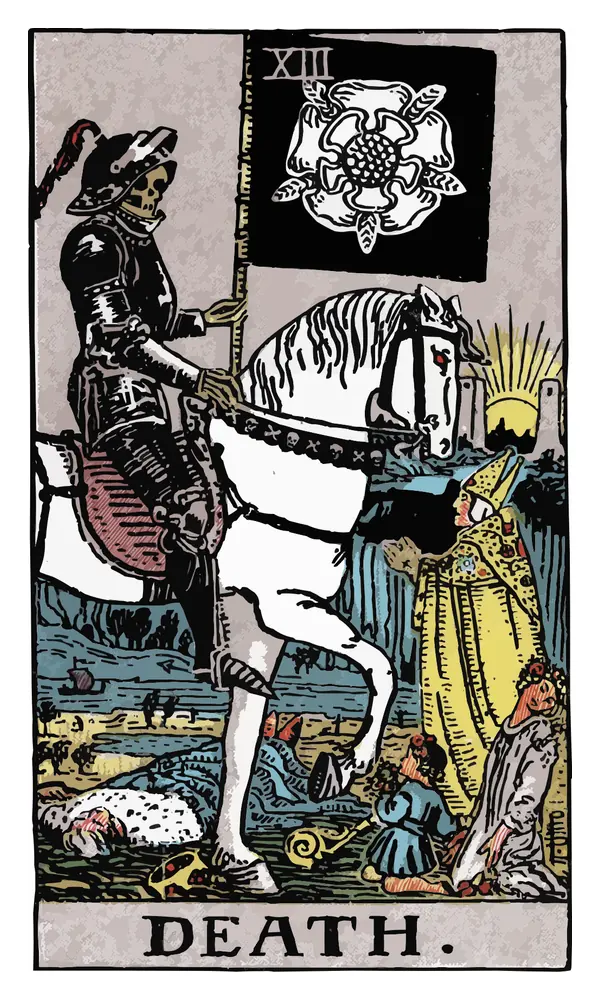
- Death
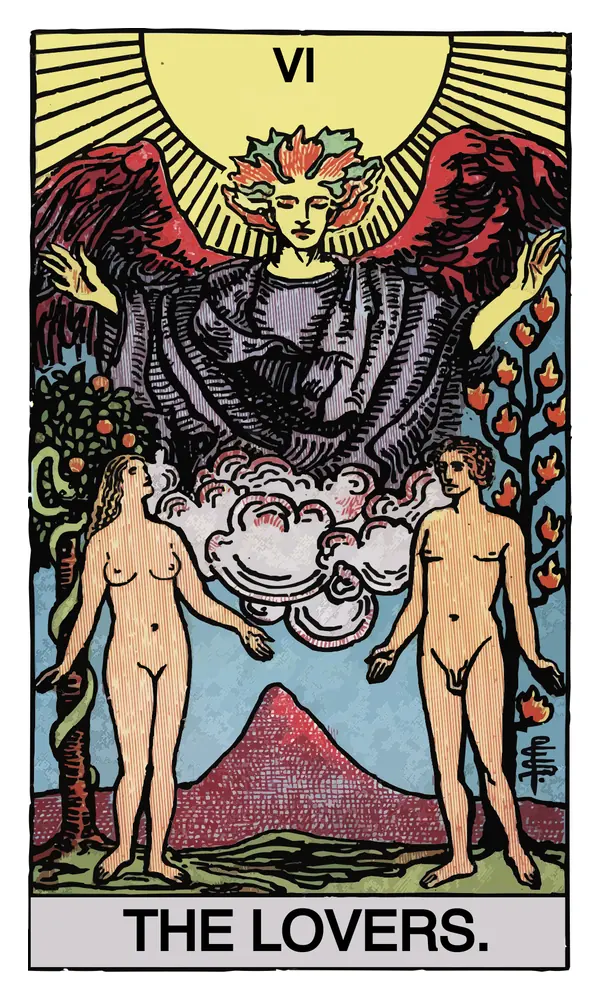
- The Lovers
Think of a guide walking past two paintings in a gallery. You look at each one first, and only then at the space between them.
How are the two cards pictured?
In the Rider–Waite–Smith deck, Pamela Colman Smith drew Death as an armored skeleton on a white horse, carrying a black banner with a white flower. Figures of different rank, a king among them, lie or kneel before the horse, while a sun rises between two towers in the distance. Smith illustrated the deck after Arthur Edward Waite commissioned it in 1909, and her biography (opens in a new tab) gives the background.
The Lovers is calmer. A man and a woman stand unclothed beneath a winged figure, with a tree behind each of them.
Notice what the two images share. Neither is about one person alone: Death addresses everyone in its scene, and The Lovers rests on two figures and a third presence above them. Whatever a reader draws from the pair begins with these pictures, not with the titles.
Where do the two cards come from?
Death is card XIII, the thirteenth trump in most traditional decks, and The Lovers is card VI. Both belong to the older Italian and French tarot traditions. The Tarot of Marseilles (opens in a new tab) is an Italian-suited 78-card pack that was very popular in France in the 17th and 18th centuries.
The Lovers changed noticeably over time. Early Marseille-style versions often show a man standing between two women, which some writers connect to the old story of Hercules at the crossroads, a choice between virtue and pleasure. Later decks, Smith's among them, turned the scene into a couple under an angel.
That shift matters for this pairing. A card about a forced decision and a card about a bond read differently next to an ending.
What does an ending beside a choice suggest?
There is no single answer, but the tradition offers a few readings that readers commonly build from the two cards. Each treats Death as closing something and The Lovers as the moment of selecting.
- An ending that makes a choice possible: something has to finish before the options become clear.
- A choice that carries an ending inside it: choosing one path means leaving another.
- Two separate matters that happen to sit together: one area of life is closing while a different one asks for a decision.
Notice that none of these is a statement about what will happen. They are ways of organizing a question. Say you ask about a job change and draw this pair. You might look at what the old role would close, and what the new one would ask you to choose, instead of hunting for a verdict in the cards.
Does the order of the two cards matter?
The tarot tradition has no rule that fixes the order of a pair. In practice, the position in a spread usually does more work than the sequence itself. A card in a "past" position reads differently from the same card in a "challenge" position.
Still, readers often notice two natural directions. With Death first and The Lovers second, the pair can be read as a closing followed by a choice. With The Lovers first and Death second, it can be read as a choice followed by what that choice leaves behind.
Neither direction is more correct. If you are working with a pair you drew, try both and see which one fits the question you actually asked.
Does this pairing mean a breakup?
No. Death is rarely read as a literal ending in modern tarot practice, and The Lovers is not only about romance. Some guides (opens in a new tab) describe it as a card of conscious choice, which can mean building a life together or walking away on grounds of values. That is one author's interpretation, not a standard reading, but it shows how wide the range is.
A breakup is only one of many things the pair might prompt you to think about. It could also point you toward a change of habits, a move, a shift in a friendship, or a decision about shared values.
Say you ask about a long relationship and draw these two cards. The more useful question may be what you want to keep and what you are ready to change. If the relationship is causing real distress, a counselor or therapist is a better guide than any spread.
How does it differ from other pairings?
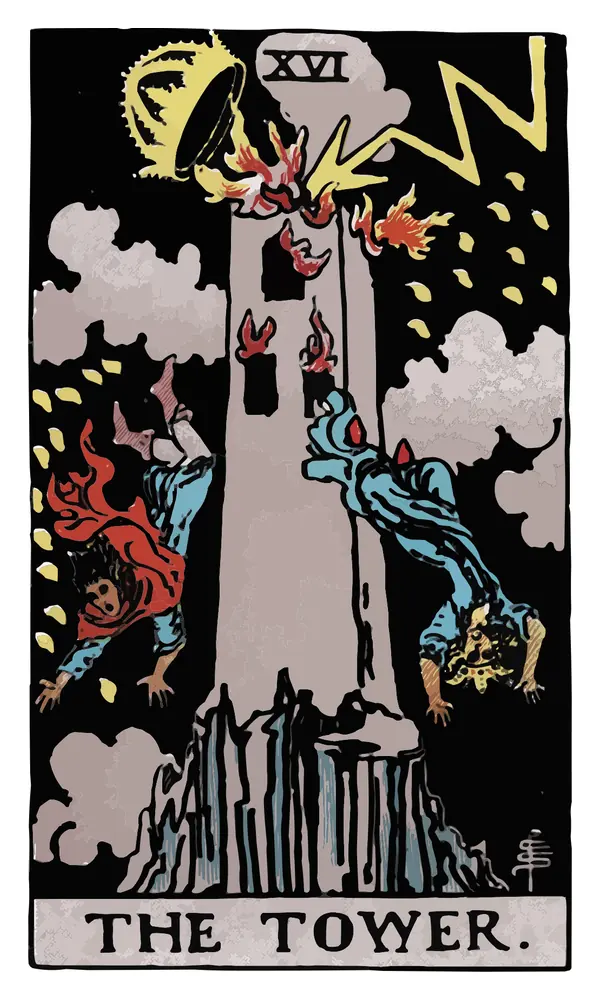
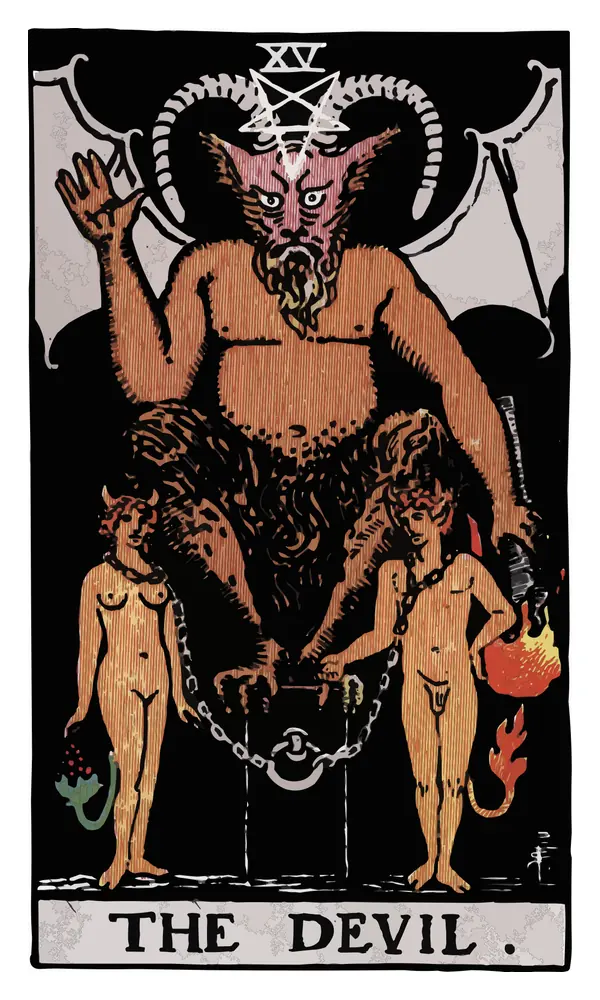
Pairs of Major Arcana cards each have a different texture. Death with The Tower is usually discussed as two kinds of ending, one gradual and one sudden. The Lovers with The Devil is usually discussed as two kinds of attachment, one chosen and one compulsive.
- The Tower
- The Devil
The Death and The Lovers pair is gentler than either of those. Neither card is about collapse or compulsion. The tension is between closing and choosing, and it can sit quietly in a spread.
If you want to see how those neighboring pairs are built, the site has articles on them:
Card combinations
The Tower and Death together: how the pair is read
Two of the most feared trumps side by side: what each one shows, why the pairing is a modern habit, and how order and position can shape a reading.
· Taronica
Card combinations
The Lovers and the Devil together: choice and attachment
What does it mean when the Lovers and the Devil appear side by side? This guide separates what the tradition records from what modern readers add, and shows how to read the pair as choice versus attachment.
· Taronica
How to try the pair in a three-card layout?
A three-card spread gives each card a position, which is a steadier way to study a pair than guessing from the titles alone. You can use Death and The Lovers as the first two cards and let a third card answer a position you define.
Tool on Tarot Told Me
Three-card spread
A three-card spread gives each card a position, so a pair like this can be read in context.
A simple way to work with it:
- Write down the situation in one sentence before you draw anything.
- Decide what each position means, for example "what is closing", "what is being chosen" and "what supports me".
- Describe what you see in each picture before you recall any meaning.
- Compare your description with the traditional readings, and note where they differ.
Treat the result as a prompt for thought. If your question touches health, money, or legal matters, take it to a qualified professional.
What should you keep in mind?
The pair is a modern construction, and it earns its meaning from the two cards and from your question. Death brings the language of endings and transformation, and The Lovers brings the language of choice and union.
Keep the reading open. A card knows nothing about your life, so the useful part of the exercise is the conversation it starts with yourself.
Questions to hold while you look at the pair
- What in my current situation feels finished, even if I have not said so aloud?
- Which decision am I postponing, and what would choosing cost and give?
- If I describe the two pictures without naming the cards, what do I notice first?
Frequently asked questions
Tarot readers usually avoid sorting cards into good and bad. The pair combines an ending with a choice, which can feel heavy or hopeful depending on your question. Look at what the two images prompt in you rather than at a label.
No. Nothing in the tarot tradition supports reading the pair as a prediction about another person. Turn the question back to yourself: what are you ready to close, and what do you want to choose?
No historical canon exists for it. Death and The Lovers each have a long history, but the combination is a modern interpretive habit, so any fixed meaning you read online is one author's view.
Some readers treat a reversed Death as resistance to change or an unfinished ending, and a reversed Lovers as a choice that is hard to face. These are modern conventions rather than old rules, and many readers do not use reversals at all.
You can, but remember that The Lovers is not only about romance. It can describe any decision about values or commitments, so keep the question open instead of assuming it is about a partner.