The Devil and the Tower together
When the Devil and the Tower meet, tradition reads a structure of bondage coming apart. Here is how the pairing is built, where the reading comes from, and where it stops.
By TaronicaPublished
In short
- The devil and tower tarot pairing puts a card of bondage next to a card of sudden collapse.
- Tradition reads the pair as a hold that breaks, though the idea of liberation is modern interpretation and not history.
- The order of the cards, the surrounding cards and the question all change how the pair is read.
What is the devil and tower tarot pairing?
The devil and tower tarot pairing is a combination of two Major Arcana cards, numbered XV and XVI in most traditional decks. One shows people held by something they could in principle slip out of; the other shows a built structure struck and emptied. Read together, they are usually taken as a story about a binding situation that gives way.
That is a reading, not a rule. No old source fixes the meaning of this particular pair. Combination meanings belong to the modern interpretive tradition, which works by setting two images side by side and asking what story they suggest.
This article treats the pairing as a way of looking at imagery. It describes what each card shows, how they connect, and how far the common reading can reasonably be pushed.
How is the Devil built?
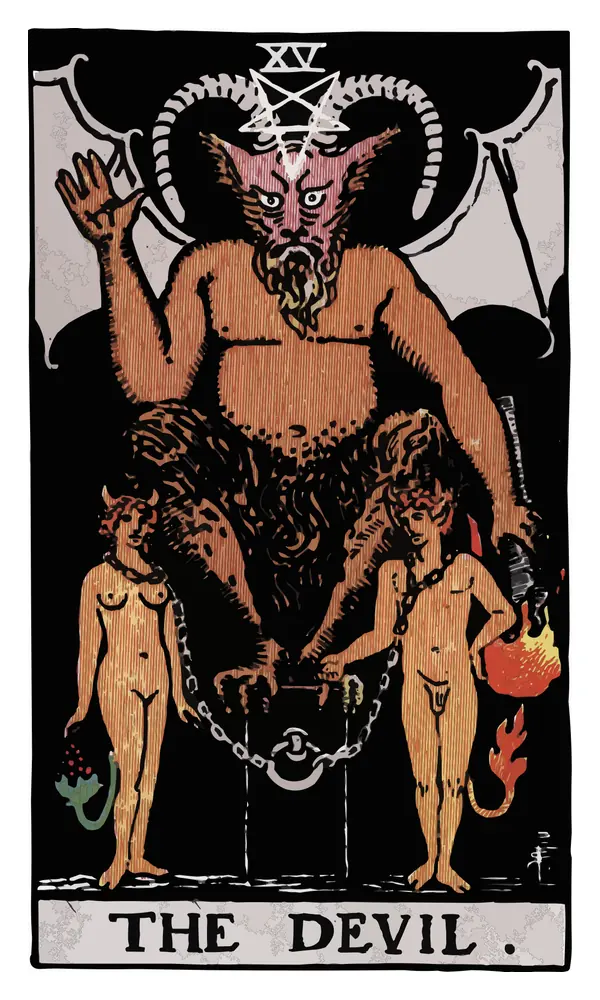
In the Rider-Waite-Smith deck of 1909, with artwork by Pamela Colman Smith under the direction of A. E. Waite, the Devil is a horned, winged figure on a black pedestal. Before him stand a man and a woman, each with a chain around the neck. Look closely and the chains hang loose.
The Devil
The Devil in the Rider-Waite-Smith tradition: a horned figure above two chained people whose neck chains are loose.
Read about The Devil on Tarot Told Me (opens in a new tab)That loose chain is the detail most modern readers point to. The picture can be taken as a scene of attachment, habit or fixation, where the restraint is partly accepted by the people wearing it. Older decks, such as those of the Marseille tradition, draw the scene more starkly, with a hybrid creature and smaller figures at its feet.
The card is numbered XV. In the tarot tradition it is associated with materiality, appetite and the things that hold attention. None of this makes it a verdict on anyone; it describes an image of being tied.
What does the Tower picture?
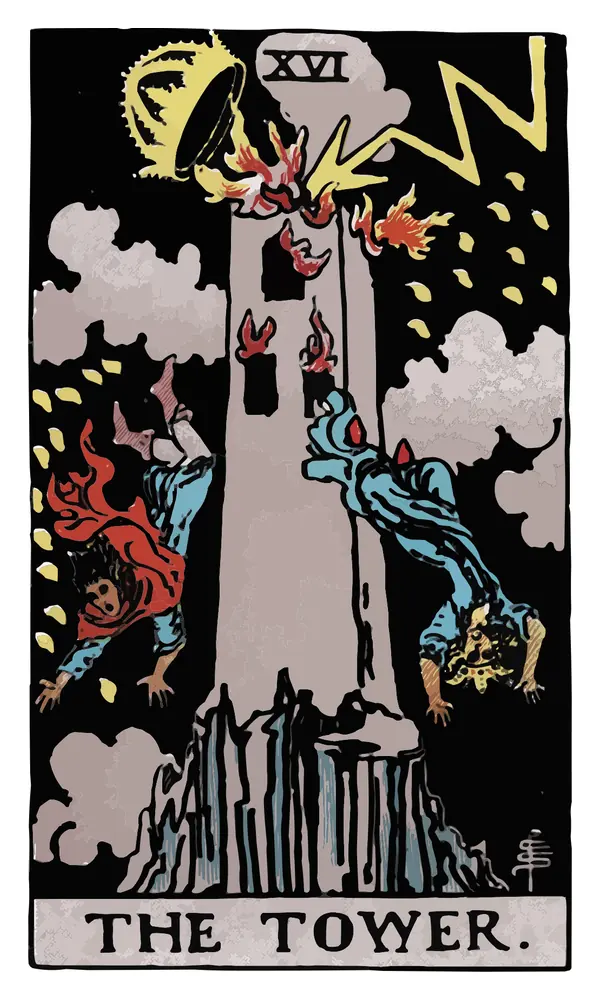
The Tower, numbered XVI, shows a tall building on a crag. Lightning strikes the top, a crown comes loose, flames burst from the windows, and two figures fall headfirst. The picture is about as abrupt as the Major Arcana gets.
The Tower
The Tower: a lightning bolt hits a crowned tower on a cliff while two figures fall from its windows.
Read about The Tower on Tarot Told Me (opens in a new tab)Its history is less tidy than its image. The card appears in many Italian-suited decks from the 15th century onward, yet some early painted decks, such as the Visconti-Sforza, do not include it. Its original name and source are debated. The destruction of the Tower of Babel is sometimes cited as a parallel, but that is a comparison and not an established origin.
Names also vary. In the Marseille tradition the card is known as La Maison Dieu, while a Belgian tradition calls it La Foudre, the thunderbolt. A Flemish deck from the mid-18th century shows a shepherd under a burning tree rather than a tower at all.
Why are these two cards read together?
The two cards sit next to each other in the numbering, and their images answer one another. The Devil depicts a hold; the Tower depicts what happens to a hold built on something unstable. That makes the pair easy to read as a sequence, even though the deck itself offers no such instruction.
A few visual echoes help the idea along:
- Both cards have two human figures, one pair standing and one pair falling.
- Both involve something raised above the figures: a pedestal in one, a tower in the other.
- Both are about structure. One is a structure of attachment, the other of stone.
- In both, the people are not shown choosing; they are shown in the middle of a condition.
These echoes are what a modern reader leans on. They are not proof of a hidden design, just a reason the pairing feels coherent when laid out on a table.
Why is the pair read as liberation through breakdown?
The common reading goes like this: the Devil is the binding, the Tower is the break, and so the pair suggests release that arrives through disruption instead of through a quiet decision. It is the angle of this article, and it is worth being plain that it is an interpretation.
The appeal is easy to see. A loose chain suggests the bond was never fully fixed, and a falling tower suggests that what looked solid was not. Together they can be read as the collapse of something a person had been holding onto, for better or worse.
Say you ask about a job you stay in out of habit, and these two cards fall together. A reader in this tradition might note the image of a hold and an image of an abrupt ending, then ask whether the question is really about staying or about how the situation might change. The cards decide nothing; the reading is a prompt to look at the arrangement.
A structure that feels like a cage may be the first thing to fall.
Does the order of the cards change the reading?
When the cards fall in a line, many readers treat the order as a small narrative. The same two images can tell different stories depending on which comes first. These are conventions, not laws, and different readers handle them differently.
Devil, then Tower. This is the order most associated with the liberation reading. The hold comes first and the break follows. It is the sequence that matches their numbers, which is part of why it is the one most often discussed.
Tower, then Devil. Here the collapse comes first and the hold second. A reader might ask whether something has fallen apart only to be replaced by another attachment, or whether the shock has left a person clinging to what remains. It is a more cautious sequence.
Side by side with no order. In a spread where position carries no time, such as a simple pair, the cards can be read as two aspects of one situation. One shows what binds, the other shows what is under strain.
Whichever way they fall, the surrounding cards and the question matter more than the pair on its own.
- The Devil
- The Tower
What should the pairing not be taken to mean?
It is tempting to hear "liberation" and assume a happy outcome. The imagery does not promise that. The Tower in particular is a hard picture, and a collapse can be disorienting even when something in it later proves useful.
There are a few cautions worth keeping in mind:
- The pairing does not predict an event. It is a way of describing an image and asking questions about it.
- It does not say what another person feels or will do. If a question concerns someone else, turn it back toward your own position in the situation.
- It is not guidance on health, money, legal or safety matters. Those belong with a qualified professional.
- It does not say the break is deserved, or that the hold was a failing.
The pair is a lens. Used lightly, it can help sort out which parts of a situation feel like a chain and which feel like a falling wall.
How to read the pair in your own spread?
A practical way to work with the pairing is to slow down and treat it as a short exercise in description. Start with the two images before any meaning, then move to the question.
- Describe the Devil in one sentence, using only what you see: figures, chains, pedestal.
- Describe the Tower the same way: lightning, crown, falling figures.
- Note the order and the neighboring cards, if there are any.
- Ask which part of your question resembles a hold, and which resembles a structure under strain.
- Write down one question the pairing raises, not an answer.
The last step matters most. A reading that ends in a question is more honest than one that ends in a verdict.
Tool on Tarot Told Me
Three-card spread
A three-card spread gives the pair a neighbor, which makes the order easier to read.
How does it compare with related pairings?
The Devil and the Tower each form pairs with other cards, and comparing them shows how much a single partner shifts the tone. Pairing the Tower with a card of endings reads very differently from pairing it with a card of attachment, because the first suggests a closing and the second a hold.
The site covers several of these combinations in separate articles. For a collapse paired with a card of endings and transformation, see:
Card combinations
The Tower and Death together: how the pair is read
Two of the most feared trumps side by side: what each one shows, why the pairing is a modern habit, and how order and position can shape a reading.
· Taronica
For the Devil in a story about attachment between two people, see:
Card combinations
The Lovers and the Devil together: choice and attachment
What does it mean when the Lovers and the Devil appear side by side? This guide separates what the tradition records from what modern readers add, and shows how to read the pair as choice versus attachment.
· Taronica
Reading several pairs side by side is a good way to see that the cards do not carry fixed verdicts. The same image changes tone with its neighbor, which is the main lesson of working with combinations.
Frequently asked questions
Tarot does not sort pairs into good and bad. The two images are intense, and the pair is often read as a hold that breaks. Whether that feels like relief or loss depends on the situation and on the reader.
In most traditional numbering, yes: the Devil is XV and the Tower is XVI. That adjacency is part of why they are often discussed as a sequence, though the deck does not present them as a formal pair.
No reliable early source gives a meaning for this specific pairing. Combination readings are part of the modern interpretive tradition, built by comparing the images of the two cards.
No. Tarot does not predict events, and the pair describes images, not outcomes. If a question touches relationships or work, the cards can prompt reflection, while decisions are better made with real information and, where needed, a professional.
Many readers treat that order as a collapse followed by a new or lingering attachment. It is a convention and not a rule, and the surrounding cards usually shape the reading more than the order alone.