The Tower and the Lovers together: when familiar ground gives way
What happens when a card of collapse meets a card of union and choice? Here is how the pair is built, where its images come from, and how modern readers interpret it.
By TaronicaPublished
In short
- The tower and lovers tarot pairing is a modern reading rather than a historical one, and it is usually taken to describe a bond whose familiar structure is breaking.
- The Tower is traditionally tied to sudden collapse, while the Lovers is tied to union and choice, so together they invite a look at what a relationship stands on.
- Because no canonical meaning exists for the pair, it works best as a question for reflection and not as a verdict.
What is the Tower and Lovers pairing?
The tower and lovers tarot pairing is what readers call it when the Tower and the Lovers land next to each other in a spread. One is Major Arcana number 16, the other is number VI. Neither card belongs to a fixed script for this meeting, so every reading of the pair is an interpretation built from the two cards' separate traditions.
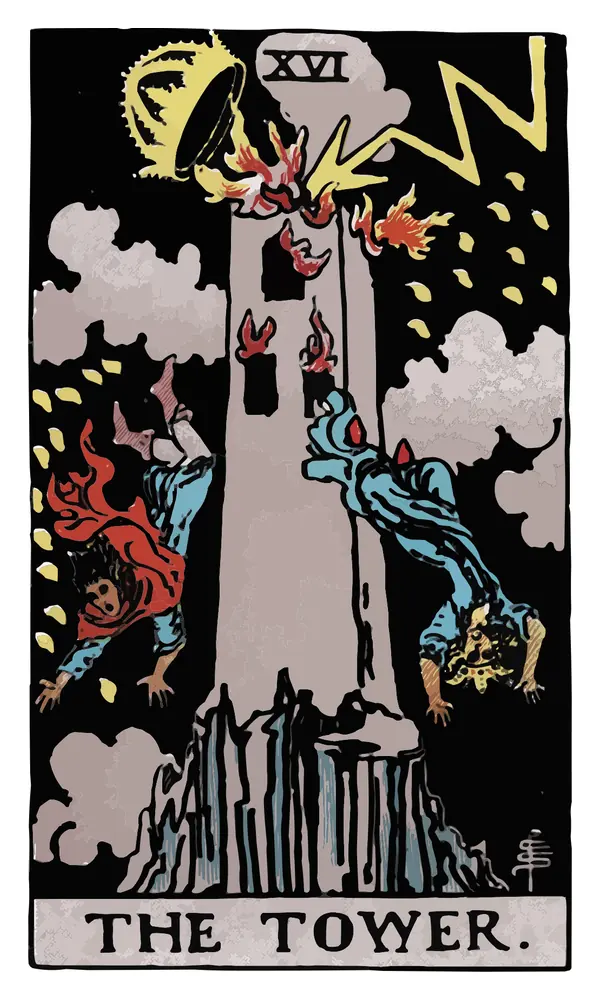
The Tower
The Tower, Major Arcana number 16: a building struck from above while figures fall from it.
Read about The Tower on Tarot Told Me (opens in a new tab)This article treats the pair the way a museum guide would treat two neighboring paintings. It looks at where each image came from, what the numbers and symbols suggest, and how several modern authors have put them together. It does not claim to know what the pair will do in anyone's life.
Where do the two images come from?
The oldest surviving tarot cards are the Visconti-Sforza decks, a group of about 15 incomplete sets from the mid-15th century. At that time the game was still called Trionfi, and the cards were closer to a courtly pastime than to a reflective tool. Not every card of the later set survives from those decks, so the early history of both images is patchy.
The Lovers appears early in a form quite different from the one many people know now. Early versions such as the Visconti-Sforza card are described as showing a wedding or betrothal scene. The Tower, by contrast, took longer to settle. One historical study notes that it has had more names than any other card, even though its imagery has changed little.
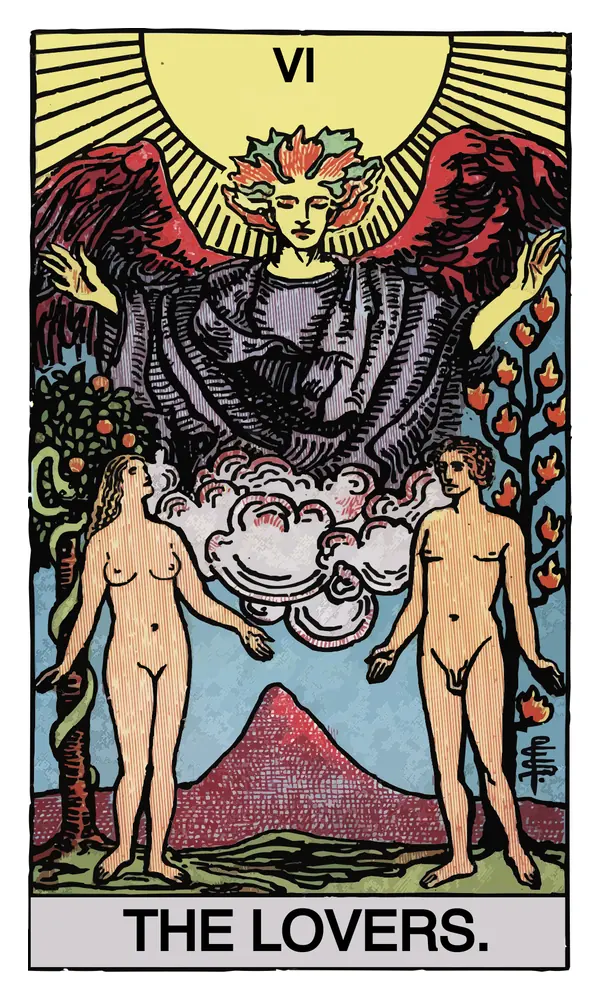
The Lovers
The Lovers, number VI in the Major Arcana: in the Rider-Waite-Smith deck, two figures stand beneath an angel.
Read about The Lovers on Tarot Told Me (opens in a new tab)Why did the Tower carry so many names?
In the Tarot de Marseille, which settled into its pattern in the mid-17th century, the card is labeled La Maison Dieu, or "God House." Some writers link the name to a hospital or hospice for the poor. That is one reading of the name, and the card's origin is still debated.
Later in the 15th century the card began to show people falling headfirst, and players of the time would likely have connected the scene to the Tower of Babel story. The English name "the Tower" emphasizes the building, while the French name emphasizes the house and what it stands for. Each name quietly steers the viewer toward a different idea: a structure, a shelter, or a human ambition.
The point for this pairing is simple. The Tower was never a card about gentle change, and the tradition around it has long stressed that the break comes from outside the plan.
What does each card contribute to the pair?
A useful way to read a combination is to ask what each card brings, in a single line, and then see how the two lines meet. The Tower is traditionally read as a structure that fails: a belief, a routine, or an arrangement that cannot hold. The Lovers is traditionally read as union, values and a choice that carries weight.
Placed together, the first card describes a collapse and the second describes a bond. The question then becomes whether the bond is the thing collapsing, the thing surviving, or the place where a choice is finally made. Readers disagree on that, and the disagreement is part of the picture.
The numbers add a small observation, though not a rule. Sixteen reduces to seven by adding its digits, and both numbers contain a six. A reader who enjoys numerology might note that shared digit as a thread between the cards, but nothing in the tradition requires it.
How do modern authors read the pair?
Several online authors have written about this pair, and their readings overlap in a few places. They are individual interpretations, so they are best held lightly. Here is a summary of the main strands.
- Astrology.com describes the pair as a relationship that may have reached a crisis point, with the Tower saying the change will not be easy or subtle.
- Kerykeion points to a hidden truth surfacing, a comfortable assumption breaking, or a choice being forced into the open.
- Tarot Institute suggests the pair pushes the reader to reevaluate their connections and inner commitments.
- Eldrin Tarot reads it as breaking free from a relationship that looked right on the surface but was wrong for the person asking.
Notice what these have in common. None of them describes a fixed outcome. They all describe a moment when something assumed turns out to be unsteady, and they leave the response to the reader.
Does the order of the cards matter?
Some readers say it does, and others treat the pair as order-free. There is no historical rule here, so any answer is a choice of method. What follows is one way to think it through.
If the Lovers comes first and the Tower follows, a reader might see a bond meeting a disruption. If the Tower comes first and the Lovers follows, a reader might see a disruption that opens a question about commitment or a new choice. Both are plausible readings, and neither is more correct than the other.
Position in the spread can matter more than order. The same two cards read differently in a "past" position, where they may point to something that has already happened, than in a "challenge" position, where they may point to a pressure that is still ongoing.
Does the Marseille Lovers change the reading?
It can. The Marseille Lovers shows a figure standing between two others while a winged archer aims at the scene. This differs from the Waite-Smith card, where two figures stand beneath the archangel Raphael in a garden-like setting. The Marseille card is usually read as a choice between paths, and the Waite-Smith card is more often read as a bond or a union.
When the Marseille version meets the Tower, the emphasis tends to fall on the decision. The collapse is read less as the end of a couple and more as the point where one path becomes impossible to keep walking. With the Waite-Smith version, readers more often speak of the strain placed on an existing relationship.
It helps to know which deck is on the table before choosing a frame. The pair does not carry a separate meaning in each tradition, but the images invite slightly different questions.
How to work with the pair in a spread?
A calm approach is to treat the pair as a prompt and to write down what you notice before looking up any meaning. Say you ask about a long friendship that has become strained, and the Tower and the Lovers arrive together. You might first note which parts of the image you respond to, such as the falling figures or the two people under the angel. Then you can ask which assumption in the friendship feels most fragile, and which choice feels most unresolved.
Tool on Tarot Told Me
Three-card spread
A simple three-card spread gives the pair a context: one card before, the pair in the middle, and one after.
A few practical habits keep the reading grounded.
- Write down the question before drawing, in one plain sentence.
- Decide in advance whether you read in the Marseille or the Waite-Smith tradition.
- Treat the result as a description of a mood or a pressure, and not as an instruction.
- Return to the notes a few days later and see which observations still seem useful.
If the relationship involves safety, health, money or legal questions, a qualified professional is the right person to speak with, not a spread.
What should this pairing not be used for?
The pairing is not a verdict on a relationship, and it says nothing about what another person feels or intends. Readings that claim otherwise go beyond what the tradition supports. The cards carry no knowledge of anyone's inner life, and they decide nothing.
It is also worth remembering that the Tower does not always point at love. It can describe a belief, a plan, a role or an identity that no longer holds. Paired with the Lovers, the shaken structure might equally be a shared habit, a family expectation or a promise you made to yourself.
A fair summary is this: the pair is a way of asking what a bond rests on. The answer comes from the reader's own life, not from the images.
Questions to hold beside the pair
- Which assumption about this relationship have I never examined?
- What would I want to keep if the familiar arrangement changed?
- Which choice am I postponing, and what is the cost of waiting?
Frequently asked questions
No. Modern authors read it as a crisis, a hidden truth surfacing, or a forced choice, and a breakup is only one possible reading. The Tower can also describe a belief or arrangement that no longer holds, which may lead to a stronger bond or to a changed one.
There is no canonical or historical meaning for this pairing. The readings found online are modern interpretations by individual authors, and they are best treated as suggestions for reflection.
No. In the Tarot de Marseille it is labeled La Maison Dieu, or "God House," while English-language decks usually call it the Tower. The imagery has changed little, but the names have varied more than for any other card.
The Marseille card shows a figure standing between two others with a winged archer above, and it is usually read as a choice between paths. The Rider-Waite-Smith card shows two figures beneath an archangel, which tends to draw readings about union.
Yes. The Lovers is traditionally linked to values and choices as well as to romance, so the pair can be read in friendships, family ties or work partnerships. The context of the question decides which reading is most useful.
Sources
- Tarot Heritage - La Torre, La Maison Dieu, The Tower (opens in a new tab)
- Wikipedia - Visconti-Sforza Tarot (opens in a new tab)
- Aeternum - L'Amoureux ou Les Amoureux (opens in a new tab)
- Astrology.com - The Lovers and The Tower (opens in a new tab)
- Kerykeion - The Lovers and The Tower (opens in a new tab)