The Star and the Moon together: hope in uncertain light
What does it mean when the Star and the Moon land in one spread? Here is how the two neighboring cards are built, what they share, and how the tradition reads them as a pair.
By TaronicaPublished
In short
- The star and moon tarot pairing puts two neighboring Major Arcana cards side by side: one traditionally linked with hope, the other with uncertainty.
- Read together, they are often taken as a picture of hoping while the full picture is still unclear.
- The pair describes a mood rather than a verdict, and the rest of your spread decides how much weight each card carries.
What do the Star and the Moon show together?
The star and moon tarot pairing is traditionally read as hope that has to travel through uncertain light. The Star is associated with calm, renewal and openness. The Moon is associated with illusion, intuition and things that are not yet clear.
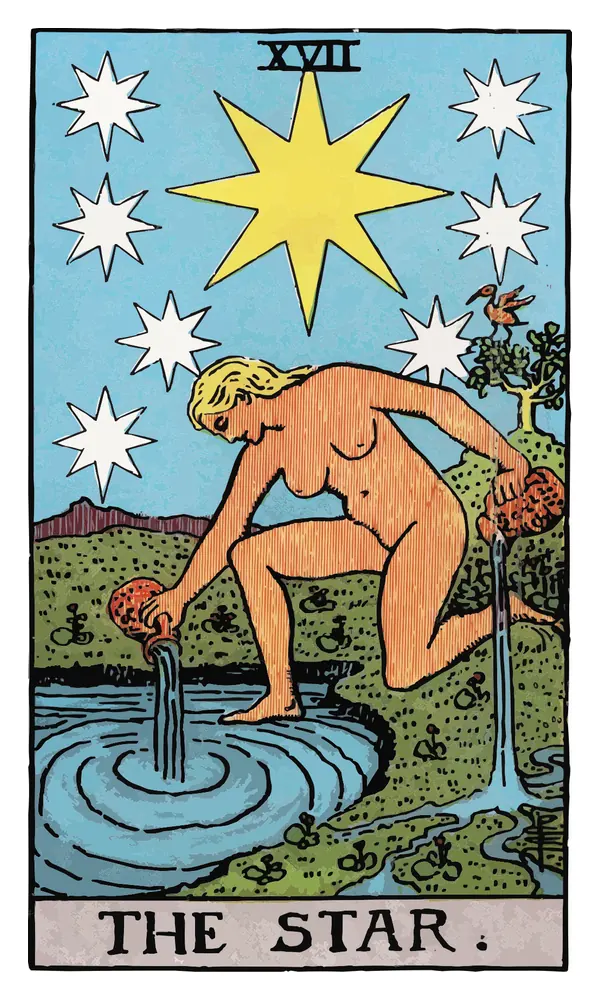
- The Star
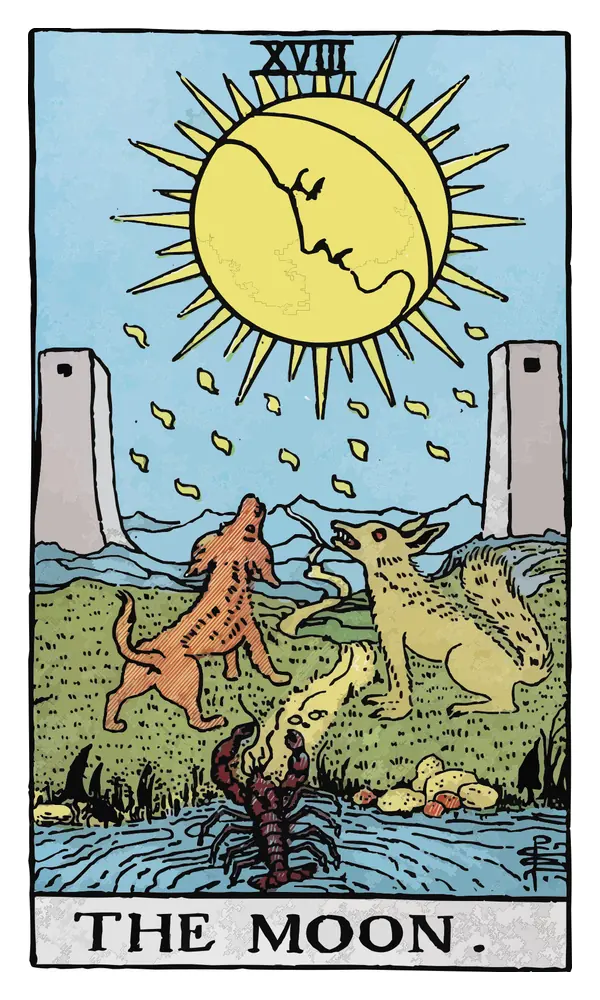
- The Moon
Neither card is a prediction. They are two images with long traditions of interpretation, and putting them together simply gives a reader two questions to consider at once. What am I hoping for, and what do I not yet see clearly?
Say you ask about a career change you have been considering for months. The Star beside the Moon would not tell you how it ends. It could, however, prompt you to separate the part of you that feels quietly hopeful from the part that is filling gaps with guesses.
Where do the two cards sit in the deck?
In the standard Rider-Waite numbering, the Star is card XVII and the Moon is card XVIII. They belong to the 22 Major Arcana, the trump-like cards that carry the deck's larger themes, and they follow one another without a gap.
That neighborhood matters for how people read them. The Major Arcana is often described as a sequence, and in many descriptions the run from the Tower to the Star to the Moon moves from upheaval, to relief, to a more ambiguous stretch. This is an interpretive habit, not a rule written into the cards.
The Sun follows the Moon at XIX, so the three form a small group of celestial cards. Reading the Star and the Moon together is, in a sense, reading two of the three lights in that group.
What does the Star bring to the pair?
In the Rider-Waite picture, a figure kneels at the edge of a pool and pours water from two jugs, one onto the land and one into the water. Above is a large star surrounded by smaller ones, and a bird perches in a tree behind. The scene is open and unhurried.
The Star
The Star in the Rider-Waite deck: a kneeling figure, two jugs of water, and a ring of stars overhead.
Read about The Star on Tarot Told Me (opens in a new tab)Readers have traditionally linked this image with hope, healing and a sense of being resupplied. The water running in two directions is often taken as a picture of giving and replenishing at once. Nothing in the scene is hidden, and that clarity is part of what the card is known for.
In a pair, the Star usually supplies the direction of the reading: what the person would like to move toward, or what feels restorative.
What does the Moon bring to the pair?
The Moon's scene is darker and more crowded. A dog and a wolf howl at a moon that seems to have a face, a crayfish crawls out of a pool, and a path runs between two towers toward distant hills. The light is real, but it is not quite enough to see by.
The Moon
The Moon in the Rider-Waite deck: a dog, a wolf, a crayfish, two towers and a winding path under a pale moon.
Read about The Moon on Tarot Told Me (opens in a new tab)The tradition links this picture with intuition, dreams, projection and uncertainty. Many readers point out that the same light that stirs the imagination can also distort what we see. That double edge is why the card is rarely described as simply good or bad.
In a pair, the Moon usually supplies the texture of the reading: what is blurry, unspoken or still being guessed at.
How do hope and uncertainty work together?
The two cards share a night sky, which is the most obvious thread between them. The Star's sky is wide and still; the Moon's is atmospheric and a little unsettling. Both are about what we can and cannot see after dark.
When they appear together, readers often describe a few different stories:
- Hope that is real but untested, because key facts are still missing.
- Intuition that deserves attention, but also a second look.
- A calm after a hard period, with a lingering sense that things are not fully settled.
- A wish that might be coloring how a situation looks.
These are possibilities, not outcomes. A reader weighing them can ask which one fits the question on the table, and which one only sounds appealing.
Does the order of the cards matter?
In many spreads, order carries meaning, though different readers handle it differently. A common approach reads the first card as the background and the second as what follows or what is layered on top. Others treat a pair as one combined image and ignore order entirely.
If the Star comes first and the Moon second, some readers describe hope that meets doubt along the way. If the Moon comes first and the Star second, they describe a hazy stretch giving way to something clearer. Both are interpretive choices, and a different reader could reasonably frame them otherwise.
The safest habit is to decide in advance how you will read order, then stay consistent. That keeps the reading from bending toward whatever answer you would prefer.
How does the surrounding spread change the pair?
No pair is read in isolation. A Star and Moon next to the Ten of Swords gives a different emphasis than the same two cards next to the Sun, and the position each card holds matters too.
A few questions help when you look at the wider layout:
- Is there another Major Arcana card nearby, which would raise the weight of the whole theme?
- Do the neighboring cards add clarity (such as the Sun) or more fog (such as the Seven of Cups)?
- Does the position name a past, a present, or an advice slot?
- Do the suits lean toward feeling (cups), thought (swords), action (wands) or material matters (pentacles)?
For general background on how pairs and clusters are handled, see the guide below.
Card combinations
How to read tarot card combinations
Tarot card combinations are read as a phrase, not as two separate answers. Here is a three-step method built on suits, numbers, and images, with a table of suit pairs.
· Taronica
How can you work with the pair in practice?
Start by writing the two images in your own words before reaching for any book. What do you notice in the Star that feels settled? What do you notice in the Moon that feels unclear? Your own list is often more useful than a stock definition.
Then sort what you wrote into two columns: what you know, and what you are assuming. The Star often fits the first column, the Moon the second, but sometimes they swap. If your question touches health, money, legal matters or safety, treat the cards as a place to organize your thoughts and bring the real decision to a qualified professional.
Tool on Tarot Told Me
Three-card spread
A three-card spread leaves room for a Star and Moon pair plus a third card that adds context.
If you prefer a guided format, Tarot Told Me (opens in a new tab) is a reflective tarot app from the team behind this site.
Where can you read more about these cards?
The Rider-Waite deck was first published by William Rider & Son in 1909, based on A. E. Waite's instructions and illustrated by Pamela Colman Smith. Waite's guide, The Pictorial Key to the Tarot, followed in 1910 and gives his divinatory notes for each card. Both are good starting points if you want to see where modern readings come from.
Keep in mind that other decks, including older Italian and French ones, draw these cards differently. The details described here belong to the Rider-Waite tradition, so check your own deck before assuming the same symbols appear.
Questions to take to the pair
- What in my situation feels clear, like the Star's open sky?
- What am I filling in with guesses, like the Moon's half-lit path?
- Which of my hopes would I still hold if I learned one more fact?
Frequently asked questions
Tarot pairs are not usually sorted that way. The tradition links the Star with hope and the Moon with uncertainty, so the pair is more often described as mixed: something hopeful that is not yet fully clear.
In the standard Rider-Waite numbering, the Star is XVII and the Moon is XVIII, so the Star comes first. Some historical decks order or number their trumps differently.
It can, but it is a poor fit, because the two cards point in different directions. Many readers treat the result as a reason to look for more information rather than as a firm answer.
Not in the tradition. Readers more often describe the Moon as adding a layer of doubt or imagination around the Star's hope, not erasing it. How the two balance depends on the question and the surrounding cards.
No. The kneeling figure, jugs, dog, wolf and crayfish described here come from the Rider-Waite deck. Other decks may show different scenes, so it helps to read the picture in front of you.
Sources
- Wikipedia - Rider-Waite Tarot (opens in a new tab)
- A. E. Waite, The Pictorial Key to the Tarot (1910)