How to read tarot card combinations
Tarot card combinations are read as a phrase, not as two separate answers. Here is a three-step method built on suits, numbers, and images, with a table of suit pairs.
By TaronicaPublished
In short
- Reading tarot card combinations means looking at how neighboring cards shape one another instead of adding up separate meanings.
- A simple method has three steps: name the suits, compare the numbers, then ask how the images relate.
- A pair offers a question to think through, never a verdict.
What are tarot card combinations?
Tarot card combinations are two or three cards read together as a single phrase, so that each card colors the others. A pair is the smallest unit, and it is where most readers first notice that a card behaves differently depending on its neighbor.
This page is the hub for the pair articles on Taronica. It explains the method behind them, so you can approach any pairing, including ones that nobody has written about.
Nothing here treats the cards as speaking on their own. The tradition supplies images, numbers, and suits, and the reader's task is to see how those parts fit together.
Why does a card change next to another?
Think of a card as a word. On its own, a word has a range of senses, and only the neighboring words narrow it down. "Light" beside "feather" and "light" beside "switch" are different ideas, though the word itself has not changed.
Tarot works in a similar way. Each card carries a cluster of traditional associations, and a neighbor tells you which part of the cluster to look at first. That is why long lists of fixed pair meanings can feel thin: they pretend there is one correct sentence for every combination.
There is no official rulebook for this. Authors, schools, and decks differ, so a method is best treated as a set of habits for looking carefully, not as a law.
How to read tarot card combinations in 3 steps?
The method below is deliberately plain. It uses only things you can see on the table: suit, number, and picture. Work through the steps in order, and keep notes short.
Step one: name the suits. Each suit in the tradition is linked with a field of life and, in many systems, an element. Two cards of the same suit stay inside one field, while two different suits put two fields in conversation.
Step two: compare the numbers. Numbers in tarot follow a rough arc from beginnings to completion. Notice whether the pair sits close together on that arc, or far apart, and which card comes earlier in the story.
Step three: read the images against each other. Look at where figures face, what they hold, and what surrounds them. Then put the whole pair into one plain sentence, such as "a decision meeting an interruption," and stop there.
What does a suit pair add?
In one widely used tradition, wands are linked with fire and action, cups with water and feeling, swords with air and thought, and pentacles with earth and material life. Some decks and schools arrange these differently, so treat the table as one convention among several.
| Pair | Fields in conversation | Question to ask |
|---|---|---|
| Wands + wands | Action and action | Is energy being focused or scattered? |
| Cups + cups | Feeling and feeling | Is the emotion shared or private? |
| Swords + swords | Thought and thought | Is the thinking clarifying or looping? |
| Pentacles + pentacles | Practical and practical | Is the matter stable or stuck? |
| Wands + cups | Action and feeling | Does the drive follow the heart or lead it? |
| Wands + swords | Action and thought | Is the plan keeping pace with the impulse? |
| Wands + pentacles | Action and resources | Is effort being turned into something lasting? |
| Cups + swords | Feeling and thought | Do the head and the heart agree? |
| Cups + pentacles | Feeling and resources | Are values shaping practical choices? |
| Swords + pentacles | Thought and resources | Is the analysis grounded in facts? |
A same-suit pair tends to intensify one theme, for better or for worse. A mixed pair tends to raise a tension or a partnership between two themes, and the question column is a prompt for reflection, not an answer.
How do numbers shape a pair?
Traditional tarot numerology reads the ace as a starting point, the middle numbers as development and friction, and the ten as a full cycle. Court cards sit outside this count and are usually read as people, approaches, or stages of maturity.
When you compare two numbered cards, a few patterns are worth noticing:
- Close numbers, such as a four and a five, suggest neighboring stages of one process.
- Far-apart numbers, such as an ace and a ten, set a beginning against an ending.
- Matching numbers in different suits, such as two sixes, show one stage of development played out in two fields.
- A pair that climbs from left to right can be read as movement toward something, while a falling pair can be read as movement away.
These are reading habits, not rules. If the images disagree with the numbers, trust what you can actually see in the picture and let the number serve as a secondary note.
How do Major and Minor cards work together?
The Major Arcana are traditionally read as larger themes and turning points, while the Minor Arcana are read as everyday circumstances. When both appear in one pair, a common approach is to treat the Major card as the frame and the Minor card as the setting in which it plays out.
Take The Lovers, a Major Arcana card whose imagery of two figures and a figure above them is traditionally linked with choice and union.
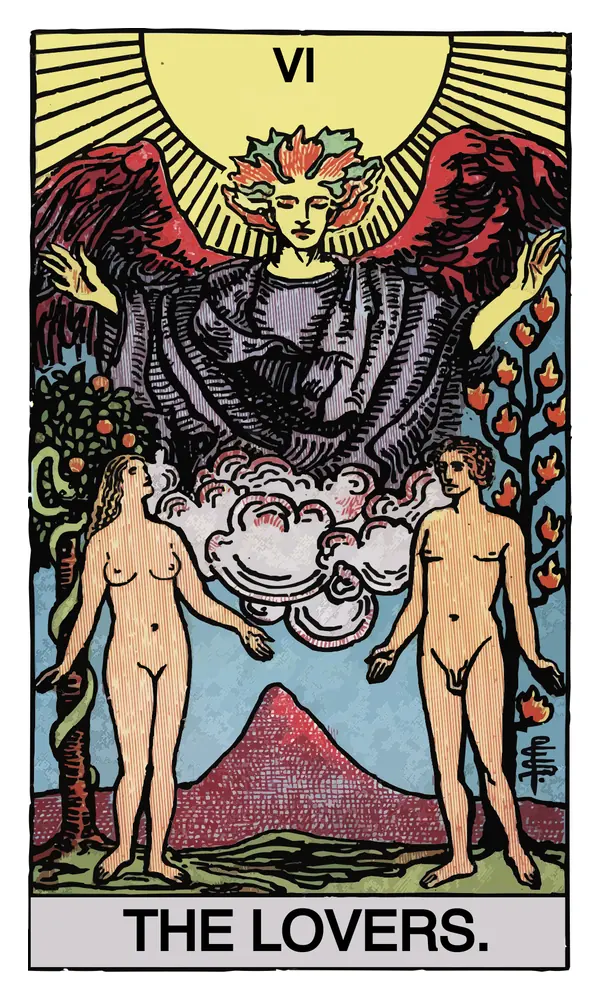
The Lovers
The Lovers: two figures with a third figure above them, traditionally linked with choice and union.
Read about The Lovers on Tarot Told Me (opens in a new tab)Say you ask about a difficult decision and see it next to The Tower, which shows a struck building and falling figures and is traditionally linked with sudden disruption. Two Major cards together can suggest that the decision and the disruption are part of one larger story, and the useful question is which comes first in your own situation.
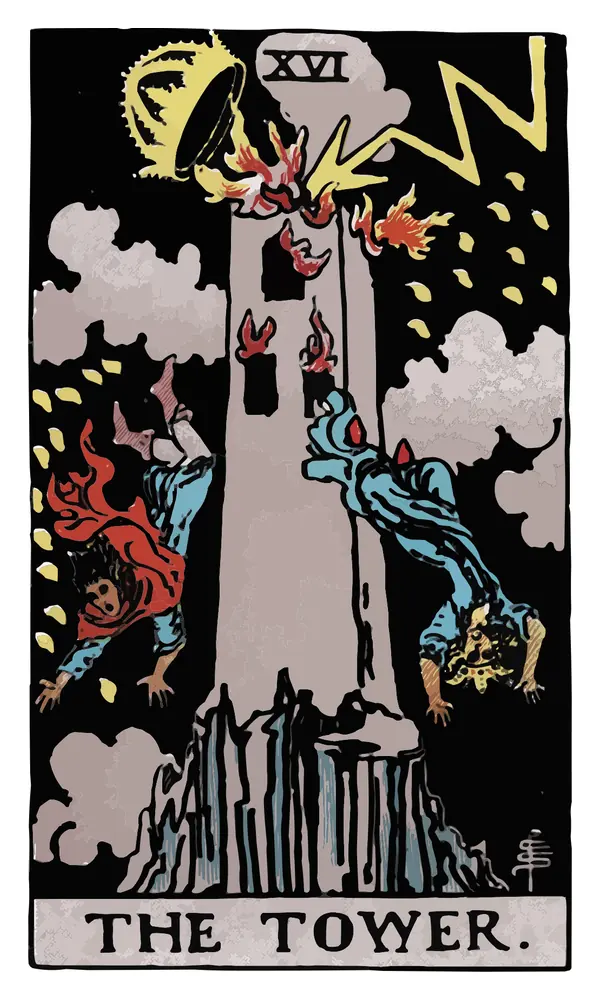
The Tower
The Tower: a struck building with falling figures, traditionally linked with sudden disruption.
Read about The Tower on Tarot Told Me (opens in a new tab)A third card can change the sentence again. The Star, with its kneeling figure pouring water, is traditionally linked with calm and renewed hope. Placed after those two, it would shift the phrase from "choice meeting upheaval" toward "choice, upheaval, then a quieter period." The order is yours to interpret, and it is only one reading among many.
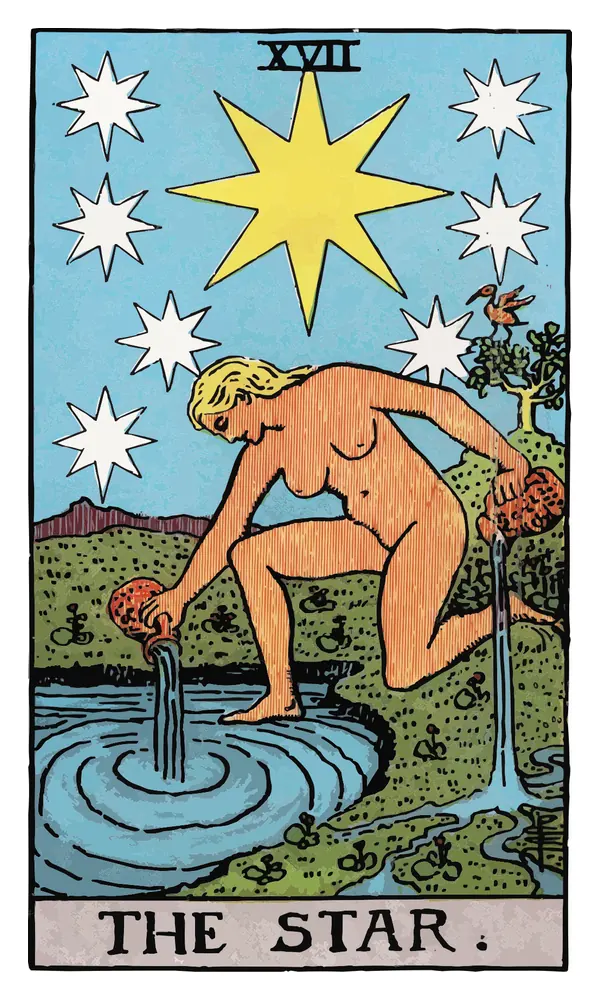
The Star
The Star: a kneeling figure pouring water, traditionally linked with calm and renewed hope.
Read about The Star on Tarot Told Me (opens in a new tab)Which habits make a pair harder to read?
Most confusion comes from a handful of habits. Noticing them early saves a lot of tangled interpretation.
- Treating every pair as a prediction instead of a prompt for reflection.
- Memorizing a fixed meaning for each pair and ignoring the deck's actual pictures.
- Reading each card fully on its own first, then gluing the results together.
- Adding more and more cards until the spread is a pile of unrelated sentences.
- Looking only for the "good" or "bad" label and skipping the question the pair raises.
A calmer approach keeps the reading small. Two cards, one sentence, one question for yourself, and then a pause.
How to practice a pair step by step?
Practice works best with a low-pressure setup. You do not need a real question at first; a pair drawn for study is enough.
- Draw two cards and place them side by side.
- Write the two suits, or mark a card as a Major.
- Write the two numbers and note which is earlier in the arc.
- Describe what each picture shows, in one short line each.
- Combine those lines into one sentence and add a single question for yourself.
If you want a ready-made layout to try this method on, the three-card tool is a gentle place to start, since it gives you a pair plus a neighbor to compare.
Tool on Tarot Told Me
Three-card spread
A three-card draw for practicing pairs: read the first two together, then see how the third changes the sentence.
Tarot Told Me (opens in a new tab) is a reflective tarot app from the team behind this site.
How do combinations fit into the wider tarot?
Combinations sit between single cards and full spreads. A single card gives you a vocabulary, a spread gives you positions, and a pair or trio gives you a first taste of grammar.
Once a pair feels natural, the same habits scale up. In a longer spread you can read neighbors in a row, compare cards across positions, and notice which suit or number appears most often. The method does not change, only the amount of material.
The other pair articles on Taronica apply these steps to specific combinations. Read them as worked examples, and keep your own sentence in mind as the thing to compare against.
Questions for your own practice
- When two cards share a suit, which theme feels amplified in your own life right now?
- Which of the two numbers feels closer to where you are in a situation?
- If you had to put the pair into one plain sentence, what would it say?
- What does the pair leave out that you would want to think about next?
Frequently asked questions
Not really. A short list of suit and number habits will take you further than a long list of fixed pairs, because it lets you handle combinations you have never seen before.
Many readers read left to right, with the first card as the starting point and the second as what follows or answers it. Others read a pair as equal partners. Pick a convention and use it consistently so that your readings stay comparable.
A contradiction is often the most useful part of a pair. It can be read as a tension to examine, such as a wish pulling against a worry, instead of something to be resolved or explained away.
That depends on whether you read reversals at all. If you do, a reversed card is usually read as a softer, blocked, or inward version of its upright idea. If you do not, the method above works exactly the same with upright cards only.
Yes, though the imagery will differ. Decks with fully illustrated minor cards give you more to compare in step three, while decks with simple pip cards lean more on suits and numbers.