Ten of Cups vs Four of Wands: a home or a party
Both cards look happy, yet they picture different kinds of happiness. Here is how imagery, suit, number and history separate them.
By TaronicaPublished
In short
- The ten of cups vs four of wands comparison is about two happy cards that picture different kinds of happiness: a settled home and a shared celebration.
- In the Rider-Waite-Smith imagery, the Ten of Cups gathers a family under a rainbow of cups, while the Four of Wands frames a festive canopy.
- Telling them apart comes down to suit, number and scene: Cups trace feeling and bonds, Wands trace action and visible milestones.
What is the difference between these two cards?
The difference in ten of cups vs four of wands is where the happiness sits. The Ten of Cups places it inside a household, and the Four of Wands places it in a public moment that others can see and join.
Both cards are traditionally read as good news, which is exactly why they get mixed up. A closer look shows that they answer different questions. One asks what lasting contentment looks like. The other asks what a finished milestone looks like.
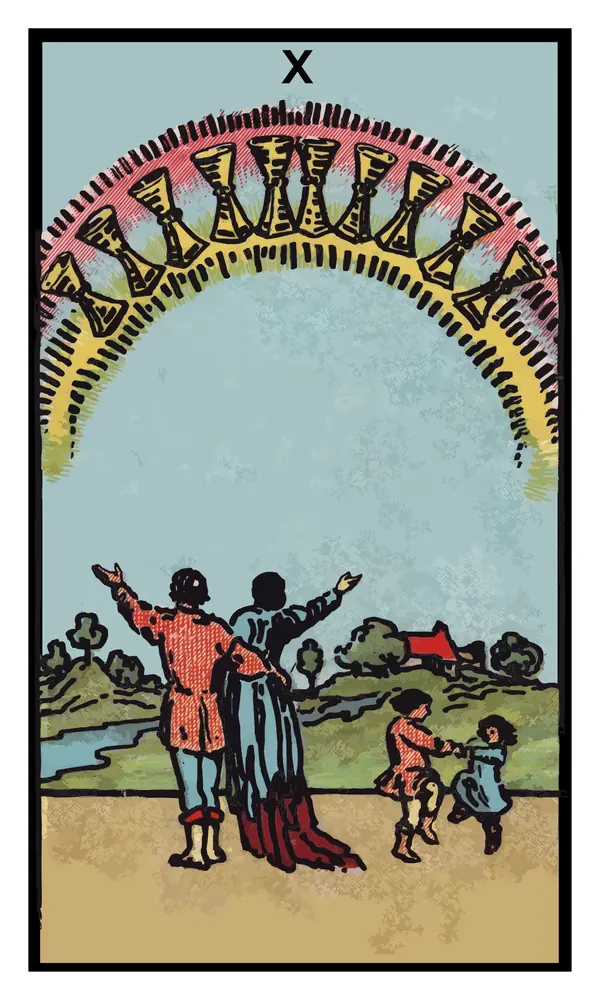
- Ten of Cups
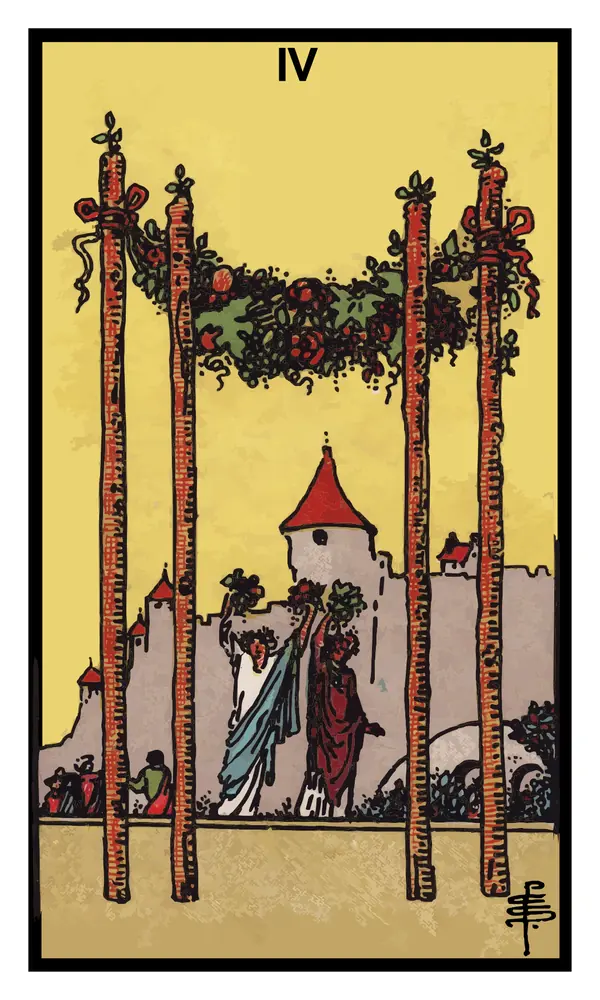
- Four of Wands
This article stays with structure: imagery, suits, numbers and history. It does not predict anything. It sets out how the tradition built each card, so that you can read the pair with more precision.
What does the Ten of Cups show?
Ten of Cups
The Ten of Cups in the Rider-Waite-Smith style: a couple with linked arms, two dancing children, a house, and ten cups arched like a rainbow.
Read about Ten of Cups on Tarot Told Me (opens in a new tab)In the Rider-Waite deck, a husband and wife stand with linked arms and look up at a rainbow of cups over their house. Two children dance beside them. This description is given in the overview of the suit of cups (opens in a new tab), and it matches the image most readers know.
Notice how closed the scene is. Nobody addresses the viewer, there is no stage and no crowd. The figures face the sky and one another, and the house waits behind them as the container of the whole picture.
In the tarot tradition the card is read as emotional fulfillment, belonging and a sense of arriving at something steady. The image does not insist on a literal family, though. One way to read the house is as any place, group or bond where a person feels at home.
What does the Four of Wands show?
Four of Wands
The Four of Wands: four upright wands holding up a garlanded canopy, with figures celebrating before a building in the background.
Read about Four of Wands on Tarot Told Me (opens in a new tab)The Four of Wands keeps an old archway or canopy motif. Four tall wands carry a garland between them, and in the common Rider-Waite-Smith image two figures raise bouquets while a castle or large building stands behind. Its traditional themes are celebration, community, stability and goals achieved, as summarized by a general reference on the Rider-Waite version (opens in a new tab).
This scene faces outward. The canopy works like a gateway or a ceremonial arch, and the people are marking a moment rather than living in it. The building is part of the setting, but the focus is the festivity at its threshold.
There is a small structural detail worth noticing. In many Wands cards the staffs are carried or gripped, while here they stand planted and hold something up. The effort has become a frame that other people can gather under.
How do the suits of Cups and Wands differ?
By standard tarot convention, Cups go with emotions and relationships, and Wands go with action and creativity. The two cards inherit this split. The Ten of Cups is a feeling brought to rest, while the Four of Wands is an effort brought to a visible result.
You can see it in what the figures are doing. In the Ten of Cups, the cups hang in the sky and the people simply look up. In the Four of Wands, the wands are built into a structure, and the people react to something that has been put together.
For more on each suit, the encyclopedic pages on the suit of cups (opens in a new tab) and the suit of wands (opens in a new tab) give background. Suits are a tool for sorting themes, not a rulebook. A Wands card can carry warmth, and a Cups card can involve work.
What do the numbers ten and four add?
In tarot numerology, ten is read as completion: the end of the run from ace to ten, where one cycle is full and another could begin. Placed in Cups, that completion is emotional. It is the sense that a bond or a place has become whole.
Four is traditionally tied to foundations, structure and a first stable platform. In Wands, the suit of drive, the fourth step reads as the point where early momentum turns into something solid enough to celebrate. It is a landing, not yet an ending.
Numbers & suits
Tarot numerology: what numbers mean in tarot
Every numbered card sits somewhere on a path from one to ten. Here is how readers use that path, where the keywords come from, and how far to trust them.
· Taronica
Say you lay the two cards out in order of number. The Four of Wands comes early in its suit, which suggests a stage along the way. The Ten of Cups comes at the end of its suit, which suggests a resting place. That difference in position is one of the cleanest ways to keep them apart.
Where do these images come from?
The Rider-Waite deck was created by Arthur Edward Waite (1857-1942) and Pamela Colman Smith (1878-1951), and Rider & Son of London first published it in December 1909. Smith drew all the scenes, including the number cards. According to one deck history (opens in a new tab), she drew on the Sola-Busca Tarot for the minor arcana and on the paintings of J. W. Waterhouse.
This matters because scenic number cards were not the norm. In many older decks, such as the Marseille style, a card like the Ten of Cups shows ten cups arranged in a pattern and no family at all. The house, the children and the rainbow are features of the Rider-Waite-Smith tradition and the decks that followed it.
Decks & history
Pamela Colman Smith: the artist behind the Rider–Waite deck
She drew every card of the best-known tarot deck in English, yet her name stayed off its title for generations. Here is who she was and what she made.
· Taronica
Waite's companion book, The Pictorial Key to the Tarot, explains his reading of each card. Its text is the best place to check what the designers intended, and it is available through its Wikipedia entry (opens in a new tab) for background. Other decks may differ in details, so the comparison here refers to the Rider-Waite-Smith lineage.
How do the two read together in a spread?
When both cards appear in one layout, the pair can describe a before and after. Say you ask about your living situation and draw the Four of Wands next to the Ten of Cups. One reading is that the first marks a gathering or a milestone, and the second describes the quieter ordinary life that the milestone is meant to lead into.
The order can be turned around. Say the Ten of Cups comes first, followed by the Four of Wands. That could be read as a settled base from which something gets shared with a wider circle. Neither order is a verdict, only a way of seeing how a story might be told.
The table below sets the differences out in one place.
| Aspect | Ten of Cups | Four of Wands |
|---|---|---|
| Setting | A house and open sky | A canopy with a building behind |
| Audience | Family only | Community and guests |
| Suit theme | Emotion and bonds | Action and results |
| Number theme | Completion of a cycle | A stable foundation |
| Mood | Quiet contentment | Public festivity |
| Question it raises | Where do I feel at home? | What is worth marking? |
Where they overlap is stability and shared joy. Both pictures show people in good company with nothing visibly wrong. The overlap is real, but the focus differs: one dwells in a place, the other stands at a gate.
How to tell them apart in your own draw?
A few plain questions keep the reading honest. They work for either card and do not depend on what you hope to hear.
- Where does the scene take place: inside a circle of a few people, or in front of an audience?
- Is the image about rest, or about a result that effort produced?
- Does the question concern a bond that already exists, or a step that has been taken?
- What position does the card hold in the spread, and what do the neighboring cards add?
If the answers lean toward private and settled, the Ten of Cups gives the better frame. If they lean toward visible and achieved, the Four of Wands does. Where the answers split, the draw may be describing both, and that is fine.
Tool on Tarot Told Me
Three-card spread
Try a three-card layout and see whether a home-like card or a celebration-like card sits in the middle.
If the question touches health, money or legal matters, a card is a prompt for reflection and not a substitute for a professional.
What is worth remembering about the pair?
One card is a home you live in; the other is a gate you celebrate at.
The Ten of Cups is enclosed, emotional and complete. The Four of Wands is open, active and marked by ceremony. Both are traditionally warm, and neither has to be the better one.
The habit that helps most is to look at the scene before the label. A house, a rainbow and dancing children say something different from a garland, a canopy and a crowd. Once you read the pictures, the keywords tend to follow.
Questions to sit with
- When I picture contentment, do I see a place, a person, or an occasion?
- Which kind of happiness do I tend to overlook: the quiet kind or the public kind?
- What would it mean to mark a milestone without losing the everyday calm around it?
Frequently asked questions
Both are traditionally read as positive, but in different registers. The Ten of Cups is about emotional contentment and belonging, usually in a private circle. The Four of Wands is about a shared, visible celebration of something achieved.
The archway and garlands of the Four of Wands are often linked to ceremonies, and the Ten of Cups shows a couple with children. These are common associations in the Rider-Waite-Smith tradition, not rules. Both cards can be read more broadly, as community and belonging.
The Four of Wands is closer to effort, since Wands are the suit of action and the wands are built into a structure. The Ten of Cups is closer to rest, with feeling already in place. In a reading, the position and the neighboring cards decide how much weight to give this.
Not always. Marseille-style decks usually show only repeated suit symbols on number cards, and modern decks vary in their scenes. The comparison here follows the Rider-Waite-Smith lineage.
Yes, and the pair is easy to read as two moments of one story: a milestone and the life around it. The order and the surrounding cards change the emphasis, so treat any single reading as one option among several.