Five of Cups vs Three of Swords: regret or pain?
One card shows a figure looking back at what was lost, the other shows the wound itself. Here is how the two images differ and where they touch.
By TaronicaPublished
In short
- The five of cups vs three of swords comparison comes down to two images: a figure grieving over spilled cups, and a heart pierced by swords.
- In the Rider–Waite–Smith tradition, the first card is often read as regret and attention fixed on loss, the second as the sharp pain of a wound.
- Looking at the pictures side by side helps you notice which one your own situation resembles, without treating either as a verdict.
What is the core difference between these two cards?
Put simply, the five of cups vs three of swords comparison is a comparison between regret and pain. In the Rider–Waite–Smith deck, the Five of Cups shows a person who has already absorbed a loss and is now looking back at it. The Three of Swords shows the wound itself, with no one standing nearby to react to it.
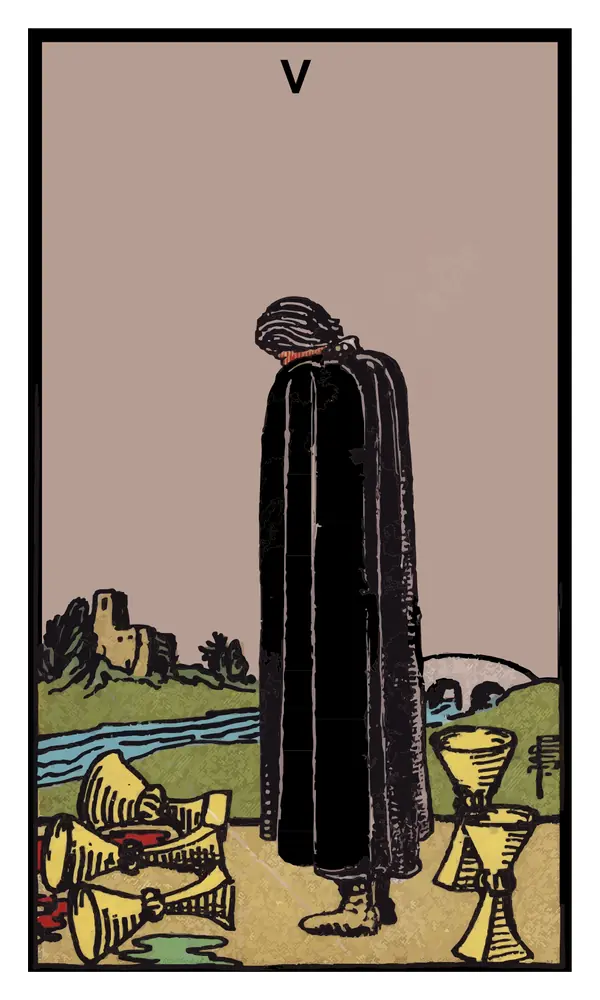
Five of Cups
The Five of Cups in the Rider–Waite–Smith style: a hooded figure with a bowed head stands before three spilled cups.
Read about Five of Cups on Tarot Told Me (opens in a new tab)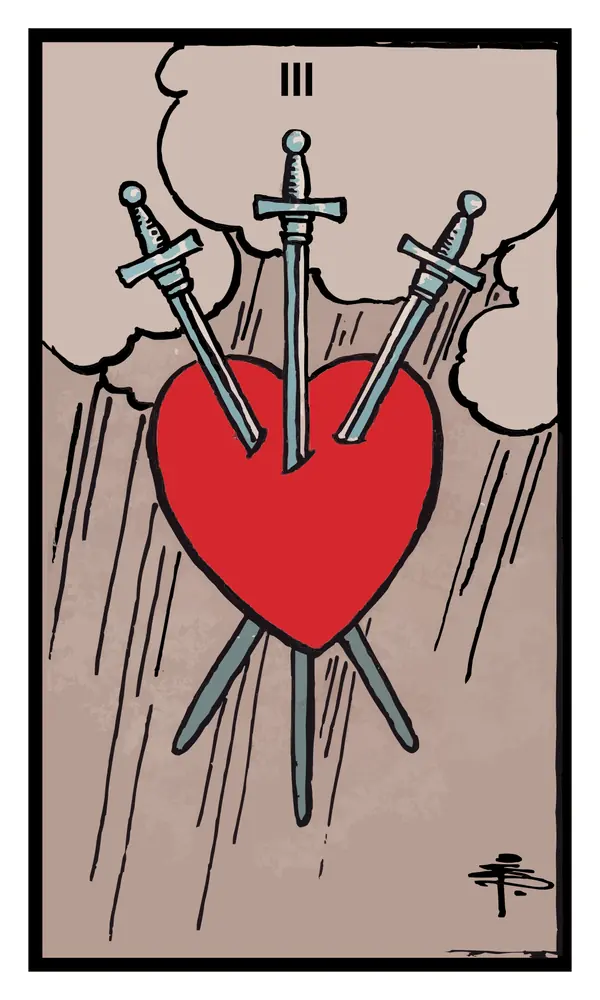
Three of Swords
The Three of Swords in the Rider–Waite–Smith style: a red heart pierced by three swords against a grey, rainy sky.
Read about Three of Swords on Tarot Told Me (opens in a new tab)This is an interpretation, not a historical rule. Readers differ on upright and reversed meanings, and the labels regret and pain are simply a convenient way to keep two similar-feeling images apart. They are not the only way to read either card.
The sections below look at what each picture contains, how suit and number shape it, and where the two overlap.
What does each image actually show?
The Five of Cups shows a hooded, cloaked figure with a bowed head. Three cups lie spilled in front of the figure. Behind, two cups still stand upright, and a river with a bridge runs through the background.
The Three of Swords is far sparser. A single red heart is pierced by three swords, set against a grey sky with falling rain. There is no landscape to walk through and no one to identify with.
Notice how much more the first picture gives you to work with. The Five of Cups has a setting, a direction of gaze, a number of cups on each side. The Three of Swords has one symbol, repeated in its starkness: a heart and the blades that cross it.
Why does one card show a person and the other only a heart?
Here is a plain observation about the two images, and it is our own reading rather than a sourced claim. The Five of Cups shows a person reacting to a loss, while the Three of Swords shows the wound with nobody reacting to it.
That difference changes how a reader can approach each card. A figure invites questions about posture, attention and what the figure is not looking at. A bare heart invites no such questions; it simply states that something has been struck.
Say you ask about a friendship that ended badly. If the Five of Cups appears, a reader might wonder what you keep returning to. If the Three of Swords appears, the reader might instead ask how recent the hurt is. In both cases the cards are only prompts for your own thinking.
How do the suits of Cups and Swords shape each card?
In the tarot tradition, Cups are associated with feeling, attachment and relationships. Swords are associated with thought, speech, conflict and decisions. Both associations are conventions of the Rider–Waite–Smith era and later practice, but they explain much of the contrast.
A cup is a vessel. It can be full, spilled or still standing, so the Five of Cups naturally turns into a picture of what has been poured out and what remains. You can read an emotional state in how the vessels are arranged.
A sword is an instrument that cuts. The Three of Swords therefore pictures a sharp, sudden kind of hurt, one that goes through something rather than draining it. Where the cups spill, the swords pierce, and that single difference of verb carries much of the contrast between the cards.
For general background on the suit, see the Wikipedia article on the suit of cups (opens in a new tab).
What do the numbers five and three add?
In many tarot traditions, fives are treated as the difficult cards of their suit. Wikipedia's page on the suit of cups notes that the fives of any suit can be seen this way. Five is often read as the point where a stable pattern breaks and something has to be reckoned with.
That fits the Five of Cups well: the stable arrangement of cups has been disturbed, and the figure stands in the aftermath. Meanwhile the rest of the picture, with its two upright cups, suggests that not everything has been lost.
Three is commonly linked with growth, groups or a meeting point of two things and a third. In the suit of Swords, the Three is usually described as a cutting of something that was joined. The number three also shows up literally in the image as three blades through one heart. None of this is fixed doctrine, so treat it as a way to read the pictures rather than as a rule.
How do regret and pain differ in practice?
Regret looks backward. It involves a story about what could have gone differently, and it keeps the mind busy with the spilled cups. Pain, as the Three of Swords pictures it, is present and immediate, with less story attached.
This is why the two cards can feel different even when the situation is the same. Say you ask about leaving a job. Feeling the sting of how it ended is closer to the Three of Swords. Replaying the choices you made leading up to it is closer to the Five of Cups.
The distinction is helpful but not tidy. People often feel both at once, and a reading is free to lean on either picture. If the grief is heavy or lasting, a friend, counselor or doctor is a better support than any card.
Where do the two cards overlap?
Both cards are traditionally associated with sorrow. Both use muted, somber moods: a dark cloak in one, a grey sky and rain in the other. Neither is a picture of celebration, and both are often grouped among the harder cards of the deck.
- Five of Cups
- Three of Swords
The overlap is also one of sequence. A wound like the one in the Three of Swords may, with time, turn into the looking-back of the Five of Cups. The reverse can also happen, when long rumination sharpens into fresh hurt.
For that reason, some readers treat the pair as two stages of a single experience rather than rivals. That is one way to read them, not the only one.
How to compare the two cards in your own reading?
A short comparison exercise can show what the pictures offer. You do not need a particular spread to try it, and a quick three-card layout works well for noticing contrasts.
- Look at each image for a minute before reading any text. Note what your eye goes to first.
- Ask whether your situation has a figure in it, someone reacting, or whether it feels more like the bare wound.
- Check the Five of Cups for what is still standing. Ask whether you have been looking only at what spilled.
- Check the Three of Swords for what has been struck. Ask whether anything is asking for care before analysis.
- Write one sentence for each card, using soft words such as might, perhaps or often.
Tool on Tarot Told Me
Three-card spread
Try a three-card spread and compare how each card sits beside the others.
If a question touches on health, money, legal matters or safety, take it to a professional rather than to a card.
Where do these two images come from?
The familiar versions of both cards come from the Rider–Waite–Smith deck, first published by William Rider & Son in December 1909. It was designed by Pamela Colman Smith with A. E. Waite, whose companion book is The Pictorial Key to the Tarot. Its text is available on sacred-texts.com (opens in a new tab).
Older decks of the Marseille family usually show the minor cards as simple arrangements of suit symbols. The scenes on the Fives and Threes that many readers know today owe much to Smith's illustrations, which is part of why the pictures carry so much detail.
That history matters for this comparison. The contrast between a grieving figure and a pierced heart is a feature of a particular illustrated tradition, and other decks may draw these cards differently.
Frequently asked questions
That is one common way to read them, but it is an interpretation and not a historical fact. Readers and decks differ, so treat regret and pain as a helpful contrast rather than a definition.
Both are generally grouped among the harder cards, so neither is clearly worse. The Three of Swords is often described as sharper, while the Five of Cups is often described as more drawn out. These are impressions, not rankings.
In the Rider–Waite–Smith image, only a heart, three swords and weather appear. One reading is that the card shows the wound itself rather than someone reacting to it. This is an interpretation of the picture, not something the deck states.
Behind the figure, two cups remain standing. Many readers see them as a reminder that not everything was spilled. That reading is a convention of the tradition, so other readers may emphasize different details.
Yes, and some readers treat the pair as two stages of a single experience. It is a way of reading, not a prediction. You are free to draw your own conclusions from the pictures.