Four of Swords vs the Hermit: rest or solitude?
Both cards show a figure apart from the crowd, yet one is recovering and the other is searching. Here is how image, number and suit set them apart.
By TaronicaPublished
In short
- The comparison of four of swords vs hermit comes down to rest versus search: one figure lies still to recover, the other walks on holding a light.
- Both cards are traditionally linked with withdrawal, but the Four of Swords reads as a pause and the Hermit as a chosen path.
- Looking at image, number and suit together gives a calm way to tell the two apart.
What separates the Four of Swords from the Hermit?
The short answer to four of swords vs hermit is that the first is traditionally read as rest and the second as solitude with a purpose. Both cards pull a figure away from other people, which is why they are so often confused. The difference lies in what the withdrawal is for.
The Four of Swords is usually described as a pause after strain: the body stops, the mind quiets, and nothing is asked of the figure for a while. The Hermit is usually described as a walk taken alone, with a lantern, in order to look for something or to pass on what has been learned.
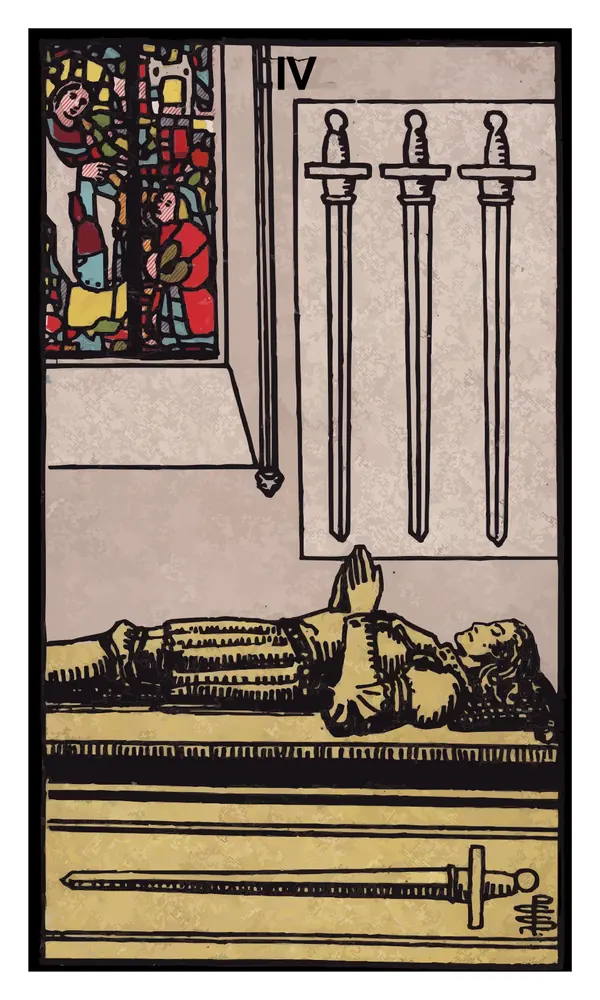
- Four of Swords
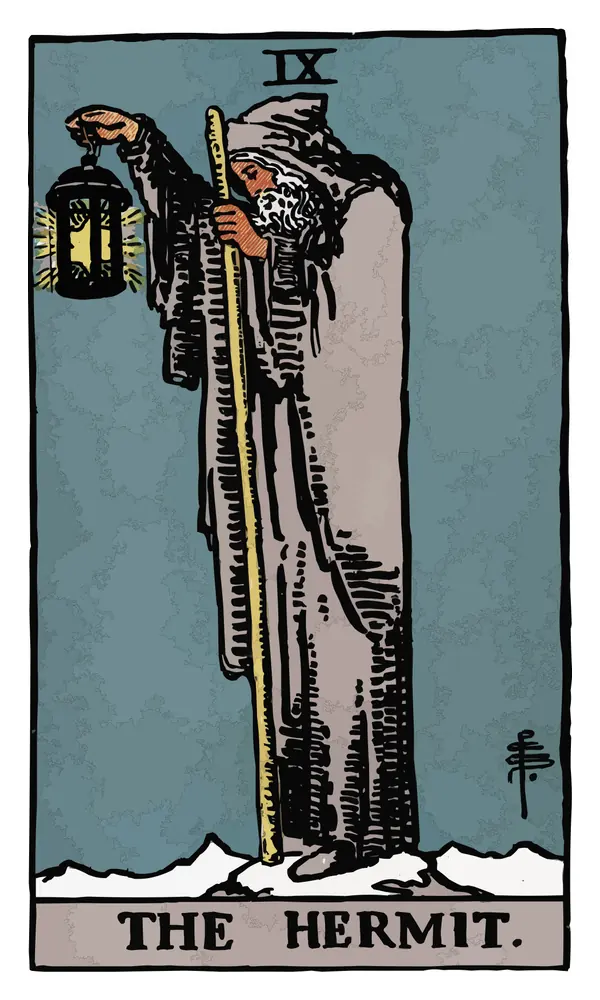
- The Hermit
A simple way to hold the contrast is this. One figure is lying down and the other is standing up. One has put the work aside, and the other is still very much at work, only quietly.
Where do the two cards come from in the deck?
The Hermit belongs to the Major Arcana, the sequence of trump cards. It is numbered IX, the ninth trump, and it is one of the cards that stayed in the tradition for centuries under names such as the Hermit or the old man. A general overview is given in the Wikipedia entry on the Hermit, listed at the end of this article.
The Four of Swords is a Minor Arcana card, a numbered card in the suit of Swords. Minor cards usually describe everyday situations in a suit's domain rather than large archetypes. In the Swords suit that domain is thought, speech, conflict and decision.
This difference in rank matters for comparison. A trump card tends to be read as a stage of a long journey, while a numbered card is read as a moment inside one area of life. The Hermit therefore speaks of a stretch of the road, and the Four of Swords of a halt along it.
What does each image show?
In the Rider-Waite-Smith deck, the Four of Swords shows a knight lying flat on a tomb, as in a church effigy. Biddy Tarot describes it as a knight lying horizontally on a tomb. Many descriptions add a stained-glass window above the figure and swords on the wall and beneath the slab, though details vary between decks.
The Hermit in the same deck is an old figure in a long gray cloak, standing on a snowy height. He holds a staff in one hand and a lantern in the other, and the lantern holds a small star. He looks downward, as if lighting a path for someone below or checking the ground ahead.
Put the two pictures next to each other and the contrast is physical. The knight is horizontal, enclosed and still, and the Hermit is vertical, in open air and holding something that gives light. One image is about stopping, the other about carrying.
Older decks, such as those of the Marseille family, draw both cards more plainly. The Four of Swords there shows four swords and decorative elements without any figure, so the resting knight is a feature of the Rider-Waite-Smith tradition rather than of every deck.
How do the numbers four and nine shape them?
Numbers give a second layer. Four is traditionally the number of structure: four sides, four corners, four seasons, four directions. A card numbered four often shows something settled or held in place, and in the Four of Swords the settling takes the form of a deliberate stop.
Nine is the last of the single digits, so it is often tied to the idea of a cycle nearly complete. The Hermit stands at IX, close to the end of the first run of numbered trumps. That placement fits the picture of someone who has seen a good deal and now steps back to take stock.
These are interpretive habits, not rules. Still, they explain why the Four of Swords feels like a bench and the Hermit like a lookout point. The first holds you steady, and the second lifts you a little above the usual view.
Why does the suit of Swords matter here?
Swords are the suit of the mind in most modern readings. A pause in this suit is therefore a pause in thinking, arguing and deciding. The Four of Swords is often described as a time when the mind is allowed to go quiet.
The card also sits right after the Three of Swords, which is traditionally linked with painful loss. Biddy Tarot reads the Four as recovery that follows, and that sequence helps explain the horizontal knight.
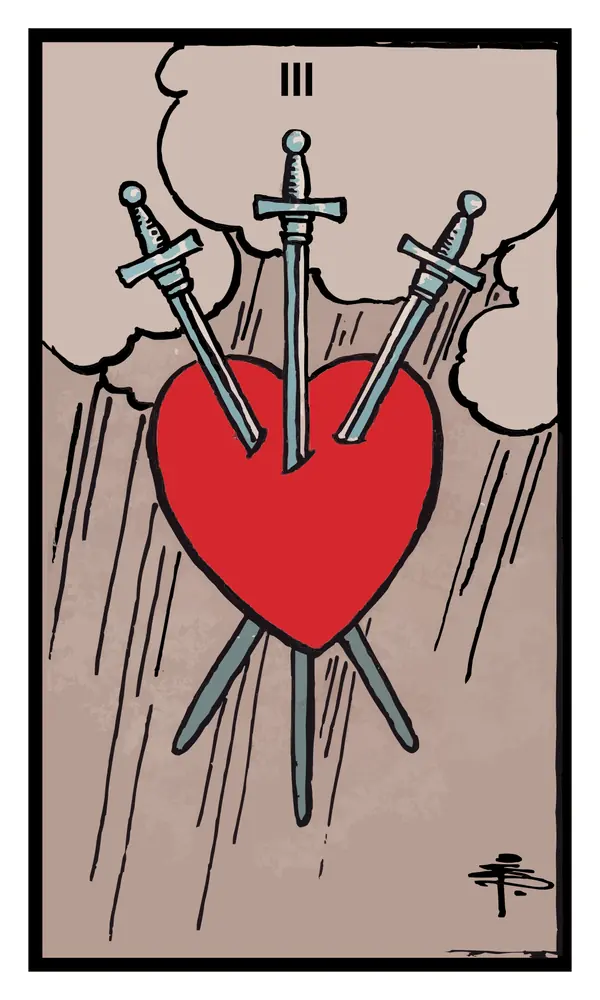
Three of Swords
The Three of Swords, the card that comes just before the Four in the suit sequence and is traditionally linked with grief.
Read about Three of Swords on Tarot Told Me (opens in a new tab)The Hermit has no suit. It stands outside the four families and is not tied to one area of life. That freedom is part of why its solitude feels larger: it is not only about the mind, but about a way of living for a while.
How do rest and solitude differ in the tradition?
Rest is about restoring. Biddy Tarot says the Four of Swords symbolizes rest, relaxation, meditation and recuperation, and that it suggests a need for seclusion to gather your thoughts. It even says the card's own challenge is to stay silent and inactive, which is hard for people who feel they should always be doing something.
Solitude, as the Hermit is usually read, is about looking. The figure withdraws to examine something: a question, a belief, a stage of life. The retreat is active, even if it looks quiet from outside.
The two can overlap, since both involve being alone. Even so, three questions tend to separate them:
- Is the aim to recover, or to understand?
- Is energy being saved, or being pointed at something?
- Would the person welcome a visitor, or a question to think over?
Say you ask about a tiring season at work and draw the Four of Swords. A traditional reading would look at whether you need a real break. Draw the Hermit instead, and the same season might be read as a prompt to think about what you want from the work at all.
How do the two look side by side?
A table keeps the contrast compact. It summarizes common traditional readings, and each deck and each reader will shift the emphasis.
| Feature | Four of Swords | The Hermit |
|---|---|---|
| Rank | Minor Arcana, Swords | Major Arcana, trump IX |
| Posture | Lying down | Standing, walking |
| Main theme | Rest and recovery | Solitude and inner search |
| Object | Swords, tomb | Lantern, staff |
| Energy | Held in reserve | Directed inward |
| Time frame | A pause | A stretch of the road |
Note what the table does not say. Neither column is better than the other. A rest that is cut short and a search that never begins are both worth noticing, and both cards can be read in several ways depending on their position in a spread.
How can you tell them apart in a spread?
Start with the surrounding cards. If the neighbors describe exhaustion, conflict or a recent blow, the Four of Swords is usually read as the pause that answers them. If the neighbors describe a question about direction, meaning or a decision, the Hermit is more often read as a time of reflection.
Then look at position. In a past slot, either card can describe a period already lived through, while in a future slot it is better treated as a possibility to consider than as a forecast. Nothing in the cards decides what happens, so the useful move is to ask what the picture invites you to think about.
A short practice: lay out a small spread and write one sentence on whether the situation calls for restoring or for looking. If you want a simple frame, try a three-card layout.
Tool on Tarot Told Me
Three-card spread
Draw a three-card spread and see whether the pattern around these cards leans toward recovery or reflection.
If the question touches health, sleep, money or legal matters, the cards are no substitute for a doctor or another professional. Treat the image as a prompt for thought and not as advice.
What if both cards appear together?
When the two sit side by side, they tell a coherent story in the tradition: first stop, then look. The Four of Swords clears the ground, and the Hermit uses the quiet to examine something with care. Read this way, the order of the cards matters.
The reverse order can read differently. A Hermit followed by a Four of Swords may suggest that a long period of searching has grown tiring and that a real break is due. Neither reading is fixed, and both depend on the question and the other cards.
There is also a cautious reading for any pair of withdrawal cards. Too much stillness can slide into avoidance, and too much solitude into isolation. You can ask whether the time alone is still serving you, and whether someone trusted might be welcome in it.
Frequently asked questions
No. Both are linked with time alone, but the Four of Swords is traditionally about rest and recovery, while the Hermit is traditionally about a solitary search for understanding. Their images, ranks and suits are different.
The Hermit is the stronger image of solitude, since its figure walks alone with a lantern. The Four of Swords shows a figure at rest, and the aloneness is secondary to the pause.
No. It is a Minor Arcana card in the suit of Swords. The Hermit is a Major Arcana card, trump number IX.
In some readings, yes. The Hermit's retreat can include a break from noise, but it is usually read as active reflection rather than rest. If the question is about tiredness, the Four of Swords is the closer fit.
No. Cards do not predict behavior. They offer images to think with, and the useful question is what kind of withdrawal, if any, would help you.
Sources
- Biddy Tarot - Four of Swords (opens in a new tab)
- Wikipedia, entry "The Hermit (tarot card)"