The Lovers vs the Two of Cups: choice or reciprocity
Both cards show a pair, yet they are built for different questions. Here is how the Lovers, about choice, differs from the Two of Cups, about mutual exchange.
By TaronicaPublished
In short
- The comparison lovers vs two of cups is mostly a comparison between choice and mutual exchange.
- The Lovers is a Major Arcana card traditionally tied to values, attraction and decisions, while the Two of Cups is a Minor Arcana card tied to two people meeting on equal terms.
- Reading them side by side helps you ask whether a situation is about deciding or about relating.
What is the real difference between these two cards?
The comparison of lovers vs two of cups comes down to a simple contrast: the Lovers is traditionally about a choice, while the Two of Cups is about an exchange. One asks what you value and what you are willing to commit to. The other shows two people already facing each other, each offering something.
- The Lovers
- Two of Cups
The two cards are easy to confuse because both show a pair and both are linked in many modern readings to relationships. Yet the structure of each image is different. In the Lovers, something larger than the couple watches over them. In the Two of Cups, the scene is only about the two of them and the cups between them.
This framing of choice and reciprocity is an interpretation, not a historical rule. It is a useful way to tell the cards apart, not the only one.
How does the Rider-Waite Lovers image work?
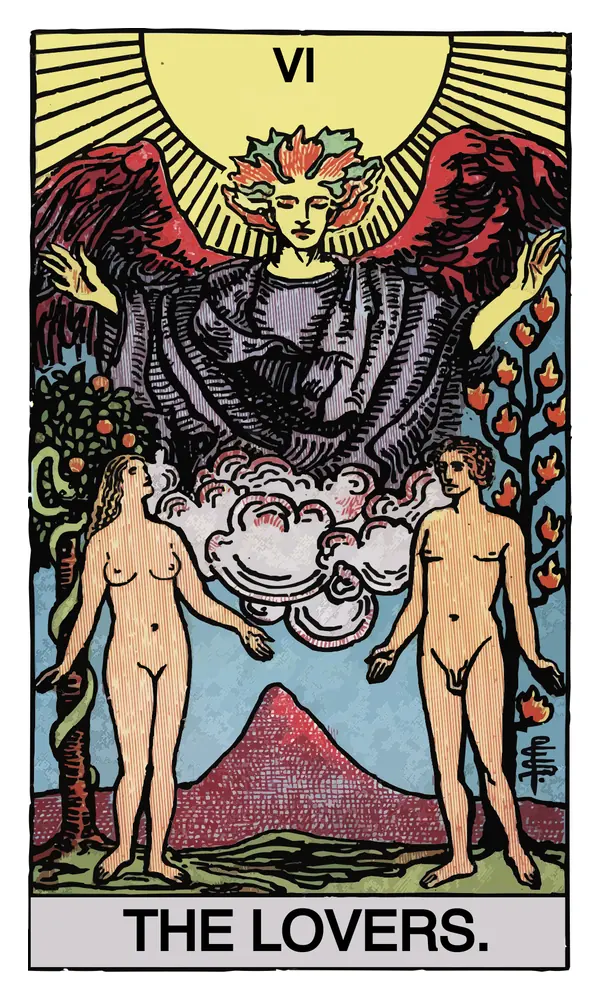
In the Rider-Waite deck, the Lovers shows a man and a woman standing under an angel, in a scene commonly read as the Garden of Eden. The angel is possibly Raphael, though sources hedge on this and the identification is not certain. The figures are placed apart, each looking in a different direction from the other.
That arrangement matters. The image does not show two people exchanging gifts; it shows two people in front of a presence that frames their situation. Many readers take this as a picture of values, temptation and moral weight rather than simple affection.
Older designs, such as those in the Marseille tradition, are usually described as showing a couple receiving a blessing from a noble or a cleric, sometimes with a third figure. Waite reduced the figures from three to two, which strengthened the card's connection to Gemini, the sign of the twins.
What does the Two of Cups show?
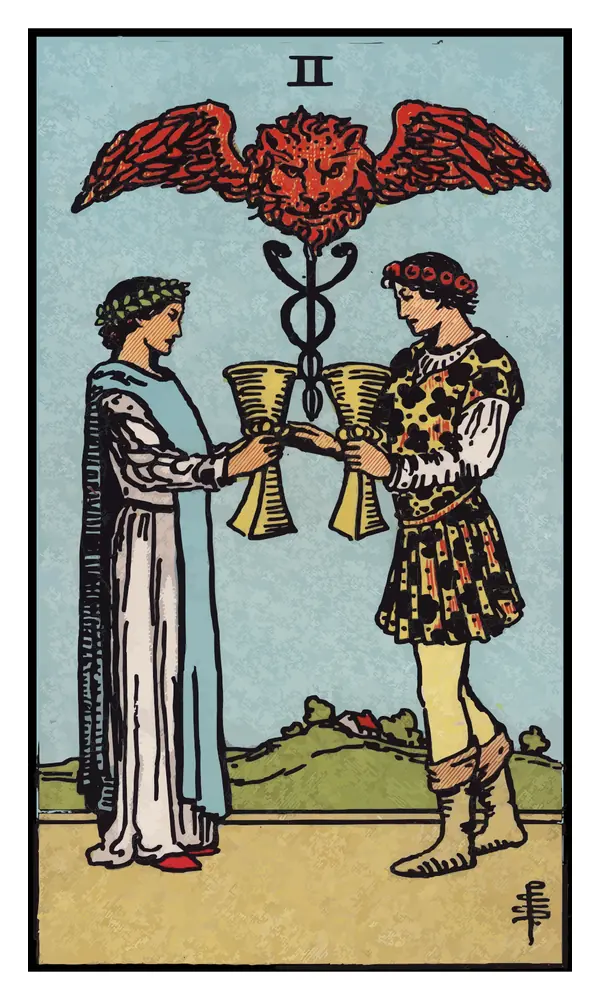
The Rider-Waite Two of Cups shows a young man and a woman, each holding a cup as if offering it to the other. Above them floats the Caduceus of Hermes, the winged staff with two serpents. The picture was drawn by Pamela Colman Smith to Waite's specifications.
Notice what is missing. There is no angel and no crowd, and no obvious third party asking for a verdict. The scene is symmetrical: what one person gives, the other returns.
This is why the card is traditionally read in terms of partnership, agreement and mutual regard. It belongs to the suit of cups, which the tradition links to feeling and relationship, so the card shows that suit in its simplest form: two vessels, two people, one exchange.
Two of Cups
The Two of Cups: two figures hold cups toward one another beneath the Caduceus, a picture of give and take rather than decision.
Read about Two of Cups on Tarot Told Me (opens in a new tab)Why is one a Major Arcana card and the other a Minor?
The Lovers is numbered VI and is the sixth trump of the Major Arcana in most traditional decks. The Major Arcana is usually described as the deck's sequence of larger themes, while the Minor Arcana covers the four suits and their more everyday scenes. That structural difference shapes how readers approach each card.
A trump tends to be read as a theme that frames a whole situation. A numbered suit card tends to be read as a specific episode inside a theme. Say you ask about a friendship that is changing: the Lovers might prompt a question about what you value most, while the Two of Cups might prompt a question about how the two of you currently treat each other.
Neither is more important in an absolute sense. They simply work at different scales, one wide and one close.
How do choice and reciprocity differ in practice?
Choice is something one person does. Reciprocity needs two people at the same moment. That is the cleanest way to separate these cards.
In the tarot tradition, the Lovers is associated with relationships and choices, and Waite's 1910 Pictorial Key to the Tarot gives it the words "Attraction, love, beauty, trials overcome." Notice that the list includes trials. The card is not only warm; it carries the idea that a decision has weight and may cost something.
The Two of Cups carries less tension in its picture. The cups are level, the gaze is shared, and the gesture is balanced. Readers often use it to ask whether give and take is roughly even.
A short comparison may help:
| Question | The Lovers | The Two of Cups |
|---|---|---|
| Type of card | Major Arcana, VI | Minor Arcana, suit of cups |
| Central idea | Choice, values, attraction | Mutual exchange |
| Who acts | One person at a crossroads | Two people together |
| Image | Figures under an angel | Figures with cups and the Caduceus |
What do the numbers six and two add?
Numbers are part of how tarot is built, and these two cards sit at opposite ends of a small scale. Two is the first number in which something can be shared: one thing meets another. In the suit of cups, that meeting is the whole subject of the card.
Six, in the Major Arcana, is more complicated. It follows the Hierophant at V in many decks, and some readers see a link: after a card about shared teaching and tradition comes a card about personal choice within it. This is a reading of the sequence, not a fixed rule, and decks differ in order.
So the numbers fit the images. Two points to a pair meeting; six points to a larger scene in which a pair stands inside a wider frame of values.
How do they read when they appear together?
When both fall in one spread, readers often treat them as two stages of one story. The Two of Cups can be taken as the meeting, and the Lovers as the question of what to do with it. Others reverse the order and read the Lovers first as a choice, then the Two of Cups as the mutual exchange that may follow.
Say you draw them in the positions for the present and the next step of a three-card layout. You could ask whether the exchange you already have is the thing you are being asked to choose, or whether a decision still stands between you and that exchange.
Neither order is correct on its own. Position, neighboring cards and your own question carry more weight than any fixed rule, and the pair cannot tell you what another person feels or will do.
How can you compare them in your own reading?
A practical way to separate them is to give each card its own question and see which one fits your situation better. Keep the questions about you, not about what someone else is thinking.
- For the Lovers: what am I choosing between, and what do I value in each option?
- For the Two of Cups: where do give and take feel balanced, and where do they not?
- For both: which of these two questions am I actually asking?
If the first question feels sharper, your situation may be mostly about a decision. If the second does, it may be mostly about how two people treat each other. Many situations contain both, and that is fine.
Tool on Tarot Told Me
Three-card spread
A simple three-card layout lets you place a choice, a mutual exchange and a next step in separate positions and compare how each reads.
For anything touching health, money, legal matters or safety, a qualified professional is a better guide than any spread.
Where can you read more about these cards?
The Wikipedia entries on the Lovers and on the suit of cups give the basic descriptions used here, including the numbering, the Rider-Waite imagery and the change from three figures to two. Waite's own Pictorial Key to the Tarot is the standard primary text for the Rider-Waite meanings, and it is worth reading directly rather than through summaries.
If you want to see how the Lovers sits next to other cards, look at the related pages on this site, such as the pages on the Lovers with the Devil and with Death. For other pairs that are easy to mix up, the page on similar tarot cards explains the logic of comparing look-alikes.
Frequently asked questions
No. The image shows two people exchanging cups, and the suit of cups is linked to feeling and relationship in general. Many readers apply it to friendships, partnerships and collaborations as well as romance.
Not only. In some traditions it stands for relationships and choices, and Waite's list of meanings includes attraction, beauty and trials overcome. Many modern readers focus on values and decisions.
They work at different scales rather than in a ranking. The Lovers is a Major Arcana card, usually read as a larger theme, while the Two of Cups is a Minor Arcana card, usually read as a specific exchange.
In the Rider-Waite deck, the angel is possibly Raphael. Sources are cautious here, so it is safest to describe the figure as an angel and note the possible identification.
Waite reduced the figures from three, as in the traditional Marseille-type designs, to two. This is said to reinforce the card's link to Gemini.
Sources
- Wikipedia - The Lovers (opens in a new tab)
- Wikipedia - Suit of cups (opens in a new tab)
- Wikipedia - Two of Cups (opens in a new tab)
- Wikipedia - Rider-Waite Tarot (opens in a new tab)
- A. E. Waite, The Pictorial Key to the Tarot (1910)