Tarot numerology: what numbers mean in tarot
Every numbered card sits somewhere on a path from one to ten. Here is how readers use that path, where the keywords come from, and how far to trust them.
By TaronicaPublished
In short
- Tarot numerology reads the number on a card, usually Ace through Ten, as a stage in a cycle.
- The suit supplies the setting, such as action, feeling, thought or material life, while the number shows how far the story has come.
- The keywords are a convention shared by many authors, not a fixed rule, so treat them as a starting vocabulary.
What is tarot numerology?
Tarot numerology is the habit of reading the number on a card as a clue to its theme. In the Minor Arcana the numbers run from Ace to Ten in each of four suits, and many readers treat that run as a small story with a beginning, a middle and an end.
The idea is simple to state. The suit tells you where a situation shows up, and the number tells you which stage of the cycle it is in. A One is a start, a Five is a turning point, a Ten is a close.
That gives you something useful even when you cannot recall a card's full traditional meaning. You can look at the number, name the stage, and then let the picture fill in the details.
The number tells the stage; the suit tells the setting.
Where does the idea come from?
There is no single founding text, and it is worth saying so plainly. Tarot cards were originally made for card games in Europe. The oldest surviving examples, the Visconti-Sforza cards from the mid-15th century, belong to the period when the game was called Trionfi.
The numbers on those early cards were first of all a way of counting, as in any pack of playing cards. Reading them as stages of a life cycle is a later layer of interpretation. We have not found a verified historical line from ancient numerology to tarot, so this article does not claim one.
What we can say is that illustrated number cards have a long precedent. The Sola Busca deck is described as the earliest complete 78-card deck and the earliest in which every numbered card carries a scene. The Rider-Waite-Smith deck followed that approach. Pamela Colman Smith was commissioned by Arthur Edward Waite in 1909 to design a 78-card pack, and it was first published in 1910. Because each number has its own picture, readers could attach a story to each step.
How do numbers and suits work together?
The four suits are traditionally linked to the four elements. Wands go with fire and action, Cups with water and feeling, Swords with air and thought, Pentacles with earth and material life. These pairings are a convention of the tradition, and decks and authors vary in the details.
Put the two layers side by side and you get a grid. The number is the stage, the suit is the field where that stage plays out. A Three means growth or first results in every suit, but what grows differs.
Say you see the Ace of Wands. The One points to a beginning and the suit points to energy, drive or a creative spark, so a reader might describe it as the start of an effort.
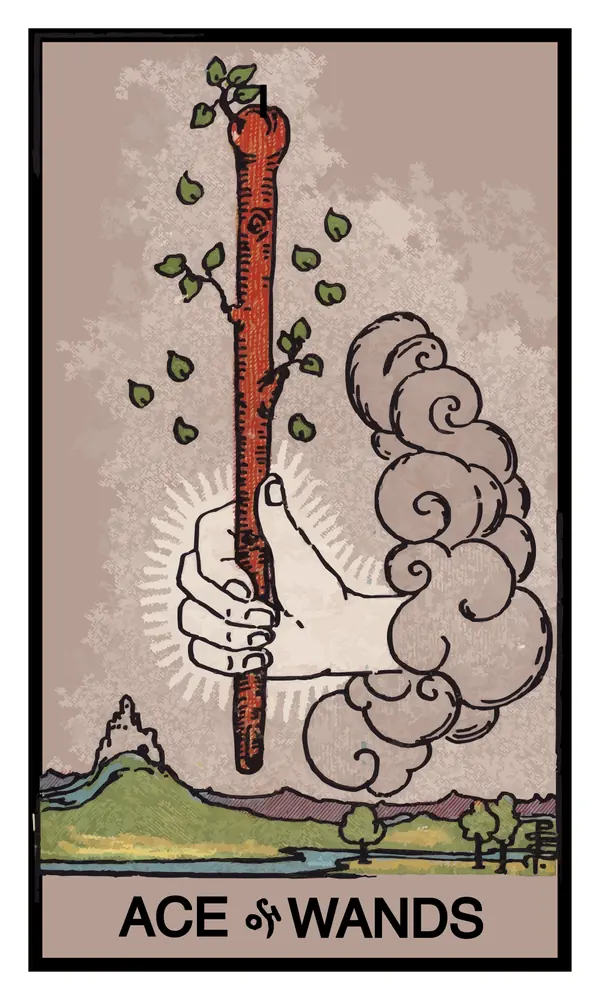
Ace of Wands
The Ace of Wands in the Rider-Waite-Smith style: a hand emerging from a cloud, holding a leafing wand. One, the seed, in the suit of fire.
Read about Ace of Wands on Tarot Told Me (opens in a new tab)The same One in Cups would be a beginning in the emotional field, and in Pentacles a beginning in the practical one. Nothing about the number changes; only the setting does.
What do the numbers 1 to 10 mean?
The table below gathers the keywords most often used for each number. Authors do not agree on every row, especially for the middle numbers, so read it as a common convention rather than a rule. The examples are traditional ways a number might color a suit.
| Number | Common keywords | Suit example |
|---|---|---|
| 1 | Beginning, opportunity, potential | Wands: a spark of an idea |
| 2 | Balance, choice, pairing | Cups: two feelings or two people meeting |
| 3 | Growth, expression, first results | Pentacles: skills joined in shared work |
| 4 | Stability, structure, pause | Swords: rest, a held position |
| 5 | Conflict, change, friction | Wands: rivalry or competing aims |
| 6 | Harmony, exchange, recovery | Pentacles: giving and receiving |
| 7 | Reflection, testing, assessment | Cups: many options to weigh |
| 8 | Movement, effort, mastery | Swords: thoughts in rapid motion |
| 9 | Near completion, resilience | Wands: staying power near the end |
| 10 | Completion, culmination, renewal | Cups: a fulfilled cycle of feeling |
Sources such as Tarot Elements offer a general guide to the numbers 1 to 10 and suggest blending it with your own card meanings. That is sound advice. The table is a scaffold, and the card images carry the specifics.
How do the Aces to Fives read?
The first half of the run is usually described as a build-up. The Ace is the seed, the Two is the first choice or relationship, the Three is the first visible growth. The Four then slows things down into a structure, a rest or a hold.
The Five is where many readers see a break. It is often described as the point at which the early plan meets friction, loss or change. That reading shows up in every suit, though its flavor differs.
Say you meet the Five of Cups. The Five suggests friction, and Cups place it in the field of feeling, so the tradition tends to read disappointment or grief. In the Rider-Waite-Smith image a cloaked figure looks at three spilled cups while two stand upright behind, which is why the card is often discussed in terms of what remains.
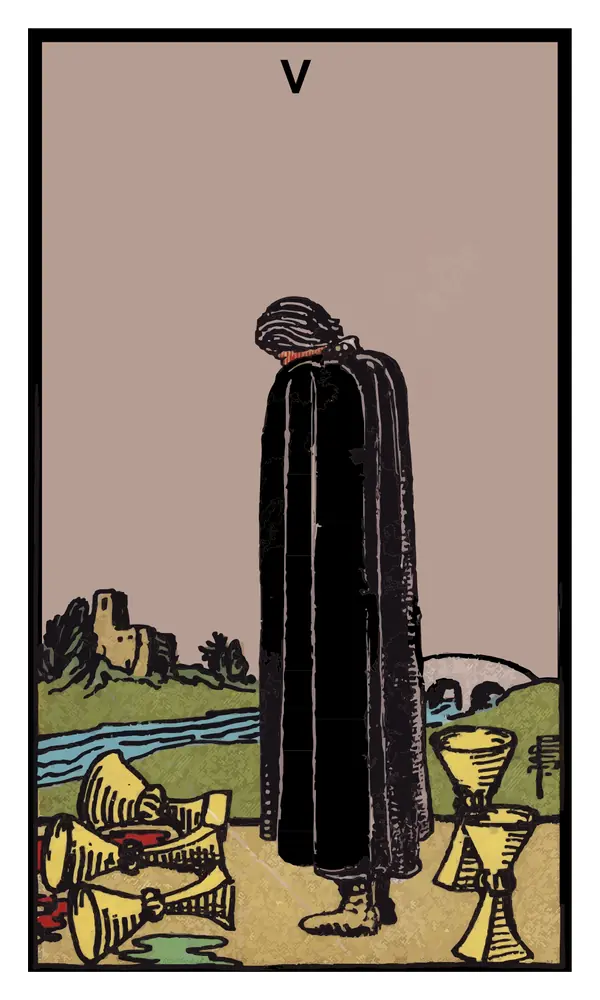
Five of Cups
The Five of Cups in the Rider-Waite-Smith style: a cloaked figure facing three spilled cups, with two upright cups behind. Five, the point of friction, in the suit of water.
Read about Five of Cups on Tarot Told Me (opens in a new tab)Notice how little of that came from memorizing the card. The number gave the tension and the suit gave the field.
How do the Sixes to Tens read?
The second half is commonly read as the movement from recovery toward completion. The Six brings a kind of balance after the Five, the Seven asks for assessment, the Eight is about effort or mastery, and the Nine stands near the finish line.
The Ten is the last number and is usually read as completion, the end of a cycle and renewal. There is a neat arithmetic reason for the last part. Ten reduces to one, since 1 + 0 = 1, so a Ten can also be read as an ending that contains a new beginning.
Say you see the Ten of Pentacles. The Ten suggests a full cycle and Pentacles suggest the material and the lasting, so readers often connect it with long-term stability, family or inheritance. The picture supports that: an older man with dogs, a couple and a child beneath an archway.
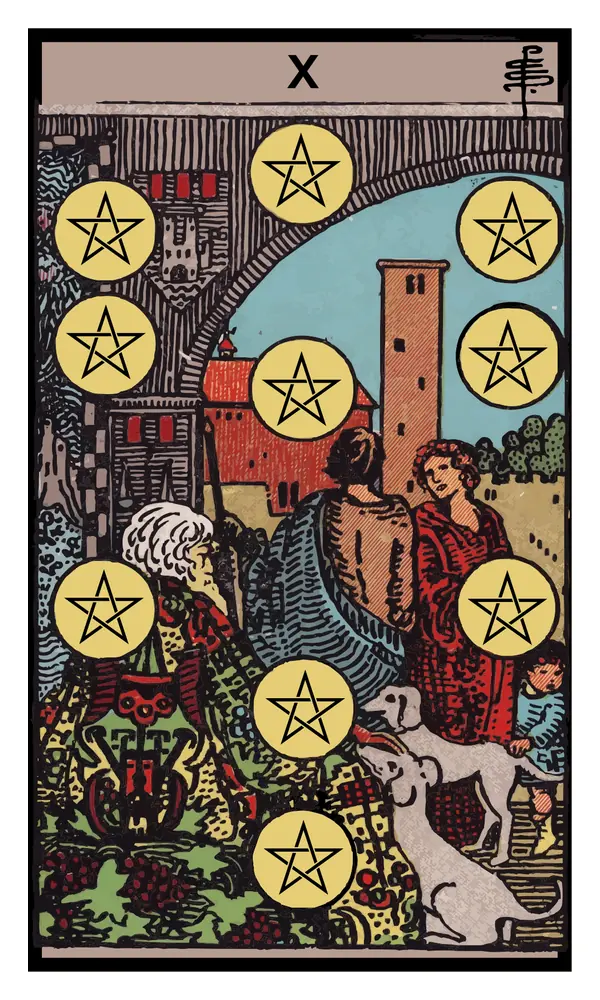
Ten of Pentacles
The Ten of Pentacles in the Rider-Waite-Smith style: an elderly man with dogs, a couple and a child under an archway. Ten, the full cycle, in the suit of earth.
Read about Ten of Pentacles on Tarot Told Me (opens in a new tab)Place the Ace of Wands and this card next to each other and you can see the whole span of the method: the same cycle, one end to the other, in different suits.
What about court cards and the Major Arcana?
Court cards do not fit the one-to-ten run, so numerology says little about them. Pages, Knights, Queens and Kings are usually read as people, roles or approaches, and the suit still gives the field. Some readers loosely place them after the Ten, as a step into a new level of the cycle, but that is a personal habit, not a standard.
The Major Arcana carry their own numbers, and some readers apply the same method. A common technique is to add the digits of a two-digit number until a single digit remains, so that 14 becomes 1 + 4 = 5. This is a modern practice, and it works best as a gentle layer on top of the card's imagery, not as a replacement for it.
One caution applies. Different decks and traditions number a few Major cards differently, so check the number printed on your own deck before you reduce anything.
How to read a card's number in practice?
You do not need a special system. A short routine is enough, and it keeps the number from taking over the whole reading.
- Name the suit and its field: action, feeling, thought or material life.
- Name the number and its stage: start, choice, growth, pause, friction and so on.
- Look at the picture and note what it adds that the number did not.
- In a spread, compare the numbers. Low numbers across the cards can read as early stages, high numbers as later ones.
- Notice repeats. Two cards sharing a number may point to the same stage showing up in two areas.
Tool on Tarot Told Me
Three-card spread
A three-card draw is a compact place to practice: compare the three numbers and suits and see which stage each one describes.
Tarot Told Me (opens in a new tab) is a reflective tarot app from the team behind this site.
Keep your notes in plain words, such as "stage: friction, field: feeling". Over a few readings you will see which keywords you use naturally and which you borrowed without needing them.
What are the limits of number readings?
The main limit is that the keywords are not standardized. Number meanings for the middle of the run differ between authors, and the common sources are blogs and guides rather than scholarly works. Treat any table, including the one above, as one reasonable summary among several.
A second limit is that a number is only one of three layers, along with the suit and the image. A reading built on the number alone can flatten a card. A Five can be conflict, but it can also be a necessary change, and only the picture and the question around it can tell you which direction to explore.
Finally, numbers describe patterns of experience, not outcomes. They cannot say what will happen or what anyone else will do. If a question touches health, money or legal matters, the cards are a place to organize your thoughts, and a qualified professional is the place for answers.
Frequently asked questions
Not exactly. Regular numerology works with numbers from names and dates, while tarot numerology reads the printed numbers of the cards. Some readers borrow ideas such as reducing two-digit numbers to a single digit, but the two practices are usually kept separate.
Most often the Ace through Ten of each suit, plus the numbered Major Arcana. Court cards are normally read by role and suit instead of by number.
The printed numbers are the same in most decks, but the keywords attached to them vary between authors. The common core, from beginning at One to completion at Ten, is widely shared, while the middle numbers differ more.
Because it closes the run of ten and, by adding its digits, reduces to one. Many readers therefore describe a Ten as a finished cycle that makes room for the next.
No. It is an optional layer. If you know the suits and the images, the numbers can simply help you name the stage of a story.
Sources
- Tarot by numbers: interpret tarot cards using numerology (Numerologist.com) (opens in a new tab)
- Numerology of the Minor Arcana (Tarot Elements) (opens in a new tab)
- Sola Busca tarot (Wikipedia) (opens in a new tab)
- Visconti-Sforza Tarot (Wikipedia) (opens in a new tab)
- Rider-Waite-Smith deck print (Victoria and Albert Museum) (opens in a new tab)