Pamela Colman Smith: the artist behind the Rider–Waite deck
She drew every card of the best-known tarot deck in English, yet her name stayed off its title for generations. Here is who she was and what she made.
By TaronicaPublished
In short
- Pamela Colman Smith was the artist who illustrated all 78 cards of the Rider–Waite deck, published in 1909.
- She worked from instructions by A. E. Waite, and for a long time her name was missing from the deck's title.
- Knowing her background helps you see the deck's pictures as designed scenes rather than anonymous symbols.
What is Pamela Colman Smith known for?
Pamela Colman Smith (1878–1951) was an artist, illustrator, writer and publisher, and she is best known for illustrating the deck most people call Rider–Waite. Every one of its 78 cards was drawn by her hand. The deck is still the visual starting point for a large share of the tarot decks printed today.
You will see the same deck under several names: Rider–Waite, Waite–Smith, or Rider–Waite–Smith, often shortened to RWS. The names reflect a slow correction of the record. The first two credit the publisher and the man who gave the instructions, and the last two add the artist.
This article follows the person rather than the card meanings. It asks who she was, what she had made before 1909, and how her pictures changed the way a tarot deck looks.
Where did she come from and how did she train?
Smith was born on 16 February 1878 in Pimlico, London. She was nicknamed Pixie, a name that stayed with her in the circles she later moved in. Much of her childhood is described in secondary sources only, so details about her family background vary from one account to another.
She studied at the Pratt Institute in Brooklyn, entering in 1893 at the age of 15. Her mother died in Jamaica in 1896, while she was still in art school. Her father died in 1899, which left her orphaned at 21.
Those facts matter for one practical reason. She did not come to the tarot as a hobbyist with private money. She was a young professional who had to earn her living by drawing, and the commission of 1909 was one job among many.
What did she do before the tarot?
By the time Waite approached her, Smith already had a working career. She was connected with the Lyceum Theatre group led by the actress Ellen Terry, and the stage left a clear mark on her style. Her figures stand in poses that read well from a distance, like actors on a lit platform.
Her book credits include an edition illustrated for W. B. Yeats and a book on Ellen Terry by Bram Stoker. She also wrote and illustrated her own books, among them Widdicombe Fair. In other words, she was a storyteller as well as a draftswoman.
In 1907 the photographer Alfred Stieglitz gave her a show at his Little Galleries of the Photo-Secession, known as 291, in New York. A McMaster University museum page describes her as the first painter to exhibit there. Yale's Beinecke Library holds her correspondence with Stieglitz from 1907 to 1909, and the Morgan Library's online tarot exhibition has a stop on her work before the deck.
How did the 1909 commission come about?
Smith and Waite both moved in the occult societies of the period. When the original Order of the Golden Dawn splintered, she followed Waite into the Independent and Rectified Rite. That shared circle is the usual explanation for why he asked her.
Waite commissioned the deck in 1909, and the publisher William Rider & Son brought it out the same year. The pictures were worked from Waite's instructions. His guide, The Pictorial Key to the Tarot, followed in 1911.
Smith lived in Battersea while she made the illustrations. She drew all 78 cards in pen and ink wash, and the color was added in printing. The result is a set of images with a clear outline and a flat, almost poster-like clarity.
What did her cards change about tarot art?
In many older decks, especially in the Marseille tradition, the number cards of the four suits show a repeated count of cups, swords, coins or batons. Nothing happens on them beyond the arrangement. In the RWS deck, each of those cards shows a small scene with people in it.
This is the feature that makes the deck easy to read at a glance, and it is usually credited to her work. Some scholars have pointed to the Sola Busca deck, an Italian set from the late fifteenth century with scenes on its number cards, as a possible influence. Whether she saw it, or how directly it guided her, is a point to treat with care.
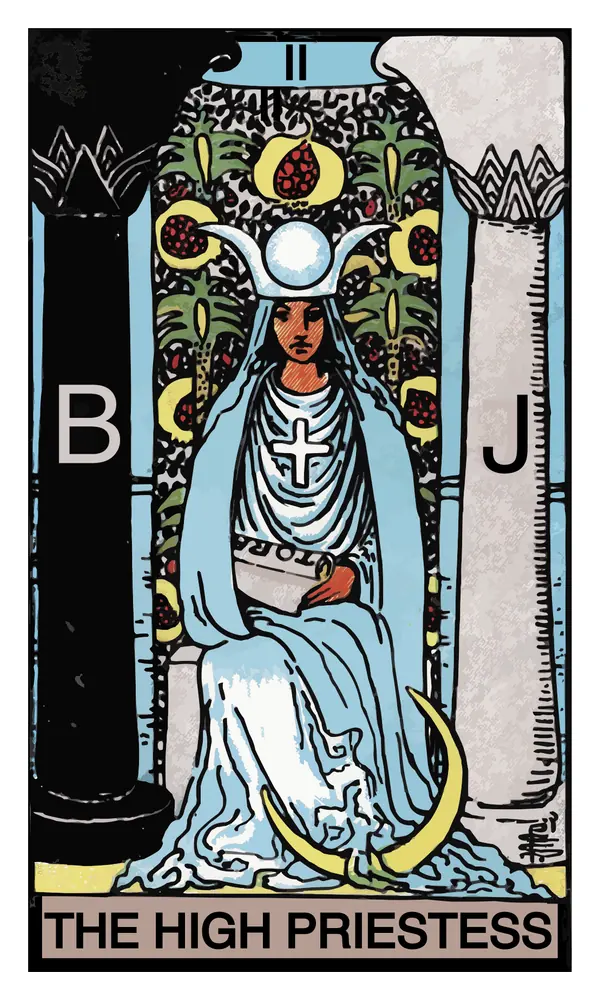
The High Priestess
The High Priestess in the Rider–Waite deck: a seated figure between two pillars, with a crescent moon at her feet and a partly hidden scroll.
Read about The High Priestess on Tarot Told Me (opens in a new tab)The Major Arcana show her taste for symbol and staging. The High Priestess is commonly described as seated between two pillars, with a veil behind her and a crescent near her feet. Nothing in the image is accidental, even if the deck's reasons for each choice were never written down by her.
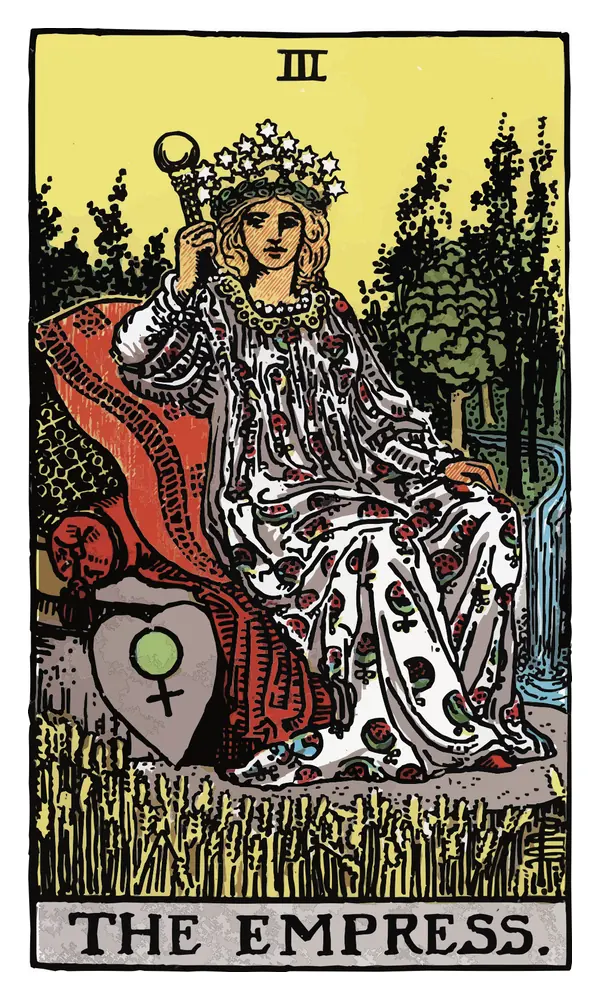
The Empress
The Empress in the Rider–Waite deck: a crowned figure among wheat, with a heart-shaped emblem and a stream nearby.
Read about The Empress on Tarot Told Me (opens in a new tab)The Empress is a good contrast. The scene is soft and full, with grain, a garden and a crown of stars, and it shows how she could shift the mood of a figure through setting alone. Looking at the two cards side by side is a short lesson in her range.
How was she credited and paid?
She received a modest one-off fee for the work. Her name does not appear in the deck's title, which names the publisher and, in common usage, Waite. That arrangement was typical for commercial illustration of the time, though it looks very unequal today.
There is no evidence in the sources used here that she earned anything from the deck's later success. The figure is not given, and writers who quote an exact original price or sum often rely on blogs, so treat those numbers with caution.
The point is not to condemn anyone from a distance. It is to notice that the deck's fame and the artist's recognition took different roads, and that the second is still catching up.
What is known about her later life?
The record of her later years is thinner than that of her early career. She died on 16 September 1951 in Bude, Cornwall. Accounts of the decades between are mostly secondary, and some details are disputed or told differently by different writers.
What survives is the work: theatre drawings, books, paintings, and the tarot. Museums and libraries hold parts of it, including the Beinecke Library at Yale and collections in London and the United States.
Interest in her has grown noticeably in recent years, shown by exhibitions, articles and the habit of writing Waite–Smith on new editions. For a reader, this means that the best sources are now easier to find, and that older books on the deck may leave her out.
How can you look at her cards more closely?
A good way to appreciate her is to treat a few cards as drawings rather than as messages. Choose an RWS-style deck, pull out two or three cards, and spend a minute on each before you read anything about them. Say you pick the Three of Cups, the Eight of Pentacles and the Seven of Swords.
Try these steps in order:
- Follow the outline: where does her line thicken, and what does it separate?
- Check the hands and feet, which are often posed like stage actors.
- Note the horizon and the sky, and whether the background is empty or full.
- Compare how many colors appear and which one catches your eye first.
Tool on Tarot Told Me
Three-card spread
Draw three cards and use them as a small drawing exercise, looking at each scene before its traditional reading.
You may find that the picture carries more than you expected. That is a testament to the artist, not to the cardboard.
Why does her name matter today?
Most modern decks, whether they imitate the RWS or deliberately depart from it, are in conversation with her pictures. A reader who knows who drew them can name that debt correctly. It also corrects a common impression that the deck was designed by the person who wrote its guide.
Crediting her is also a matter of accurate history. Waite supplied the plan, the publisher supplied the press, and she supplied the images that people remember. All three contributions are real, but they were not equally acknowledged.
If you want to go further, the sources below are a fair place to start. The Morgan Library's tarot exhibition, Yale's catalogue and the Wikipedia article each point to primary material.
Frequently asked questions
Not entirely. A. E. Waite commissioned the deck and gave instructions, and the publisher William Rider & Son issued it in 1909. Smith produced the artwork for all 78 cards, so the images are hers while the plan was shared.
The name follows the publisher and the author of the instructions and guide. Many people now say Waite–Smith or Rider–Waite–Smith to include the artist, and some modern editions print her name on the box.
She drew them in pen and ink wash, according to a Battersea Society heritage article. The color seen on printed decks was applied in production, and later editions have recolored the images in different ways.
The sources describe a modest one-off fee. Exact sums are rarely given in reliable sources, so be cautious with any specific price you read online.
Libraries and museums hold her drawings and papers, including Yale's Beinecke Library, which has her letters to Alfred Stieglitz. The Morgan Library's online tarot exhibition also includes a stop on her earlier work.
Sources
- Wikipedia - Pamela Colman Smith (opens in a new tab)
- Wikipedia - Rider–Waite Tarot (opens in a new tab)
- The Morgan Library - Tarot online exhibition (opens in a new tab)
- Yale Library - Pamela Colman Smith correspondence (opens in a new tab)
- Battersea Society - Heritage blog (opens in a new tab)
- McMaster Museum of Art - Pamela Colman Smith exhibition (opens in a new tab)