Six of Swords vs Eight of Cups: leaving or moving?
Both cards show a departure, but one traveler is carried and the other walks alone. Here is how to tell the two pictures apart and what each one traditionally stresses.
By TaronicaPublished
In short
- The six of swords vs eight of cups question comes down to who carries the traveler: in one image a ferryman does, in the other the figure walks alone.
- Traditionally the Six of Swords is read as a passage toward calmer water, and the Eight of Cups as a chosen departure from something emotionally invested.
- Looking at direction, company, and suit helps you tell the two apart when they land in a spread.
How do these two departure cards differ at a glance?
In a six of swords vs eight of cups comparison, the short answer is that both pictures show someone leaving, but they show different kinds of leaving. The Six of Swords shows passengers in a boat, poled by a ferryman toward another shore. The Eight of Cups shows one figure turning away on foot from a neat stack of cups.
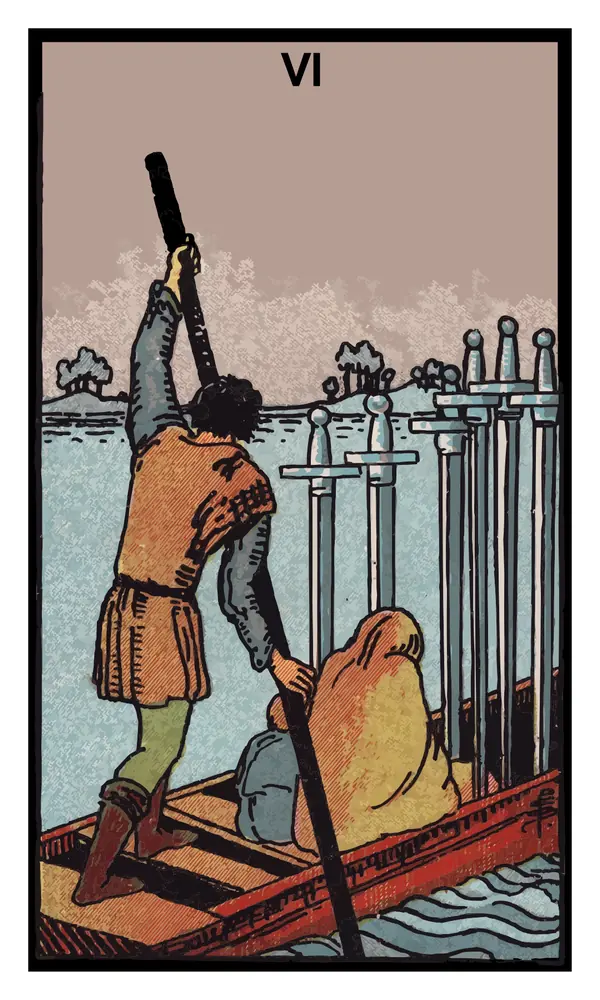
Six of Swords
The Six of Swords in the Rider-Waite-Smith tradition: hooded passengers, a ferryman, and a boat carrying upright swords across water.
Read about Six of Swords on Tarot Told Me (opens in a new tab)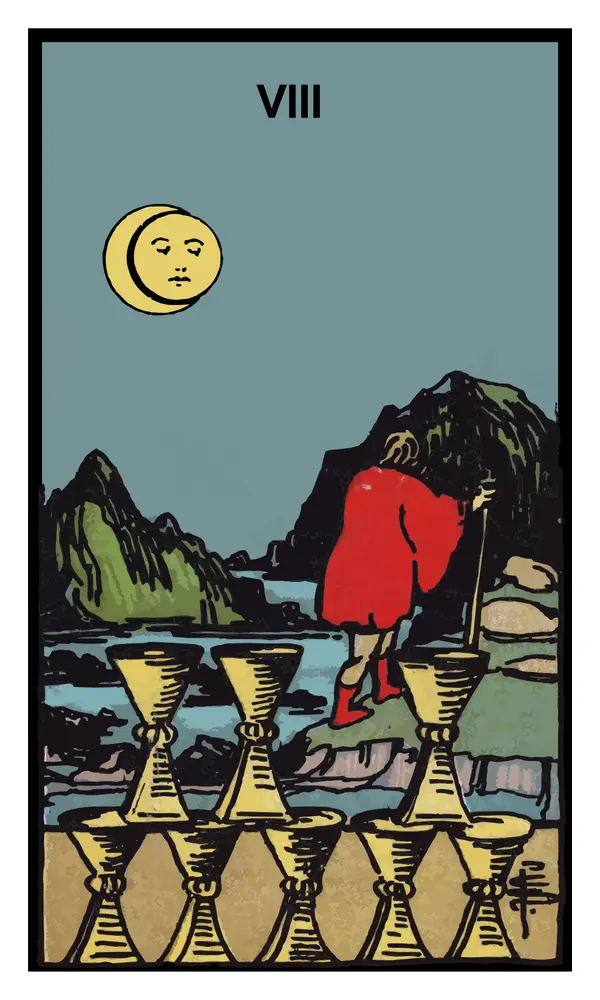
Eight of Cups
The Eight of Cups in the Rider-Waite-Smith tradition: a lone traveler with a staff walks away from eight arranged cups.
Read about Eight of Cups on Tarot Told Me (opens in a new tab)Many modern readers summarize the difference as being carried versus walking away. That shorthand is useful, but it is a modern interpretation and not a rule from the older sources. The rest of this article looks at what the pictures contain, so you can judge the shorthand for yourself.
What does each image actually show?
In the Rider-Waite-Smith version of the Six of Swords, a small group sits in a boat. The figures are wrapped in cloaks, and a ferryman stands at the back with a pole. Six swords stand upright in the boat. The water near the boat is rougher behind it and calmer ahead, which is why the card is so often linked to a crossing.
The Eight of Cups is a quieter, lonelier scene. A single figure in a cloak, carrying a staff, walks away between hills. Eight cups sit in the foreground, arranged so that one gap is visible, and a large moon hangs above the landscape.
So the first thing to notice is population. One card has company and a helper, and the other has a solitary walker with no one to steer.
How do the suits shape the two cards?
Swords is traditionally the suit of the mind: thought, decision, conflict, and the things we carry in our heads. Cups is tied to water and to emotional situations. Those associations color how each departure is read.
The swords in the boat are cargo. The passengers bring their thoughts, worries, and unresolved matters across the water with them, which fits the idea of a transition that is more mental than dramatic. Nothing in the picture says the troubles are gone.
The cups in the other card are things the figure has gathered and now leaves standing. They are feelings and investments, set out with care. Walking away from cups is therefore traditionally read as walking away from something emotionally meaningful, not from something merely unpleasant.
Who is moving, and who is deciding?
The clearest visual difference is agency. In the Six of Swords the passengers sit, and someone else does the work of moving the boat. In the Eight of Cups the traveler stands, holds a staff, and has turned their back on the cups.
That is why the Six of Swords is often described as a passive or assisted transition, and the Eight of Cups as an active, deliberate one. Neither word is a verdict on the person, though. Being carried can be a sensible choice, and walking alone can be a hard one.
Say you ask about a job that is ending. A reader might notice the Six of Swords and wonder whether the change is arriving through other people or circumstances. With the Eight of Cups, the same reader might wonder what they themselves are choosing to set down.
What did Waite write about each card?
A. E. Waite's Pictorial Key to the Tarot, illustrated by Pamela Colman Smith, gives short divinatory phrases. For the Six of Swords the list includes a journey by water, a route, a way, an envoy, a commissionary, and an expedient. The same text says the voyage will be pleasant. You can read this wording on a page that reproduces the Key entry (opens in a new tab).
Notice how practical that vocabulary is. Route, way, envoy, and expedient describe a means of getting somewhere, and they do not describe a feeling about it.
The Eight of Cups entry is available in the Pictorial Key text at Sacred Texts (opens in a new tab). It is worth reading directly instead of relying on summaries, since later writers often add their own emphasis. Here the card is described only through its common modern reading of a deliberate departure.
Is this really about leaving versus moving?
The phrase leaving versus moving is a useful lens, but it is interpretive. Neither card shows a house, a city, or a relocation. Both are symbolic pictures, and both can be read about work, relationships, habits, or inner attitudes just as well as about travel.
If you want to use the lens, here is one cautious way to frame it. The Six of Swords leans toward moving on in the sense of a transition with a destination, however vague. The Eight of Cups leans toward leaving in the sense of a decision to step away from something, even before the destination is known.
The Eight of Cups figure walks toward hills without a visible goal. The Six of Swords boat is heading for a visible shore. That contrast between an open road and a visible landing is the most reliable part of the comparison.
| Feature | Six of Swords | Eight of Cups |
|---|---|---|
| Suit | Swords, the mind | Cups, emotions and water |
| Figures | Passengers and a ferryman | One walker |
| Travel | By boat, assisted | On foot, alone |
| Destination | A shore in view | Hills, no clear goal |
| Usual modern reading | Passage toward calmer waters | Deliberate walking away |
What do the numbers six and eight add?
Numbers in tarot are a layer on top of the suit, and they should be handled gently. Sixes are often described as a point where trouble eases, or where some balance is found after harder cards. That fits a boat moving toward calmer water, though the swords in the boat show that the mind still carries its load.
Eights are often discussed in terms of movement and change of direction, and a figure turning away suits that. Benebell Wen's video transcript on the eights (opens in a new tab) compares the Eight of Cups in the Marseille and Rider-Waite-Smith decks. She notes that the imagery differs between the two traditions, and she places the card under the trigram Wind.
That comparison is a reminder that the walking-away scene belongs to one deck tradition in particular. Other decks can show the card quite differently, so it helps to know which deck you are reading.
How can you compare the two cards in your own reading?
When one of these cards turns up and you are unsure which sense fits, a short checklist can slow you down. Look at the picture first, and only then at any keyword list.
- Ask whether the scene has other people or helpers in it, and whether that matches your situation.
- Ask whether you are choosing the departure or whether it is arriving through circumstances.
- Notice whether a destination is visible, and whether you know yours.
- Note which of the two suits, mind or emotion, the question is really about.
A spread gives these questions some room, and a three-card layout is a simple place to begin.
Tool on Tarot Told Me
Three-card spread
A three-card spread gives each card a position, which makes it easier to see which one stands for the situation and which for the next step.
Questions to hold beside the two images
- Is there a ferryman in your situation, someone or something carrying part of the weight?
- What would the cups look like if you described them as things you built, not things you suffered?
- Which feels more accurate today: crossing toward a shore, or walking without one?
Can the two cards appear in the same reading?
Yes, and the order in which they appear changes how a reader might tell the story. An Eight of Cups followed by a Six of Swords can be read as a walk away that then turns into an assisted passage. The reverse order can be read as a crossing that ends in a decision to leave something behind.
These are narrative habits, and they are not fixed rules. Different readers will tell different stories with the same pair, and each story is only as good as the question and the layout behind it.
For a broader look at how neighboring cards are combined, see this guide.
Card combinations
How to read tarot card combinations
Tarot card combinations are read as a phrase, not as two separate answers. Here is a three-step method built on suits, numbers, and images, with a table of suit pairs.
· Taronica
For cards that are easy to mix up, see this one.
Card vs card
Similar tarot cards: how to tell them apart
Some cards share colors, figures or moods and are easy to confuse. Here is a calm method for comparing them by what is actually drawn.
· Taronica
Frequently asked questions
No. Waite's wording does include a journey by water, but modern readers more often treat the picture as a symbol of transition. Whether it points to a trip, a change of job, or an inner shift depends on the question and the reader.
The image is quiet and a little somber, but it is not a picture of disaster. In the tarot tradition it is commonly read as stepping away from something that no longer satisfies, which can be a hard choice and a considered one.
Neither card is specific to relocation. A reader might lean on the boat image for a move that involves help or a clear destination, and on the walking figure for a move that starts with a decision. For a real move, practical and legal matters belong with the relevant professionals.
No. This article describes the Rider-Waite-Smith imagery, first published by William Rider and Son in 1909. Other traditions, such as the Marseille decks, show these cards differently, so check your own deck first.
The ferryman is what separates a carried passage from a solo walk. He suggests that the traveler is being helped, and that the crossing is being steered by someone other than the passenger.
Sources
- Pictorial Key to the Tarot, Eight of Cups (Sacred Texts) (opens in a new tab)
- Six of Swords, Pictorial Key text reproduced (opens in a new tab)
- Six of Swords on the Tarot Wiki (opens in a new tab)
- Benebell Wen - video transcript on the eights (opens in a new tab)
- Wikipedia - Suit of cups (opens in a new tab)