The Tower vs Death: sudden break or gradual passage?
The Tower and Death are the two Major Arcana cards people fear most, yet they picture loss in different ways. Here is how their images, numbers and history set them apart.
By TaronicaPublished
In short
- A tower vs death tarot comparison comes down to pace and manner: the Tower is traditionally pictured as a sudden break, Death as an ending that passes through a scene.
- The sudden-versus-gradual contrast is this site's own framing, not a rule of the tradition, so it works best as a lens rather than a verdict.
- Both are Major Arcana cards, and both are often misread as predictions of disaster, which neither one is.
What separates the Tower from Death?
In a tower vs death tarot comparison, the short answer is pace and manner. The Tower is traditionally pictured as a structure struck all at once, while Death is pictured as an ending that moves steadily across the ground it clears. Both cards deal with loss, but they show different kinds of it.
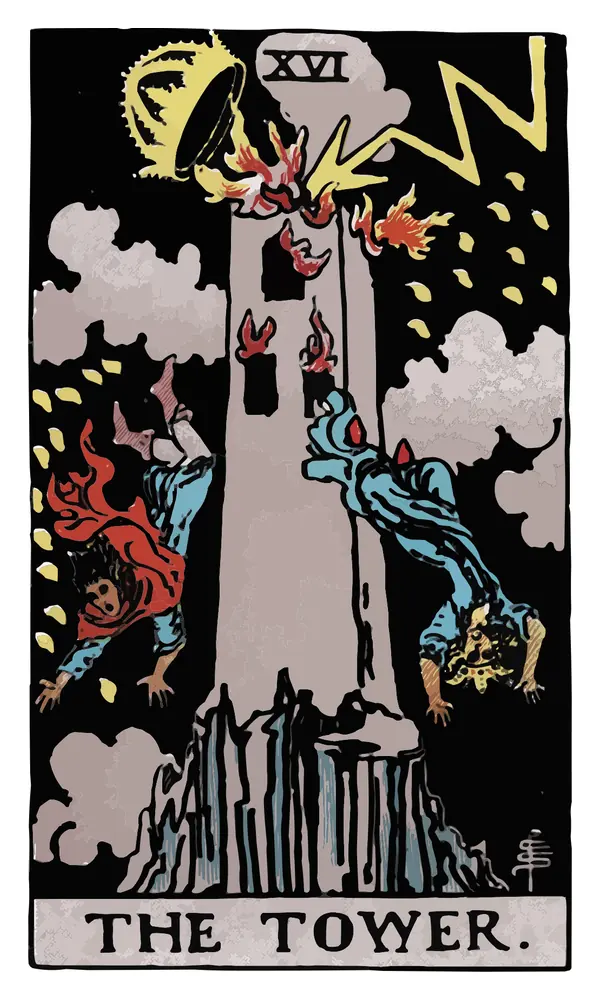
The Tower
The Tower in the Rider-Waite-Smith tradition: a crowned tower on a cliff, lightning, flames and two falling figures.
Read about The Tower on Tarot Told Me (opens in a new tab)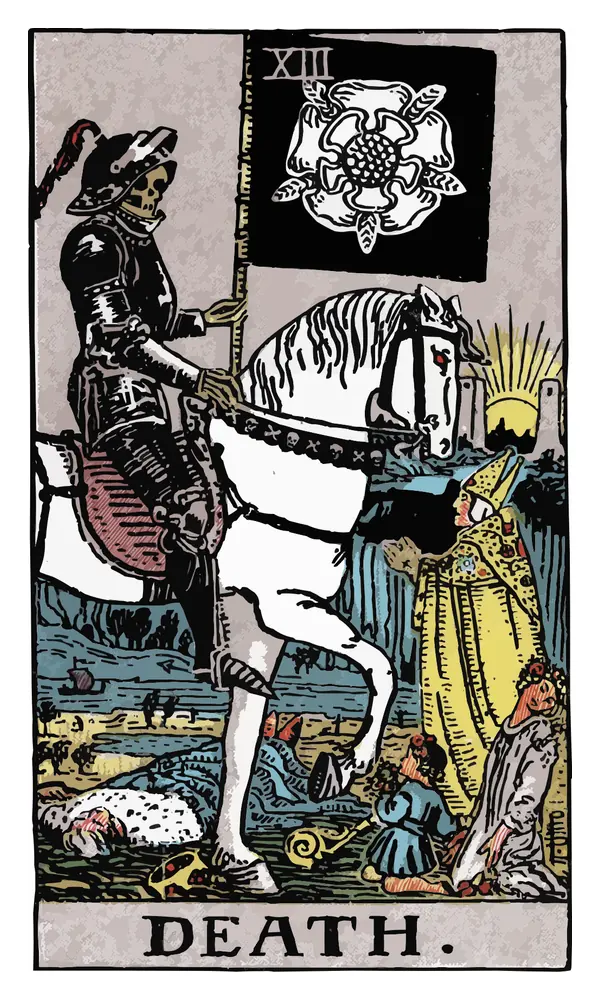
Death
Death in the Rider-Waite-Smith tradition: an armored skeleton on a white horse moving past a fallen king and other figures.
Read about Death on Tarot Told Me (opens in a new tab)One caution before going further. Tarot sources describe the Tower as abrupt, and they describe Death as transition and ending, but none that we reviewed calls Death slow. So "sudden versus gradual" is our angle on the pair. Use it to look at the pictures more closely, and drop it wherever the images argue against it.
How do the two images differ?
In the Rider-Waite-Smith deck, the Tower shows a tall building on a cliff, struck by lightning, with two figures falling from it. The Victoria and Albert Museum describes the image in much those terms. Nothing in the picture is settled: a crown is knocked loose, flames break out of the windows, and the ground is far below.
Aeclectic Tarot points out that the image puts the viewer in the middle of the action, like a frozen frame from a film of the strike. That is a useful observation. You see no before and no after, only the instant.
Death is staged differently. A skeleton in dark armor rides a white horse, and the people in front of the horse react in different ways: one lies fallen, others kneel or look away. In the distance, the sun sits between two towers. The scene has a direction and a rhythm, closer to a procession than to a flash.
What do the numbers 16 and 13 add?
The Tower is card XVI in the Rider-Waite-Smith deck, and Death is card XIII. Numbers in the Major Arcana work as positions in a sequence, so they tell you where each card sits on the Fool's path rather than what it does.
Death is the thirteenth trump, just past the middle of the run from the Fool to the World. The Tower comes later, in the stretch that leads toward the final images. Some readers like to say that Death belongs to the turning point of the story and the Tower to its late tests.
Treat that as a reading habit, not a fact about the cards. The popular fear of the number thirteen is a separate cultural story, and it does not explain why the card is placed where it is. The ordering simply follows the sequence the deck inherited.
How did each card get its name?
Death carries a notable naming history. The Tarot of Marseilles and the Visconti-Sforza deck leave the name off this card, and it is sometimes called The Card with No Name. Readers often take that as a hint that the image points to something broader than literal death.
The Tower's older titles differ from deck to deck, and some historical decks use other names for it. We do not list them here, because we have not checked them against a museum or scholarly source. The Rider-Waite-Smith version is the one most people know today.
That deck was designed by Pamela Colman Smith (1878-1951), commissioned by A. E. Waite in 1909. The V&A dates the first printing of its Tower card to 1910, with a reprint in 1916. Waite's 1910 book The Pictorial Key to the Tarot gives divinatory associations for Death, and later writers have built on both sources.
Is Death really slow and the Tower fast?
Not always, and this is where the framing needs honesty. Endings that Death is associated with can arrive quickly, such as a contract that closes or a season that ends. What the card emphasizes is passage: something finishes, and the scene keeps moving.
The Tower, by contrast, is associated with structures that fail. Aeclectic Tarot reads it as false structures, institutions and beliefs collapsing suddenly, violently and all at once. That is a modern interpretation, but it fits the picture well.
A more precise contrast might be rupture against conclusion. The Tower interrupts something that was still standing. Death finishes something whose time was already running out. SelfGazer, a modern blog, describes Death as a card of necessary endings that make room for new beginnings, and says it rarely points to physical death.
How do they compare at a glance?
The table below sums up the contrast in this article. It mixes what the images show with common modern readings, so it is a guide for comparison and not an official list.
| Aspect | The Tower | Death |
|---|---|---|
| Number | XVI | XIII |
| Central image | Lightning, falling figures | Rider on a white horse |
| Pace in the picture | One frozen instant | A steady procession |
| Common modern theme | Collapse of false structures | Necessary ending, passage |
| What is left | Open ground, exposure | A cleared space, a rising sun |
| Typical misreading | Pure catastrophe | Literal death |
Where do readers confuse the two?
The most frequent mix-up is treating both as the same warning in different clothes. In practice, the Tower is usually discussed in terms of shock and exposure, and Death in terms of closure and what comes next. Swapping them flattens a useful distinction. A helpful habit is to name which picture your situation resembles and to say why, before reading anything into the card.
A second mix-up is reading either one as a forecast. A card knows nothing and decides nothing, and in the tarot tradition each is read as a symbol to reflect on. Neither says what will happen to you or to anyone else.
When both appear in the same spread, some readers see a sequence: a break, then a passage. Others see two descriptions of one situation. Both approaches are interpretations. For a longer treatment of the pair, see the related article below.
Card combinations
The Tower and Death together: how the pair is read
Two of the most feared trumps side by side: what each one shows, why the pairing is a modern habit, and how order and position can shape a reading.
· Taronica
How to tell them apart in a reading?
Say you draw one of the two cards while thinking about a job that is ending. Before you reach for a meaning, slow down and compare what you see on the card with what you know about the situation. A few steps help:
- Describe the picture in one plain sentence, without interpreting it.
- Ask whether the situation felt like an interruption or a conclusion.
- Note what remains standing afterward, if anything.
- Write one sentence about what you can control, and leave the rest.
If the question touches money, health or legal matters, a professional is the right person to ask, not a card.
Tool on Tarot Told Me
Three-card spread
Try a three-card spread to see how a card sits between what came before and what follows.
What is worth remembering?
The Tower and Death share a tradition of being feared, and both are easier to read once the fear is set aside. The Tower pictures a structure breaking. Death pictures a passage and a clearing. Neither is a verdict. Seen side by side, they offer two vocabularies for loss, one of interruption and one of closure, and a reader can borrow either word without claiming that a card has decided anything.
The contrast of sudden and gradual is a handy first step, not the last word. Return to the images, the numbers and the history, and let them correct you where the shortcut fails.
Frequently asked questions
Neither card is worse in the tradition. The Tower is often discussed with more shock and Death with more finality, but both are read as symbols of change, and both can lead toward clearer ground.
Modern sources, such as SelfGazer, say the card rarely points to physical death. Its older nameless version in the Marseilles tradition is often taken to imply a broader idea of ending and transition.
Tarot does not rank the Major Arcana by strength. The Tower sits at XVI and Death at XIII, but a higher number does not make a card more forceful, only later in the sequence.
Yes. Some readers see a break followed by a passage, others see two angles on one situation. Which fits depends on the position each card occupies and on your own circumstances.
It is the thirteenth trump in the usual order of the Major Arcana. The reputation of the number thirteen is a separate cultural idea and does not explain the placement.