The Tower and Death together: how the pair is read
Two of the most feared trumps side by side: what each one shows, why the pairing is a modern habit, and how order and position can shape a reading.
By TaronicaPublished
In short
- The tower and death tarot pairing brings together a sudden collapse and a quiet ending, two images of change that work at different speeds.
- The pair is a modern interpretive habit, not an old rule, so any reading of it is a framework rather than a fact.
- Order, position and your own question do more to shape the reading than the two names alone.
What is the tower and death tarot pairing?
The tower and death tarot pairing is what readers call it when the Tower (trump XVI) and Death (trump XIII) fall next to each other in a spread. Both belong to the Major Arcana, and both are traditionally read as cards of change rather than of comfort. That shared theme is why the pair gets so much attention online.
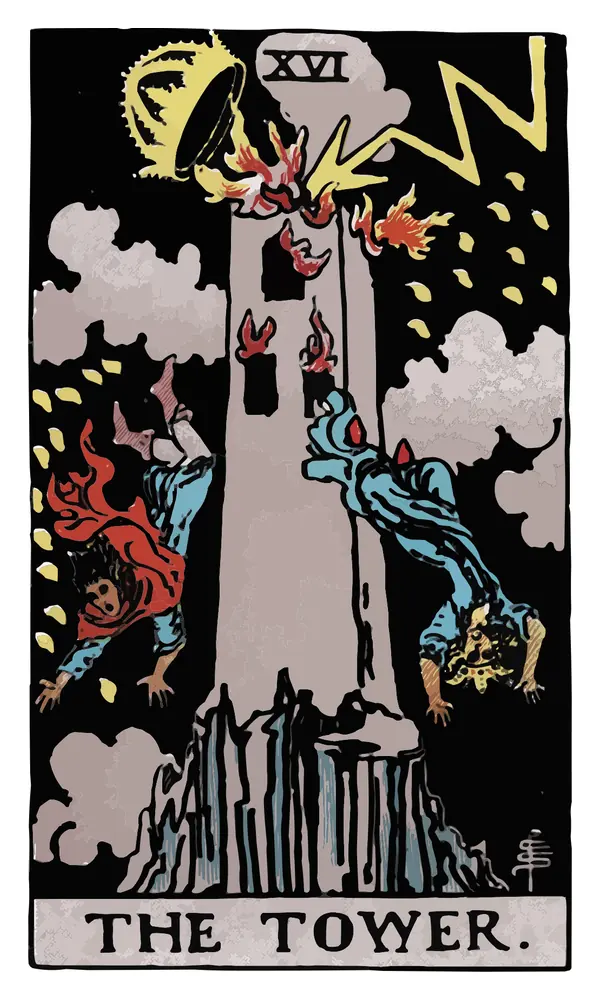
The Tower
The Tower in the Rider–Waite tradition: a crowned structure struck by lightning, with two figures falling from it.
Read about The Tower on Tarot Told Me (opens in a new tab)The two cards are not twins, though. One shows an event arriving from outside, and the other shows a process that has been moving for some time. Reading them together is mostly a matter of noticing how those two speeds meet.
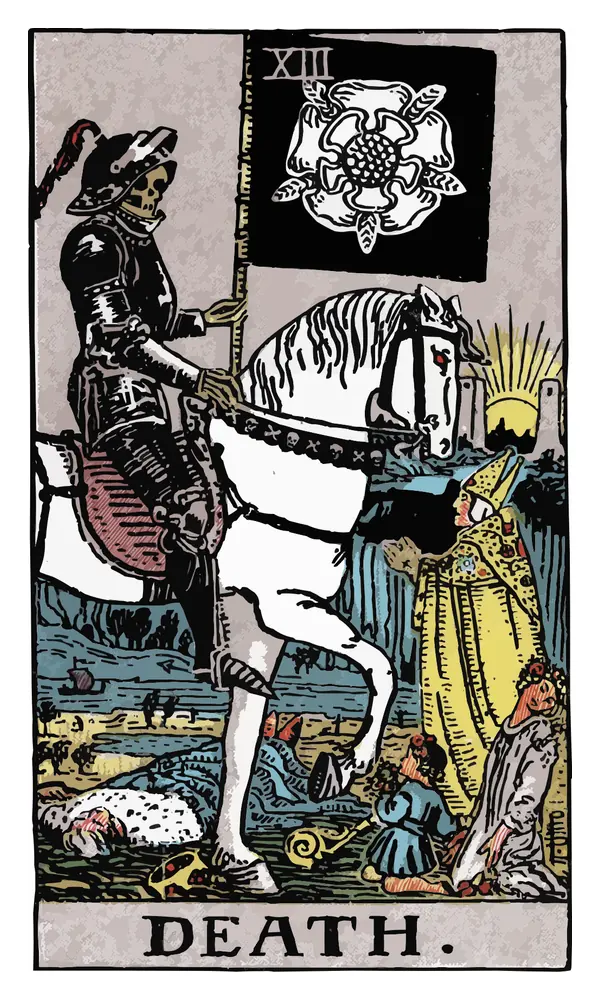
Death
Death in the Rider–Waite tradition: a skeleton in armor on a white horse, moving through a crowd.
Read about Death on Tarot Told Me (opens in a new tab)This article treats the pair as a tool for thinking, not as a verdict. It looks at the images, the history, the order of the cards and the questions a reader might ask.
How do the two images differ?
In the Rider–Waite deck, the Tower is a tall structure on a rock, hit by a bolt of lightning. Its crown is knocked off, flames come out of the windows, and two figures tumble through the air. The mood is shock, noise and speed.
Death looks very different. A skeleton in black armor rides a white horse at an unhurried pace, carrying a flag with a white rose. People of different ranks stand or kneel in its path, and a sun rises between two towers in the background. The mood is stillness and inevitability rather than shock.
Put side by side, the contrast is useful. The Tower is the structure that breaks, and Death is the passage that follows an ending. One is closer to an interruption and the other closer to a threshold.
Both cards also pull on the same symbolic material: things built to last, and the limits of that effort. The Tower tests a structure from outside, while Death shows time doing its ordinary work.
Where do the names and pictures come from?
The Tower is a trump in most Italian-suited tarot decks, but it is not in every early deck. Some early painted sets, such as the Visconti-Sforza tarot, do not contain it. Older French and Belgian decks call it La Foudre, "The Lightning," and the Marseilles pattern shows a burning tower struck from the sky with its top section dislodged.
Death has its own naming quirks. In the Marseilles and Visconti-Sforza traditions the card carries no name at all and is known as "The Card with No Name." Some modern decks soften the title to "Rebirth" or "Death-Rebirth." The figure is usually the Grim Reaper.
The imagery most English-speaking readers know comes from the Rider–Waite deck. It was first published by William Rider & Son in 1909, designed on instructions from A. E. Waite and illustrated by Pamela Colman Smith. Waite's The Pictorial Key to the Tarot followed in 1910 with Smith's illustrations, and it shaped much of the vocabulary readers still use.
The point for combinations is simple: names and pictures vary by deck. A reading of the pair that leans on the word "Death" or on a particular drawing of the Tower may not carry over to a deck that draws them differently.
Is there a traditional meaning for the pair?
No. The old sources give no standard rule for this pairing, and combination reading is modern interpretive material rather than historical tradition. What exists is a set of contemporary website readings that tend to agree on a general mood.
Several of them frame Death as the natural ending of a cycle and the Tower as sudden upheaval. One describes Death as composting what has finished while the Tower clears the ground with sudden, revealing force. Another calls the pair a total upheaval with a chance for deep transformation, and a third reads it as a major life transition.
You may see claims that the pair in a love question points to letting go of a relationship. That is one site's reading, not a rule, and it is worth treating as a prompt for your own reflection. Nothing in the cards decides what happens in a relationship.
A reasonable summary is this: the pair is usually read as intense, and usually read as a turning point. How you apply that depends on your question, your deck and your own judgment.
Does the order of the cards matter?
Here the sources run out. There is no agreed rule about Death then Tower versus Tower then Death, so any order-based reading is an interpretation, and the following is ours, offered as one way to think.
Say you draw Tower first and Death second. You might read it as a rupture followed by an acceptance: the structure falls, and then comes the slower work of letting it be over. The pair then looks like a sequence from shock to settling.
Say you draw Death first and Tower second. You might read it as an ending that was already underway when something sudden forced the matter. The pair then looks like a slow process finally meeting its decisive moment.
Neither version is more correct. They are two ways of telling a story with the same two characters, and it is fine to try both and see which one asks better questions of your situation.
How does position change the reading?
In a spread, the slot a card sits in gives it a role. A Tower in a "past" position invites different questions than the same card in a "challenge" position. The pair inherits that logic, and the positions often matter more than the cards themselves.
Here are a few common ways to place the pair:
- Both in the past: a look back at something that ended, and at how it ended, abruptly or gradually.
- Both in the present: a prompt to ask what is already finished and what is being forced to change.
- One in the past and one in the future position: a way of comparing how change arrived before with how you might meet it next.
- Side by side in a single slot, as with a two-card draw: the pair as a theme, with no timeline attached.
Adjacent cards can also color the pair. A gentle card nearby may soften the tone of the whole line, and a heavy one may deepen it. Some readers also pay attention to reversals, but conventions differ, so keep to the approach you already use.
Which questions can you ask yourself?
A combination is most useful when it opens questions rather than closing them. These are written to be asked of yourself, not of the cards, and they do not require you to believe anything about the pair.
- What in my situation has already ended, even if I have not said so aloud?
- What feels sudden, and what has actually been building for a long time?
- Which parts of this structure were holding things up, and which were just habit?
- If the ending is real, what would I want to keep from it?
- What would a slower, more deliberate version of this change look like?
Notice that none of these asks what another person thinks or will do. They stay with what you can observe and decide. If a question touches health, money, legal matters or safety, a qualified professional is the right person to ask, not a spread.
How can you read the pair in a spread, step by step?
Start with the layout, not the cards. Decide what each position stands for before you draw, so that the pair has a frame to sit in. A simple past, present and future line works well for a first try.
Then describe each card's image in plain words, before any meaning. Say you draw the Tower in the present and Death in the future: you might write down "a structure breaks" and "a figure rides on, unhurried." Only after that, ask how the two descriptions relate to the question you started with.
Finally, write one or two sentences that begin with "I might consider..." rather than "this will happen." That wording keeps the reading conditional and keeps the decision with you.
Tool on Tarot Told Me
Three-card spread
Try a three-card draw and see where the Tower and Death land in the line.
What are the limits of this reading?
The first limit is evidence. There is no historical rule for this pairing, and the online readings are interpretations written by modern authors, many of which repeat one another. That does not make them useless, but it does mean confidence should stay modest.
The second limit is the deck. Names, numbers and drawings differ between traditions, and the notes on numbering in non-Waite decks deserve a check before you rely on them. A reading built on Rider–Waite imagery may not translate to a Marseilles-style deck without adjustment.
The third limit is what a spread can do. It can organize your thinking, and it cannot predict an outcome or replace advice from a doctor, lawyer, financial adviser or counselor. Treat the pair as a way of noticing something, then act on what you decide yourself.
Frequently asked questions
No. Both cards are intense, but tradition links them with endings and clearing rather than with simple misfortune. Many readers see the pair as a prompt about change and what comes after it.
In the tarot tradition it is generally read as a symbol of ending and transition, not a literal event. Some decks soften the title to "Rebirth" for that reason, and the Marseilles tradition leaves the card unnamed.
Tarot has no official ranking of power between them. The Tower is usually associated with sudden disruption and Death with a deeper, slower closing of a chapter, so they speak about different kinds of change.
Yes, but check how your deck draws and names the cards. The Tower may be called La Foudre, and Death may appear unnamed or as Rebirth, which can shift the tone of what you notice.
A draw is a picture to think with, not a forecast. If something in your life feels uncertain, use the pair to ask questions, and speak with a professional about anything involving health, money, law or safety.