The Lovers and the Devil together: choice and attachment
What does it mean when the Lovers and the Devil appear side by side? This guide separates what the tradition records from what modern readers add, and shows how to read the pair as choice versus attachment.
By TaronicaPublished
In short
- The lovers and devil tarot pairing sets two Major Arcana cards side by side: one traditionally linked with choice, the other with attachment.
- This pair is not a fixed combination from tarot history; it is a modern reading habit built on how the two images relate.
- A useful reading asks where a choice is still open and where a habit or bond may have started to feel like a chain.
What is the lovers and devil tarot pairing?
The lovers and devil tarot pairing is a modern way of reading two Major Arcana cards together, the Lovers and the Devil, as a contrast between choosing and being bound. Neither card was designed to be paired with the other, and old sources do not describe the pair as a combination. What exists is a reading practice, and it is worth treating as exactly that.
The appeal is easy to see. The Lovers is commonly connected with relationships and decisions, while the Devil is commonly connected with bondage, desire and compulsion. Put them together and a natural question appears: is this a bond you chose, or one you have stopped examining?
- The Lovers
- The Devil
This article describes the structure behind the pairing: numbers, images, history and the limits of the reading. It does not predict what any person will do, and it does not tell you what to decide.
Where do the two cards sit in the Major Arcana?
The Lovers is the sixth trump in most traditional decks, and the Devil is the fifteenth. In the traditional Marseille order these are numbered VI and XV. In the Rider-Waite deck, two other cards swap places at positions 8 and 11, but the numbers 6 and 15 stay as they were.
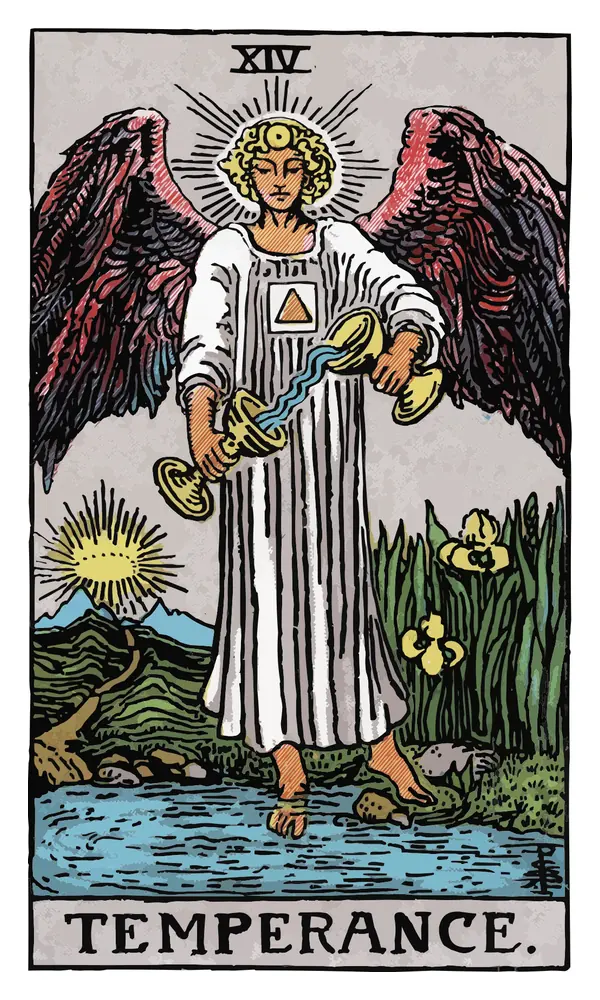
The Devil comes right after Temperance, which is XIV. That neighbor matters for anyone who reads the sequence as a story: a card of blending and moderation is followed by a card of excess.
Temperance
Temperance, the fourteenth trump, which comes immediately before the Devil in the traditional order.
Read about Temperance on Tarot Told Me (opens in a new tab)The gap between 6 and 15 is nine places. Some readers like the arithmetic, since 6 plus 9 gives 15, and 1 plus 5 reduces to 6. It is a tidy numerical echo, though it is a reading device and not a historical design. You can enjoy it without leaning on it.
How do the images of the two cards compare?
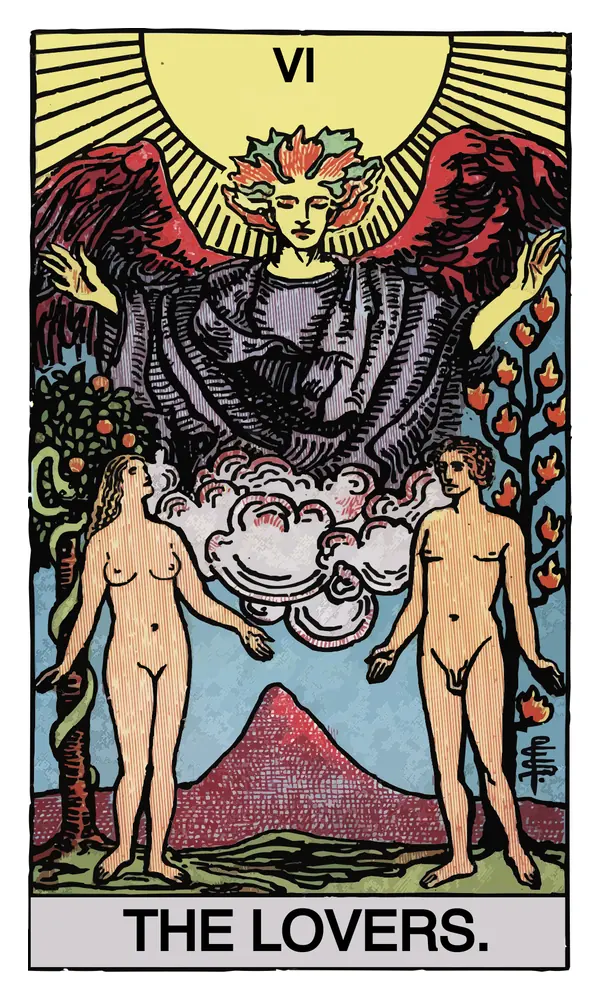
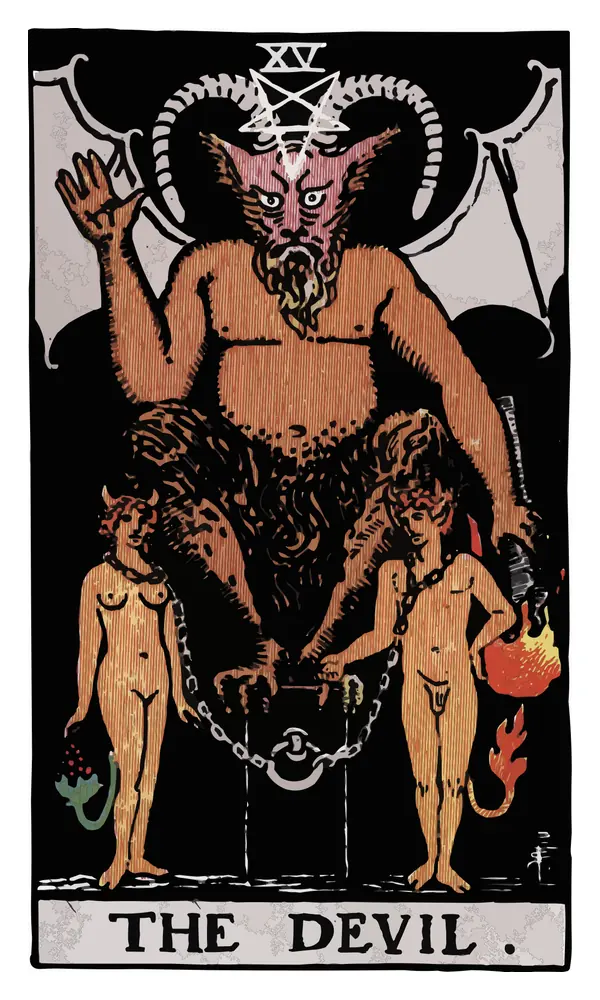
The Rider-Waite-Smith versions invite comparison. The Lovers shows Adam and Eve in Eden beneath an angel, possibly Raphael, with a tree and a serpent in the scene. The Devil shows a horned figure above two smaller human figures who stand before him.
Many writers say the Devil mirrors the Lovers, with a pair standing before a larger figure in both cards. This is an interpretive claim, and it is best credited to the authors who make it, such as Waite himself or Robert M. Place, rather than stated as settled fact.
A few details are often discussed side by side:
- A single figure presides in each card: an angel above, a horned creature above.
- Two human figures appear below in both images.
- A tree and a serpent belong to the Lovers scene, which already hints at temptation.
- In the Devil, the pair appear with chains around their necks, though readers often note the chains look loose.
That last point is a common observation and leads to the central question of the pairing.
Why read choice against attachment?
The angle of choice versus attachment rests on two traditions. Some traditions read the Lovers as relationships and choices. Waite's 1910 Pictorial Key to the Tarot lists attraction, love, beauty and trials overcome among its divinatory associations. For the Devil, Waite's keywords point toward bondage and the weight of material things.
The chains-versus-choice reading of the Devil is modern interpretation, not historical fact. It is the idea that the bonds shown are not locked, and that the figures could step away. Readers who use it are offering a lens, and the lens may or may not suit your question.
Seen through that lens, the pair does not describe good love against bad love. It asks about awareness. A bond can be chosen and still be examined, or it can be comfortable and unexamined, and the two cards are a convenient shorthand for that difference.
A choice you can still revisit and a bond you no longer notice look very different from the inside.
How did the Lovers change over the centuries?
The earliest Lovers images were less about romance than about a decision or a blessing. Older decks show a couple receiving a blessing from a noble or a cleric, usually with three figures in the scene. The card sometimes appears under names meaning love or the lovers, and its scene reads more like a ceremony than a dilemma.
Waite reduced the figures from three to two. That change strengthens the link to Gemini, the astrological sign of the twins, and it moves the card toward the Eden story. In the Rider-Waite-Smith deck, which William Rider & Son of London first published in 1909 with art by Pamela Colman Smith, the image is closer to a moment of awareness than a wedding.
This history matters for the pairing. The idea of the Lovers as a card about choice is partly a result of how designers reshaped it. When someone says the Lovers is about choosing, they are describing a tradition that has layers, and not a single fixed meaning.
What does the Devil show in the Marseille and RWS decks?
The two best-known Devil designs look quite different. The Marseille Devil is a composite creature with a face on the belly and eyes on the knees, standing above two small figures. It reads as a strange hybrid more than a personal portrait.
The Rider-Waite-Smith Devil is partly derived from Eliphas Lévi's Baphomet illustration in Dogme et Rituel de la Haute Magie, published in 1855. It has ram horns, bat wings, harpy feet and an inverted pentagram on the forehead. His raised right hand and lowered left hand hold a torch.
These details show that the Devil is a constructed image, assembled from earlier sources, and not a literal figure the deck endorses. For a reader, this is useful. The card pictures a pattern, such as fixation or dependence, in a dramatic form. It does not claim that a person or a relationship is evil.
How do position and neighbors change the pairing?
The same two cards can be read in different ways depending on where they fall. In a spread, order and position carry meaning that no list of keywords can supply. Say you ask about a long-term commitment and the Lovers lands before the Devil in a row of three. One reading is that a decision came first and a sense of obligation followed.
Reverse the order and the emphasis changes. With the Devil first and the Lovers after it, a reader might note a pattern that is being looked at and a choice appearing in response. Both are readings, not facts, and both depend on the question you brought.
The card between them also shifts the tone. A card of rest, of conflict or of reconciliation can soften or sharpen the pair. For a broader view of how pairs and triples work, see the guide below.
Card combinations
How to read tarot card combinations
Tarot card combinations are read as a phrase, not as two separate answers. Here is a three-step method built on suits, numbers, and images, with a table of suit pairs.
· Taronica
How to read the lovers and devil pair step by step?
A short, structured method keeps the reading grounded. Take a notebook and work through the pair in a fixed order, so that the cards do not become a mirror for whatever mood you are in.
- Write your question in one plain sentence, without asking what another person feels or intends.
- Describe each image in two lines, before using any keyword.
- Name one thing in your situation that you chose and one that you simply kept doing.
- Note which feels lighter to describe, and which feels heavier.
- Close with one small, reversible step, not a verdict.
If the question touches health, money, legal matters or safety, the cards are not the right authority, and a qualified professional is. The pair can help you phrase what you want to ask, but it cannot replace that advice.
Tool on Tarot Told Me
Three-card spread
A three-card spread gives the pair a position and a neighbor, so you can compare past, present and next step.
What should this pairing not be used for?
The pairing is easy to overread. It is not a test of whether a relationship is healthy, and it is not a way to judge anyone else's motives. The cards know nothing about the people in your life, and a reading cannot say what another person thinks or will do.
It also should not be taken as a warning about desire. The tradition around the Devil includes pleasure, ambition and material life, and the card is often read as an invitation to notice how much of that is a choice. That reading is gentler than the stern one, and it fits the calm tone of this site.
What the pair can do is offer vocabulary. It gives you two images to describe a familiar tension: the feeling of having chosen something, and the feeling of having ended up somewhere. If that helps you think more clearly, it has done its job.
Questions to sit with
- Which part of this situation did I actively choose?
- Which part have I kept simply because it is familiar?
- What small, reversible step would show me more clearly?
Frequently asked questions
Not in the historical sense. The sources found give no tradition of reading these two cards as a fixed pair. It is a modern reading practice, and its value depends on how well it helps you think about your question.
No. The Devil is traditionally read as bondage, attachment or fixation, and that can apply to habits, work or money as easily as to relationships. If you have concerns about your safety or wellbeing in a relationship, speak with a qualified professional.
The Rider-Waite-Smith designs both show a pair of human figures below a larger central figure. Some authors read the Devil as a kind of mirror of the Lovers for this reason. It is an interpretive observation and not a documented design intention.
In the traditional Marseille order they are VI and XV. The Rider-Waite deck swaps two other cards, but keeps 6 and 15 as they are. Some modern decks reorder or rename cards, so it is worth checking the deck in your hands.
Readers differ. Some treat a reversed card as a softer or blocked version of its upright meaning, and others ignore reversals entirely. Choose one approach before you start and keep to it.
Sources
- Wikipedia - The Lovers (tarot card) (opens in a new tab)
- Wikipedia, The Devil (tarot card)
- Wikipedia - Rider-Waite Tarot (opens in a new tab)
- Arthur Edward Waite, The Pictorial Key to the Tarot (1910)