Full moon tarot spread for reflection
A five-card layout with questions about yourself, built for the night of a full moon. It uses no wishes and no forecasts, only a calm structure for looking back over the month.
By TaronicaPublished
In short
- This full moon tarot spread has five positions and treats the full moon as a prompt to look at your own month, not as a source of answers.
- It is a modern layout designed by this site, because no historical tarot tradition ties the cards to moon phases.
- You can lay it on the night itself or any evening nearby, with any deck.
What is a full moon tarot spread?
A full moon tarot spread is a layout of cards read around the time of a full moon, with positions that ask what has become visible over the past weeks. The one below uses five cards and five questions about you: your habits, your energy, what you carry and what you might set down. It makes no forecast and asks for no wish-making.
The idea is simple. The full moon is the point in the lunar cycle when the moon appears fully lit, which makes it a convenient marker for a pause. Tarot supplies images that give that pause some structure.
Does tarot have a history with moon phases?
Not that we can document. The oldest surviving tarot cards are the Visconti-Sforza set, made in northern Italy shortly after 1450 according to The Met (opens in a new tab). At the time the cards were called trionfi, and they were used for a card game.
We found no reliable source linking tarot to lunar phases in those early centuries. Full moon spreads belong to the modern habit of pairing tarot with the sky, and they are best described that way: a contemporary practice, not an inherited rite.
That is why this article presents the layout as our own design. Nothing here has an old authority behind it, and it does not need one. A spread is a tool for organizing attention, and it works or does not work by how useful the questions are to you.
When is the next full moon?
The next full moon after today, November 15, 2026, falls on November 24 at 9:53 a.m. EST (1453 GMT), according to Space.com's calendar (opens in a new tab). It is traditionally called the Beaver Moon. The last full moon of 2026 is the Cold Moon on December 23 at 8:28 p.m. EST, which is already December 24 in GMT.
That last detail matters. Dates shift with time zones, so the full moon you see on your calendar may land a day earlier or later than a table written for another region. Check a calendar for your own location if the exact day matters to you.
In practice, the exact minute is not important for a reflective spread. The evening before, the night of, or the evening after all give you a nearly full moon and the same quiet occasion to sit down with your cards.
How is the spread laid out?
The spread uses five cards placed in a rough circle, like a moon seen from the front. Position one sits at the top, then you move clockwise, and position five sits at the center. Reading the center last gives the spread a sense of arriving somewhere.
| Position | Name | The question it poses |
|---|---|---|
| 1 (top) | Full light | What is clearly visible in my life right now? |
| 2 (right) | Shadow side | What have I been avoiding looking at? |
| 3 (bottom right) | Tide | Where is my energy rising or draining? |
| 4 (bottom left) | Release | What could I set down without losing myself? |
| 5 (center) | Return | What do I want to carry into the next weeks? |
The names are only labels. If you prefer different words, change them, as long as each position keeps one clear question.
What does each position ask?
Each position is phrased as a question about you, never about another person. That keeps the reading in your hands and avoids guessing at what anyone else thinks.
- Full light looks at what has become obvious since the last new moon: a pattern, a mood, a decision that has been taking shape.
- Shadow side asks about what you tend to skip. It could be a task, a feeling or a conversation you keep rescheduling.
- Tide is about energy. Say you ask where your time went this month; this position invites you to notice which commitments fill you up and which empty you out.
- Release is not about getting rid of people or things. It asks about habits, expectations or tasks that have outlived their use.
- Return gathers the rest into one modest intention for the coming weeks, phrased as something you might try, not something you demand.
Notice what is missing: no position asks for a result, a timeline or a wish granted. The spread is built to describe, not to promise.
Which cards tie in with the moon in the deck?
Any deck works, but three cards often come to mind for a moon-themed layout because of their imagery. You do not need them to appear, and no card should be treated as required.
The first is The Moon. In the Rider-Waite-Smith deck, drawn by Pamela Colman Smith for the 1909 pack that A. E. Waite commissioned, it shows a moon above a dog, a wolf and a crayfish, with two towers in the distance. Traditionally it is read as a card of uncertainty and half-seen things.
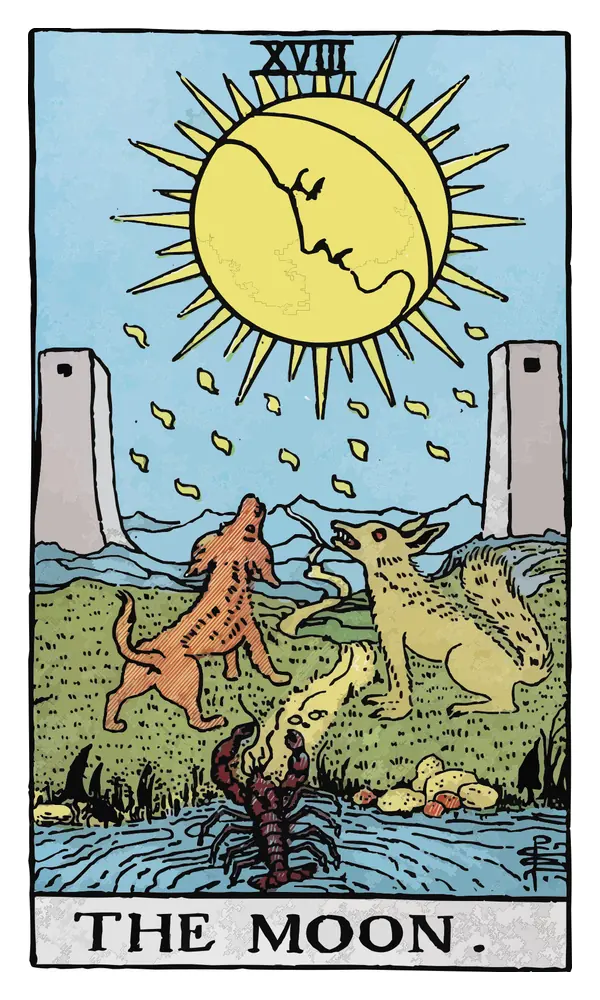
The Moon
The Moon in the Rider-Waite-Smith tradition: a moon face above a dog, a wolf and a crayfish on a winding path.
Read about The Moon on Tarot Told Me (opens in a new tab)The Star, in the same deck, shows a woman kneeling at a pool, pouring water, under a large star and seven smaller ones. In the tarot tradition it is associated with calm and renewal after strain, which is why it is often compared with the Moon. Our separate article on the pair follows the card.
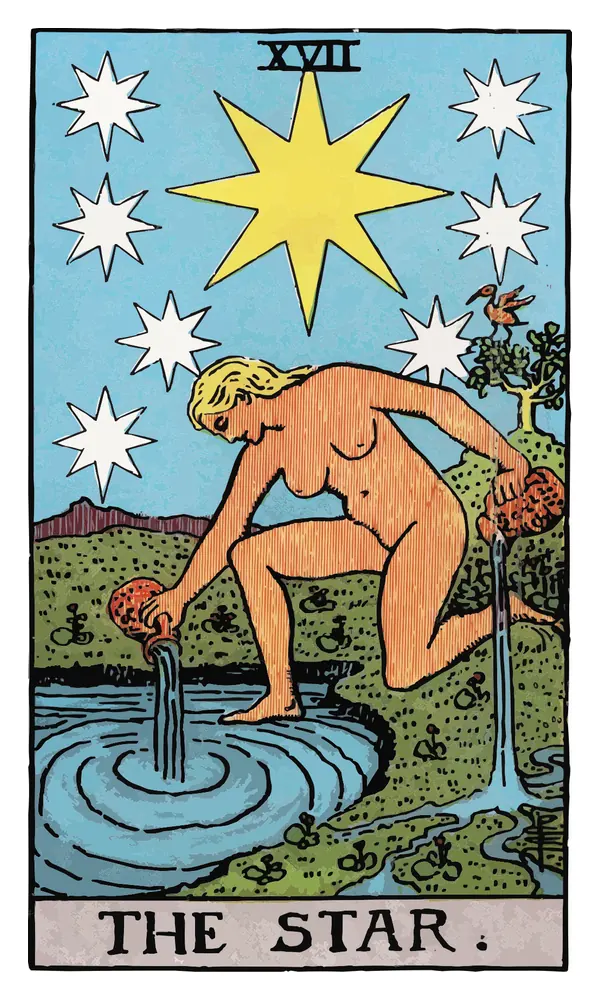
The Star
The Star: a kneeling figure pours water onto land and into a pool beneath a night sky of eight stars.
Read about The Star on Tarot Told Me (opens in a new tab)Card combinations
The Star and the Moon together: hope in uncertain light
What does it mean when the Star and the Moon land in one spread? Here is how the two neighboring cards are built, what they share, and how the tradition reads them as a pair.
· Taronica
The High Priestess is the third. She sits between two pillars with a crescent moon at her feet, and tradition links her with the unspoken and the inward.
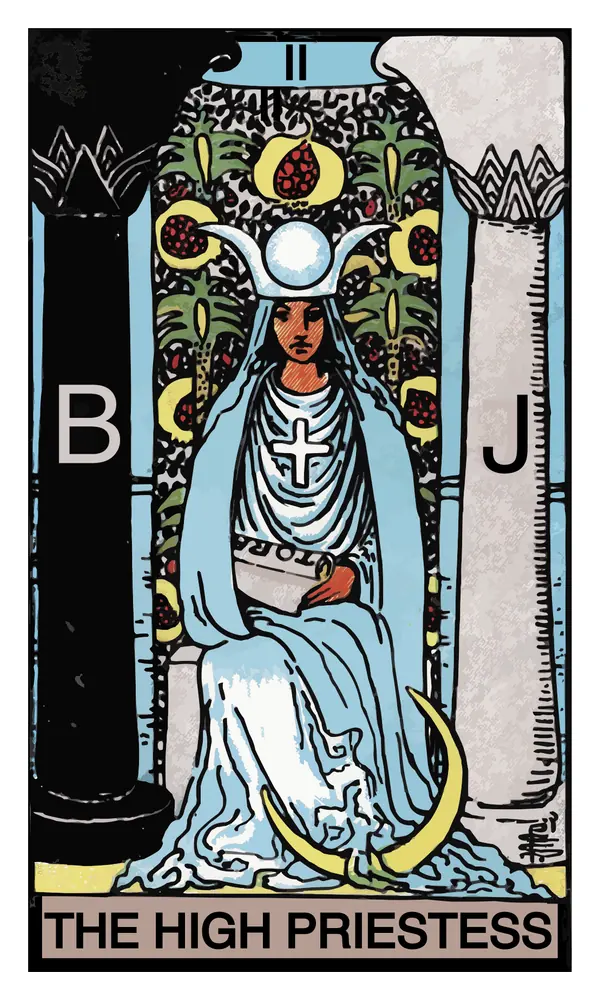
The High Priestess
The High Priestess seated between two pillars, with a crescent moon at her feet.
Read about The High Priestess on Tarot Told Me (opens in a new tab)The link between these cards and the moon is one of imagery, not of astronomy. They can enrich a reading, but the spread works the same way without them.
How do you read the five cards together?
Start by reading each card alone, in its position, in one sentence. Then look at the whole circle before you decide what any of it means. A spread is not five separate answers; it is one picture.
Some habits help. Compare neighbors: positions two and three often touch on avoidance and energy, so see whether the cards echo each other. Count suits, since a circle heavy in Cups invites a different conversation than one heavy in Swords. Notice how many Major Arcana appear, because a cluster of them traditionally signals themes larger than a single week.
For pairs of cards that sit side by side, our guide to tarot card combinations explains how to compare them. Leave room for the cards that confuse you. Not every position needs a neat sentence, and a blank is a legitimate result.
How do you lay the spread tonight?
Keep the setup plain. You need a deck, a flat surface and ten or fifteen minutes. A notebook helps more than candles do.
- Write the date and your time zone at the top of a page, then one line about how the past month felt.
- Shuffle until you feel ready to stop. There is no correct number of shuffles.
- Place five cards in the circle, face down, then turn them one at a time in the order of the table.
- Write a sentence per card before you look up any book.
- Finish by reading the center card aloud and noting one small thing you might try.
If you want a quick comparison with a shorter layout, try the three-card version below, then return to the five-card circle another night.
Tool on Tarot Told Me
Three-card spread
A short three-card spread on the site, useful as a lighter alternative to the five-card circle.
Tarot Told Me (opens in a new tab) is a reflective tarot app from the team behind this site.
What should you avoid with a moon spread?
Avoid turning it into a test of the future. If a card makes you anxious, that is a reason to pause and write down what the image brings up, not to conclude something is about to happen. A card knows nothing about your next month.
Avoid reading for other people's minds. A question like "What does my colleague think of me?" cannot be answered by a layout, but "What do I fear they think?" can.
Avoid using the spread for decisions about health, money, legal matters or safety. A tarot reading is a way to organize your own thoughts; for those topics, a qualified professional is the right place to start.
Finally, avoid doing it every night. A spread tied to the full moon has a built-in rhythm of about once a month, and that spacing is part of what makes the look back worthwhile.
Frequently asked questions
No. The moon looks nearly full for a day or so on each side of the peak, and the spread does not depend on astronomy. Choose an evening when you can sit quietly without hurrying.
You can use the five questions on their own, as journaling prompts, and skip the cards. The cards add images to react to, which some people find helps them put words to a vague feeling.
We found no reliable source tying tarot to moon phases in its early history. The oldest surviving decks date from the mid-15th century and were made for a card game. Treat moon spreads as a modern practice.
Once per lunar cycle, which is about every 29 to 30 days, fits the design. Using it more often tends to blur the sense of a monthly look back.
Read them as images to describe, not verdicts. Write down what you see in the picture and what it reminds you of. If a subject feels too big to handle alone, speaking with a friend or a professional is a sound next step.