New moon tarot spread: a monthly intention in four cards
A new moon tarot spread uses four cards to frame one month: what to release, plant, nurture and do. Here is how the layout is built and how to read it calmly.
By TaronicaPublished
In short
- A new moon tarot spread is a four-card layout drawn at the start of the lunar cycle to frame an intention for the coming month.
- Its positions are release, plant, nurture and act, a design of this blog rather than a historical tradition.
- The cards work as prompts for reflection, not as forecasts.
What is a new moon tarot spread?
A new moon tarot spread is a short layout that people draw around the dark phase of the Moon, when the lunar cycle begins again. In this version it uses four cards to sketch a monthly intention: what to let go of, what to start, what to keep tending, and one concrete step. It is a modern practice from the contemporary lunar-ritual and tarot community, not an old tradition.
The layout described here is the design of this blog. No historical source prescribes these four positions, so treat them as a convenient frame that you are free to change.
Why do people pair tarot with the new moon?
The pairing rests on a simple image. The new moon is the point where the Moon is not visible and a fresh cycle of about 29.5 days begins, so it reads naturally as a starting line. Many people like to match a small ritual to that moment, and a tarot spread is one way to do it.
It helps to be clear about what this is. The idea that the Moon carries a special energy is a belief held by some practitioners, not something that has been demonstrated. You do not need to hold that belief to use the spread, because the calendar itself gives you a useful rhythm.
A month is long enough to see whether an intention changes anything and short enough to revisit. That is the practical appeal. The Moon works here as a bookmark in time, and the cards give you language for thinking about what you want to write on the page.
How is the four-card layout built?
The spread is a row of four cards, read from left to right. Each position answers one question about the month ahead, and together they move from clearing space to taking a step. The order matters, because each card builds on the one before it.
The design borrows a familiar arc from many planning methods: look back, choose, sustain, act. Tarot spreads in general are arrangements that assign a question to each position, and this one does exactly that in its simplest form. If you want to see how other layouts are constructed, the article on tarot card combinations shows how neighboring cards shape each other.
| Position | Question | Role in the arc |
|---|---|---|
| 1. Release | What am I ready to set down? | Clears space |
| 2. Plant | What do I want to begin? | Names the intention |
| 3. Nurture | What will help it grow? | Sustains it |
| 4. Act | What is one step I can take? | Makes it concrete |
What does each position ask?
The first position, release, asks what you are carrying that no longer serves the month ahead. It might be a habit, an expectation or a task you keep postponing. Read the card as a description of the thing, not as a verdict on you.
The second position, plant, is the intention itself. The card here suggests a direction or a theme rather than a fixed goal. Say it in a sentence and write it down before you move on.
The third position, nurture, looks at what supports the intention over weeks: routines, people, rest, attention. The fourth, act, narrows everything to one step small enough to take within days. A spread that ends in action stays practical, and that keeps it from turning into a pure mood.
How do you read the four cards together?
Start with the whole row before you read any single card. Notice which suits dominate, whether the Major Arcana appear, and whether the images face the same way. A row of cups tends to point toward feeling and relationships, while a row of swords points toward thought and decision, in the usual reading of the suits.
Then read in pairs. Position one and two form a before and after: what is set down and what is picked up. Position three and four form a support and a step. Ask whether the pairs agree or pull against each other, and write down what you see before you reach for a meaning.
A spread is a set of questions with pictures attached.
If two cards seem to contradict each other, that is not an error. It often marks the tension you are already living with, and naming it is part of the value of the exercise.
What does a sample reading look like?
Say you ask about a month in which you want to change how you work. In the release position you draw a card you read as overcommitment, and you decide that means saying yes to fewer small requests. That gives you something specific to set down.
In the plant position comes The Fool, a figure at the edge of a cliff with a small bundle.
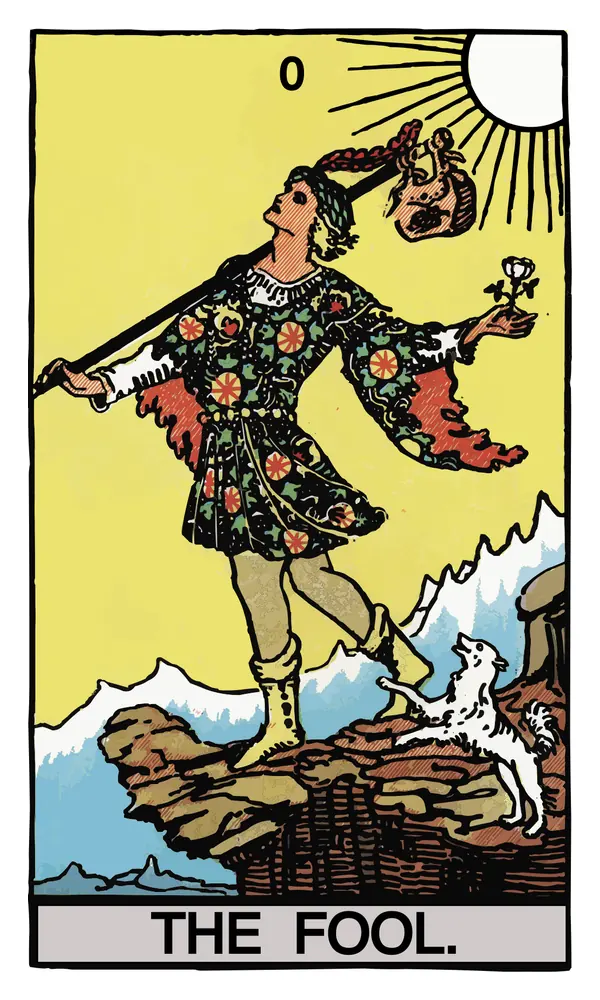
The Fool
The Fool, a figure at the edge of a cliff with a small bundle, traditionally read as a beginning taken with little certainty.
Read about The Fool on Tarot Told Me (opens in a new tab)In the tarot tradition this card is tied to starts and open-ended journeys, so you might phrase your intention as trying one new way of working without needing it to be perfect.
In the nurture position you draw the Ace of Cups, a hand offering an overflowing cup.
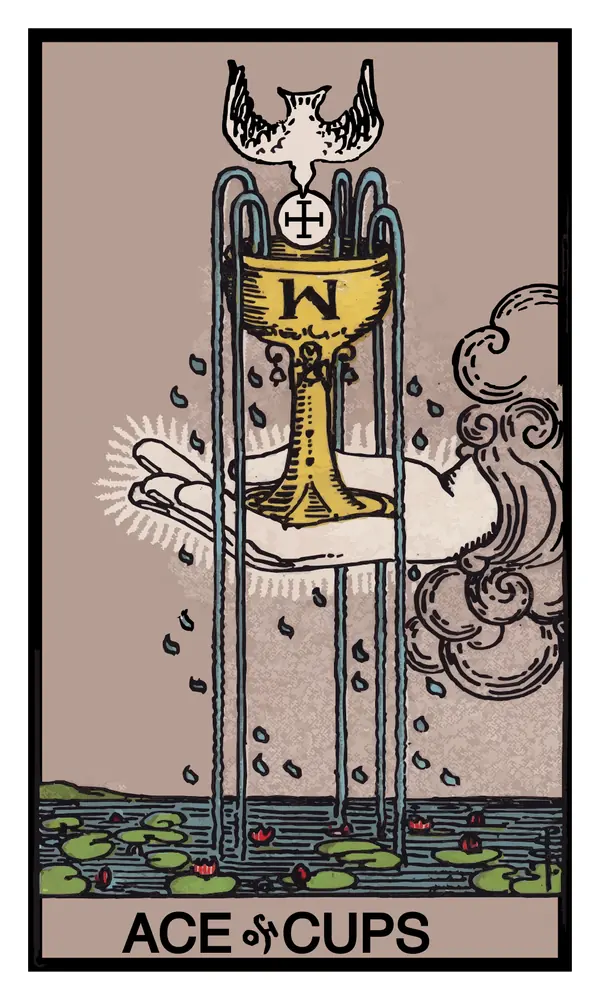
Ace of Cups
The Ace of Cups, a hand offering an overflowing cup, traditionally associated with new feeling and emotional openness.
Read about Ace of Cups on Tarot Told Me (opens in a new tab)The Ace is read as a seed of the suit of cups, so you might take it as a prompt to protect the part of the work you actually enjoy. The fourth card then gives the step, perhaps a card tied to practice or planning, which you turn into one scheduled hour.
Nothing in this example is a prediction. It is a way of using images to make a vague wish specific enough to act on.
How do suits and numbers shape the reading?
The suit tells you which area of life a card is speaking about, and the number tells you where the matter sits in a process. Aces are seeds, middle numbers are effort and tension, and tens are completion or overload. This is why a new moon spread, which is about beginnings, often feels natural with low numbers in the plant and nurture positions.
A useful habit is to check four things for each card:
- The suit: wands for drive, cups for feeling, swords for thought, pentacles for work and body.
- The number or rank: where the card stands in the arc from beginning to completion.
- Major or Minor: whether the theme feels large or everyday.
- The direction of the figures: whether they look toward or away from the next card.
These cues keep the reading grounded in how the deck is built. They also help when a card seems unrelated at first glance. If you want to compare near-identical cards that are easy to confuse, the piece on similar tarot cards is a good companion.
How to lay out the spread step by step?
The practical side is short. Choose a quiet ten minutes near the new moon, since the exact date depends on your time zone and a moon calendar such as the one at timeanddate (opens in a new tab) will show it. You do not need to draw on the precise minute; many people simply pick the day or two around it.
- Write one sentence about the month you are entering: what feels crowded, what feels open.
- Shuffle while holding that sentence in mind, then draw four cards and place them left to right.
- Turn them one at a time and name the position before you look at the card.
- Write one line for each card, using your own words first.
- Circle the fourth card's step and put it in your calendar.
If you want a lighter layout for a quick check, a three-card draw works too.
Tool on Tarot Told Me
Three-card spread
Draw a quick three-card spread online if you want a shorter alternative to the four-card layout.
When should you read it again?
A natural moment to return is the full moon, about two weeks later, when you can look at your notes and ask what has moved. You do not need to draw new cards. Simply reread your four lines and see which ones still fit.
At the next new moon, review the whole month before starting again. Ask which intention changed something, which one faded, and whether the step you chose was too large. Adjusting the size of the step is usually more useful than adjusting the intention.
For questions about health, money or legal matters, a spread is not the right tool on its own. Use it to clarify what you want to ask, and then take the question to a qualified professional.
Questions to keep with your notes
- What am I actually ready to set down this month?
- Can I state my intention in one plain sentence?
- What would make the fourth step small enough to do this week?
Frequently asked questions
No. The exact moment depends on your time zone and is only a convention. Many people draw within a day or two of it, and the spread works the same way on any quiet day that suits you.
No. It is a modern practice from the contemporary lunar-ritual and tarot community, and the four positions used here are this blog's own design. Early tarot began as a card game in Renaissance Italy, long before such rituals existed.
Yes. Three cards give a shorter version, and some people add a fifth card as a theme for the month. Keep the positions clear, because a spread with unclear questions is hard to read.
A difficult-looking card in the release position often just names what you are ready to set down. In other positions, read it as a description of a challenge or a tension rather than a forecast, and ask what a small, practical response could be.
No. In the tarot tradition the cards are images to think with, and nothing here tells you what will happen. The value is in the intention you write down and the step you choose.