Birthday tarot spread: a year back, now, a year ahead
A birthday tarot spread is a modern layout that treats your birthday as a checkpoint. Here is how the 12-card and three-row versions are built, and how to read them as questions, not forecasts.
By TaronicaPublished
In short
- A birthday tarot spread is a modern layout that uses the turn of your personal year as its frame, most often twelve cards for twelve months.
- No historical source prescribes it, so every version you meet is a convention that you may adapt.
- Our variant, a year ago, now and a year ahead, works through questions rather than forecasts.
What is a birthday tarot spread?
A birthday tarot spread is a layout you lay out once a year, around your birthday, to look at the year that ended and the year that begins. It is not a fixed historical pattern. Writers online describe several versions, and they differ in size, shape and purpose.
The most common version uses twelve cards, one for each month ahead. Another uses a single card or a short row for a year ago, for now and for a year ahead. Both treat the birthday as a natural checkpoint, much like New Year, but tied to one person instead of the calendar.
Taronica treats it as a tool for reflection. The cards offer images to think with. They do not hand over a schedule of events.
Where does the birthday spread come from?
Short answer: it is modern and informal. We found no authoritative or historical source for it, and the layouts that circulate on tarot blogs read as shared habits rather than a tradition with a founder. That is worth knowing before anyone tells you there is a correct way to do it.
Tarot itself is much older. Three luxury decks survive from the middle of the 15th century in northern Italy, and one was probably made for Filippo Maria Visconti, who died in 1447. Those decks were made as costly objects for a court, and the practice of laying cards in set positions to answer questions developed later.
So a birthday spread borrows an old deck for a new custom. Seeing it that way keeps expectations realistic and leaves you free to change the design.
How is the classic 12-card layout built?
The familiar version has twelve positions, one per month of the coming year. You can place them in a line from left to right or in a circle, like the face of a clock. The first position usually stands for the month of your birthday, and the circle closes on the month before the next one.
Each position is read as a theme to consider, not an event that will arrive. Say you ask what you might pay attention to in the fourth month, and the Sun appears there. In the tarot tradition the Sun is read as warmth, clarity and openness, so you might ask where in that stretch of the year you would like more of those qualities.
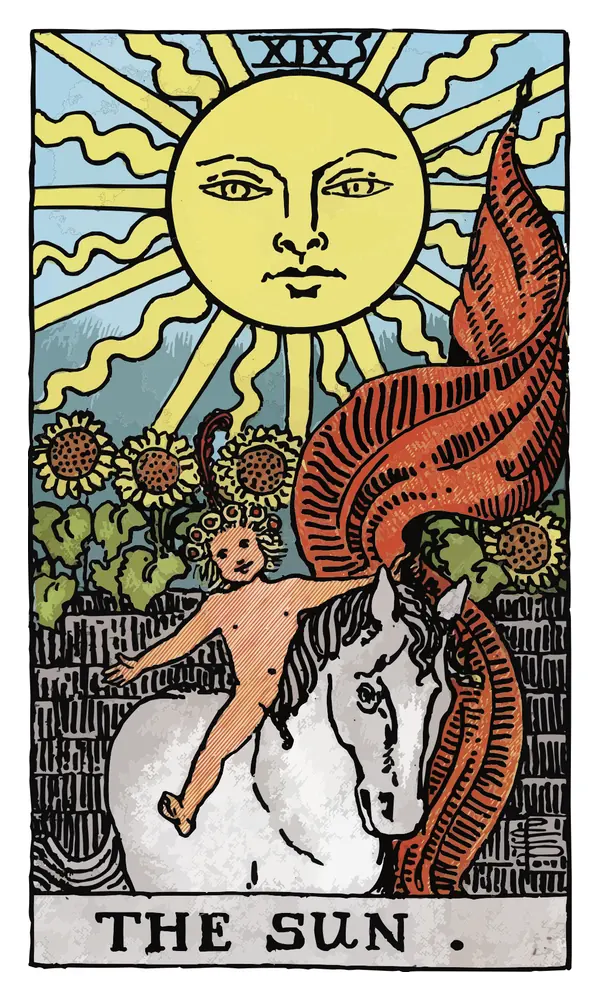
The Sun
The Sun from a Rider-Waite-Smith style deck: a child on a white horse beneath a large sun, traditionally read as warmth and clarity.
Read about The Sun on Tarot Told Me (opens in a new tab)Twelve cards give a lot to read at once. If that feels heavy, read the circle in quarters of three months, and note one question for each quarter before moving on.
How does the year ago, now, year ahead version work?
This is our own variant, and we present it as such. Instead of twelve monthly slots it uses three rows, each with one to three cards: a year ago, now, and a year ahead. The structure is closer to a classic past, present and future spread, anchored to your birthday.
The first row looks back at the year you have just finished. The middle row describes where you stand on the day, and the last row gathers what you may want to carry forward. Three cards are enough, and nine make a fuller version if you prefer more detail.
Traditionally, the Six of Cups is read as memory, childhood and things received from the past. Say it lands in the first row. You might use it as an invitation to ask what from last year you still carry with you, and what you are ready to set down.
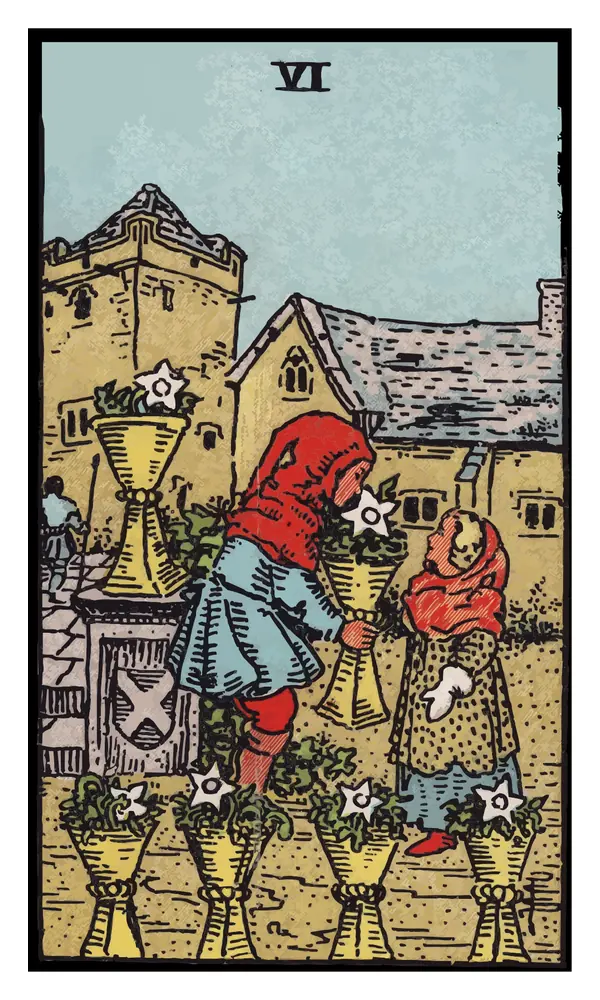
Six of Cups
The Six of Cups: children and flowers in a quiet courtyard, traditionally linked with memory and the past.
Read about Six of Cups on Tarot Told Me (opens in a new tab)Which questions fit each row?
The strength of the three-row version lies in the prompts, because they give each card a job. A card without a question tends to turn into a vague mood. A card with a question gives you something specific to answer in writing.
Here are prompts you can adapt, in the order you will read them:
- Year ago: What took most of my energy, and what did I learn from it?
- Year ago: Which moment would I handle differently now?
- Now: What feels settled in my life, and what still feels open?
- Year ahead: What would I like to give more room to?
- Year ahead: What would I like to need less of?
Keep the wording about you. Questions about what other people will do or feel send the reading outward, where no card can help. Questions about your own choices keep it useful.
Can you link the spread to astrological houses?
Some versions do. The twelve positions are matched with the twelve houses of an astrological chart, so that each card is read against a department of life such as home, work, partnerships or learning. One tarot blog describes this as an option for the twelve-card layout, alongside the line and the circle.
It helps to be clear about what this combination is. Months and houses are two separate systems, and the mapping between them is a convention, not an astronomical fact. The first month does not literally correspond to the first house for everyone.
If you enjoy astrology, you can still use the houses as themes for your questions. If you do not, the plain monthly version works just as well, and nothing is lost.
Which deck suits a birthday spread?
Any deck you can read comfortably will do. Many readers prefer the Rider-Waite-Smith deck because every card, including the numbered suit cards, shows a small scene. Scenes give you something to describe when a position asks about a particular month or period of life.
The deck was published in December 1909 by William Rider & Son of London, and it came from a collaboration between the artist Pamela Colman Smith and Arthur Edward Waite. It is often called Rider-Waite alone, so the longer name, Rider-Waite-Smith, is used here to credit Smith. Waite's book The Pictorial Key to the Tarot appeared with her illustrations in 1910, dated 1911.
Earlier decks, such as the Visconti-Sforza deck made in Milan shortly after 1450, are worth a visit in a museum or a book. For a yearly ritual, though, a scenic modern deck is usually easier to work with.
How do you lay out your birthday spread step by step?
Prepare a notebook before you touch the cards, because writing is where this spread does its work. Choose one version, either the twelve-card circle or the three rows, and stay with it for the whole sitting. Mixing layouts halfway through tends to blur the answers.
- Write three or four sentences about the year behind you, before drawing anything.
- Shuffle in the way you like and lay out the positions in order.
- Turn the cards one at a time, and note what you see before you recall any traditional meaning.
- Then add what the tarot tradition associates with each card, and compare the two.
- Close by writing one intention you can act on within a month.
If you would like a ready-made yearly layout to compare with your own, try the year spread.
Tool on Tarot Told Me
Year card
A guided spread for the year ahead, useful for comparing with your own birthday layout.
Tarot Told Me (opens in a new tab) is a reflective tarot app from the team behind this site.
How should you read the result without over-reading it?
Start with the whole picture. Look at which suits dominate and whether many Major Arcana cards appear, then move to single positions. Many wands or swords, for instance, simply draw attention to action or thought in your own account of the year.
Treat odd or uncomfortable cards as questions. A hard card in the year-ahead row does not describe a fixed outcome, since a card knows nothing about your circumstances. It points to a theme you can look at, change or prepare for.
For health, money, legal or safety matters, a tarot reading is no substitute for a professional. Use the spread for perspective, and take practical decisions to people qualified to advise.
Questions to take with you
- What would I say about the past year if nobody were going to read it?
- Which question in this spread feels hardest to answer, and why?
- What is one small thing I can do this month that fits my intention?
Frequently asked questions
No. The date is a convention, and a day nearby works equally well. What matters is that you choose a quiet time and treat it as a yearly checkpoint.
There is no rule. Twelve cards for twelve months is the most common version, and three cards or three rows suit shorter sittings. Choose the size you can read thoughtfully.
You can lay it for a friend if they ask and take part, but it is safest to keep questions about their own choices. Avoid reading what other people will think or do.
No. We found no historical source for it, and the versions online appear to be modern conventions. Tarot decks are far older, but spreads like this one are recent.
Most people do it once a year. Keeping the notes from earlier years lets you compare answers over time, which is often more useful than the cards.