New year tarot spread: questions for the year ahead
A new year tarot spread turns twelve cards into twelve monthly questions. Here is how the layout is built, what each position can ask, and how to read it as a whole.
By TaronicaPublished
In short
- A new year tarot spread is a circle of twelve cards, one for each month, often with a thirteenth card for the theme of the whole year.
- The layout is a modern, informal format with no documented ancient source, so you can adapt it freely.
- Its strength is structure: twelve separate questions are easier to reflect on than one vague wish about the year.
What is a new year tarot spread?
A new year tarot spread is a layout of twelve cards placed in a circle, with each position standing for one month of the coming year. Many versions add a thirteenth card in the center as a theme for the whole year. You will also see it called a year-ahead spread, and the two names describe the same format.
The circle borrows the look of a clock or a calendar. Readers usually lay it out around 1 January or on a birthday, and the common purpose is to review the past year, set down what no longer fits and name a few intentions.
On this site the cards are treated as prompts for reflection, not as forecasts. The spread gives you twelve places to pause and ask a question, which is a different job from predicting what will happen in March.
Where does the year-ahead layout come from?
Nobody can point to an inventor. Year-ahead spreads have no documented historic origin, and they look like a modern, informal layout that grew through books, blogs and word of mouth. Any claim of an ancient or single-author source should be treated with caution.
It helps to place the spread against the longer history. The oldest surviving tarot cards are about fifteen Visconti-Sforza decks from the mid-15th century, made when the cards were still a game called tarocchi. Layouts for reading came much later.
Even the best-known spread, the Celtic Cross, was set down in print only in the early 20th century. Arthur Edward Waite published its diagram in The Pictorial Key to the Tarot, and he was codifying existing practice rather than inventing it. Sources give the year as 1910 or 1911, and the "ancient Celtic" label is Waite's own, not verified history.
So the year spread is young, flexible and still being reshaped. That is useful to know before you start: there is no correct version to get wrong.
How are the twelve positions arranged?
The standard format is twelve cards in a circle, one per month. A common instruction is to make card one the first month counting from now, and then to run the cards in order around the year. If you lay it on 1 January, card one is January. If you lay it in mid-December, card one is the month ahead of you.
There are two sensible ways to place them.
- Clock style: put card one at the position of 12 o'clock and move clockwise, so card four sits at 3 o'clock, card seven at 6 and card ten at 9.
- Calendar style: put the cards in two rows of six, January to June above and July to December below.
- Seasonal style: group them in threes, which gives you four small chapters of the year.
The circle has one quiet advantage. The twelfth card sits right next to the first, which reminds you that a year ends where the next one begins.
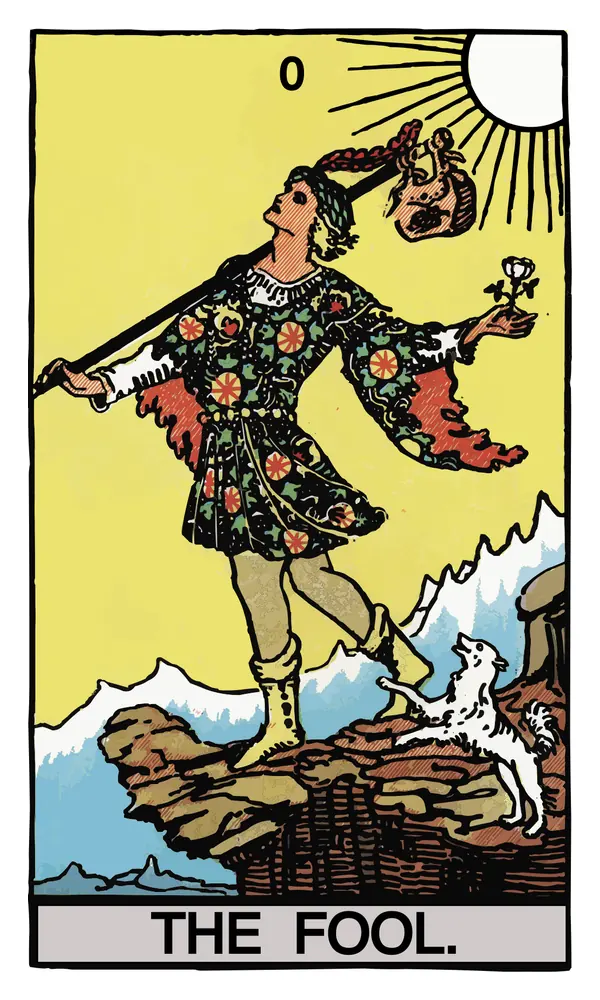
The Fool
The Fool, the first card of the Major Arcana, often used as an image of a starting point when a spread opens a new cycle.
Read about The Fool on Tarot Told Me (opens in a new tab)Some readers like to draw the first card with this image of a beginning in mind. It is a habit, not a rule, and the spread works the same without it.
What does the thirteenth theme card add?
A common variant adds one card in the middle of the circle. It is read as a theme for the whole year, a kind of title over the twelve chapters. You draw it either first, before the months, or last, after you have seen the full circle.
The order changes how you read. Drawing the theme card first gives you a lens, and you may find yourself reading every month through it. Drawing it last works more like a summary: you look at the twelve cards and then ask what ties them together.
The theme card is optional. If you have limited time, or you want the spread to stay simple, twelve cards are enough. If you do add it, write down in advance whether you will read it as a topic, a question or a tone, so that you are not deciding after the fact.
Which questions fit each month?
The weakest use of this spread is to ask the same thing twelve times. The strongest is to give each month its own question, written before you draw. Questions that begin with "how" and "what" tend to keep the reading open, and they are easier to answer in your own words.
Here is one possible set, which you can change freely.
- January: What do I want to carry over from last year?
- February: What needs more patience from me?
- March: What could I begin in a small way?
- April: Where can I ask for help?
- May: What do I want to make visible?
- June: What am I tending that is worth my energy?
And for the second half of the year:
- July: How do I want to rest?
- August: What am I learning about my limits?
- September: What deserves a fresh plan?
- October: What can I let go of?
- November: Who or what do I want to thank?
- December: What have I built, and what comes next?
Notice that none of these asks what will happen. They ask what you might notice, choose or do. That wording keeps the decision with you and not with the cards.
How do you read the circle as a whole year?
After you have read each month on its own, step back. Look at the circle the way you would look at a page of text: where are the clusters, where are the gaps, and what repeats? Several cards of one suit, or several Major Arcana in a row, are traditionally noticed as emphasis, and you can note them without drawing a hard conclusion.
Say you ask the April question and draw The Star. In the tarot tradition this card is often linked with hope and quiet renewal. You might simply write that April is a month in which you want to ask for help gently and see what comes.
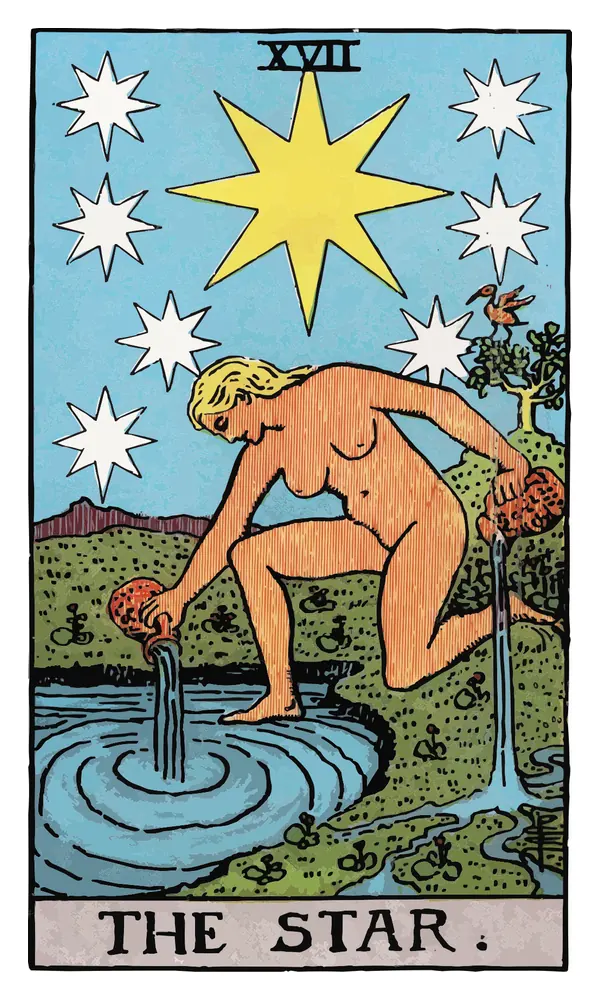
The Star
The Star, a Major Arcana card traditionally associated with hope and renewal, shown here as an example of a card you might meet in one monthly position.
Read about The Star on Tarot Told Me (opens in a new tab)Now suppose the twelfth position brings The World. It is traditionally read as completion, so the December question about what you have built has a natural echo. The card knows nothing about your year, but the image can help you phrase what completion would mean for you.
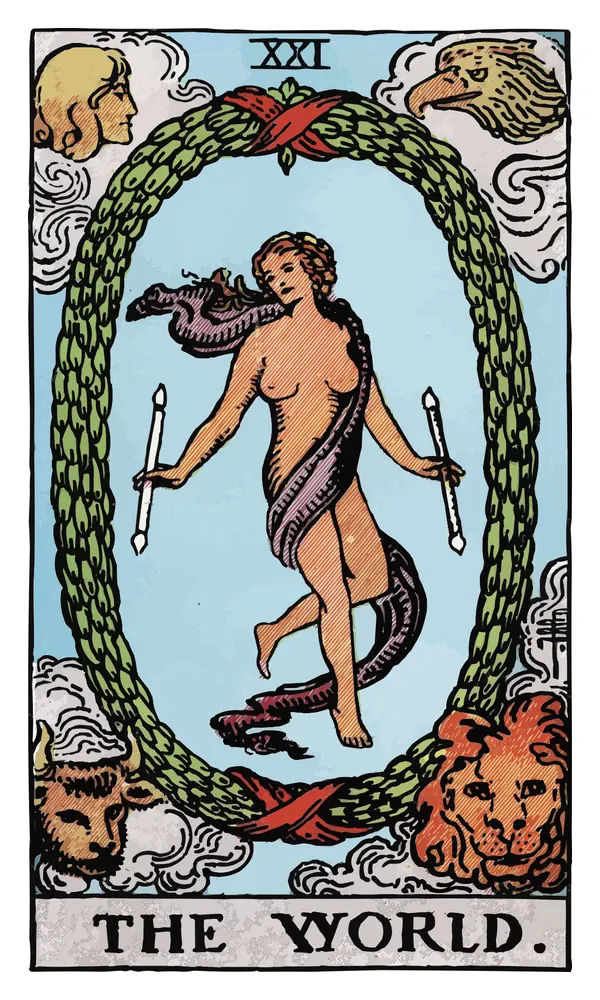
The World
The World, traditionally an image of completion and a full cycle, a fitting picture for the last position of a year spread.
Read about The World on Tarot Told Me (opens in a new tab)Finally, ask two things of the whole circle. What do I want to remember from this? And what is one small step I could take in the first month?
When is the best time to lay the spread?
The spread is usually recommended for New Year's Day or for a birthday, because both mark a natural turning point. If you plan to read on 1 January, mid-December is a good time to prepare. You can choose your deck, write your twelve questions and decide how you will keep notes.
There is no reason to be strict, though. A year does not need to match the calendar. Some people lay the spread at the start of a school year, a new job or the first day of spring.
Two habits make the reading more useful later.
- Write down the date, the questions and the cards, so you can return to them.
- Photograph the layout before you collect the cards.
- Set one reminder per quarter to reread your notes.
The quarterly reread is the part most people skip. It turns a single evening into a slow conversation with your own year.
How can you lay your own new year spread step by step?
Start by choosing how many positions you want. Twelve is the standard, but you may prefer a lighter version with four cards, one per season. Then write your questions on paper, shuffle in the way you like and draw card by card.
Here is a simple order that keeps things calm.
- Write your twelve questions, or use the list above as a base.
- Shuffle while thinking about the year as a whole, not about a result.
- Draw the optional theme card and place it in the center.
- Draw twelve cards in order and place each in its position.
- Read slowly, one month at a time, and write a sentence beside each card.
- Step back and note any patterns, then stop for the day.
If you would rather draw a year spread without arranging the cards yourself, you can use the tool below.
Tool on Tarot Told Me
Year card
A year-ahead spread you can draw online, one card for each month of the coming year.
If you want a place to keep your notes and reflections, Tarot Told Me (opens in a new tab) is a reflective tarot app from the team behind this site.
What can a year spread not do?
It cannot tell you what will happen. Twelve cards are twelve images, and what you see in them depends on your question, your mood and the deck. Treat the reading as a structured way to think, not as a calendar of events.
It also cannot replace professional advice. If a month's question touches on health, money, legal matters or safety, take it to a doctor, a financial adviser, a lawyer or another qualified person, and use the cards only as a way to prepare your thoughts.
Finally, it cannot be done wrong. If a position feels flat, you can redraw your questions for next year. If a month feels heavy, you can look at the card as one image among many, and remember that you wrote the question.
Questions to ask before you draw
- What do I want to remember about the year that is ending?
- Which three months of the coming year feel most open to me?
- What is one question I would like to ask every quarter?
Frequently asked questions
The standard version uses twelve cards, one per month. Many readers add a thirteenth card as a theme for the year, which makes thirteen in total. A shorter version with four cards, one per season, also works.
No. The spread is usually recommended for New Year's Day or a birthday, but that is a custom and not a rule. You can lay it at any moment when you want to look ahead over twelve months.
A common instruction is to make card one the first month counting from now, then continue in order around the circle. If you read on 1 January, card one is January. Whatever you choose, decide before you draw and write it down.
Yes. The spread does not depend on a particular deck. The Rider-Waite-Smith deck, which has 78 cards, is the most common choice, and it is useful to know that the artist Pamela Colman Smith illustrated it, so many people now use the full name to credit her.
Both are used. Drawing it first gives you a lens for the twelve months, while drawing it last works as a summary. Pick one before you start so you do not choose the reading that fits afterwards.
A light rhythm is enough, such as once per quarter. Reread your notes and compare the monthly questions with what happened, and treat the cards as a record of your own thinking.