Winter solstice tarot spread: what to release on the longest night
A five-card layout for the longest night of the year, built around what you might set down and what you might carry toward the light. Here is how it is built, position by position, and how to read it calmly.
By TaronicaPublished
In short
- A winter solstice tarot spread is a five-card layout built around the longest night of the year, used to look at what you might release before the days begin to lengthen.
- This version places the Hermit at the start and the Sun at the end, and you draw the three cards in between.
- It is a reflection exercise, not a forecast: the cards offer images to think with, and you decide what to do with them.
What is a winter solstice tarot spread?
A winter solstice tarot spread is a layout designed for the shortest day and longest night of the year in the Northern Hemisphere, arranged so that each position follows the movement from darkness toward returning light. It is not an old, fixed formula. Tarot spreads are modern tools that people adapt to a season, a date, or a question, and this one is no exception.
The design here has five positions. Two of them are set in advance, and three are drawn from the shuffled deck. The theme is release: what has been carried through the year, what can be set down, and what is worth keeping for the cold months ahead.
Why does the longest night suit a spread about release?
The solstice is an easy marker to use. On this one night the dark is at its maximum, and from the next day the daylight grows by small amounts. That shape, a low point followed by a slow turn, is a natural frame for asking what you are ready to leave behind.
There is nothing magical in the date itself. It is a fixed point in the calendar that many people already treat as a pause, and a pause is useful for review. Say you ask yourself in late December which habits of the past year felt heavy; the solstice simply gives the question a place to sit.
A spread for the longest night is a way to take stock, not a way to be told what comes next.
When is the 2026 winter solstice?
According to the Old Farmer's Almanac, the Northern Hemisphere solstice in 2026 falls on Monday, December 21, at 3:50 P.M. EST. That is 20:50 UTC, so in time zones far ahead of the United States the moment may fall late on December 21 or early on December 22. If the exact minute matters to you, convert it for your own location.
The Northern Hemisphere solstice lands between December 20 and 23 in any given year, most often on December 20 or 21. In the Southern Hemisphere the winter solstice in 2026 comes on June 21, so people there may prefer to use this spread in June, when their own longest night arrives.
You do not need to draw the cards at the exact minute. The evening of the solstice, or any quiet evening that week, works just as well.
How is the five-card layout built?
The layout reads left to right, like a line of lanterns along a path. Each position asks one plain question, and the questions move from the dark toward the light.
- Position 1, the lantern: where you stand at the end of the year (the Hermit, chosen in advance).
- Position 2, the weight: what you carry that you could set down.
- Position 3, the hearth: what is worth keeping through the winter.
- Position 4, the ember: what small thing deserves tending, even in the dark.
- Position 5, the daylight: what you might turn toward as the days lengthen (the Sun, chosen in advance).
Positions 2, 3 and 4 are drawn from the deck after you remove the Hermit and the Sun and shuffle the remaining 76 cards.
Why frame the spread with the Hermit and the Sun?
These two cards are picked for their imagery, not because the tradition assigns them to the solstice. In the Rider-Waite-Smith deck, the Hermit is an older figure in a gray robe who stands on a snowy height holding a lantern with a star inside it. The card is traditionally read as solitude, withdrawal and inner guidance, which suits a long evening spent alone with a question.
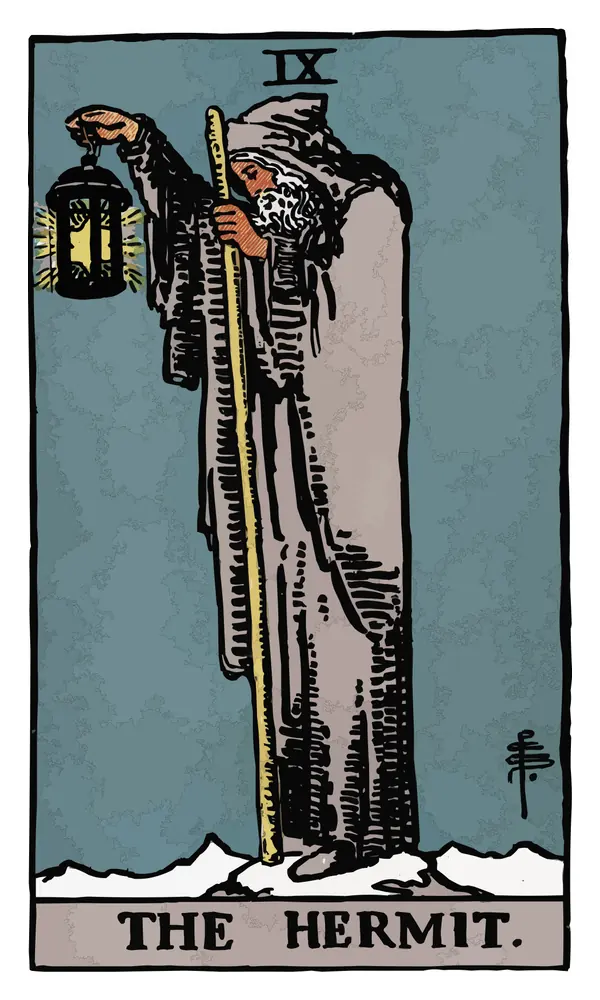
The Hermit
The Hermit in the Rider-Waite-Smith tradition: a figure with a staff and a lantern, standing in snow.
Read about The Hermit on Tarot Told Me (opens in a new tab)The Sun sits at the other end. In the same deck it shows a child on a white horse beneath a large sun, with sunflowers behind a wall. It is traditionally associated with warmth, clarity and openness, which makes it a fitting image for the returning light.
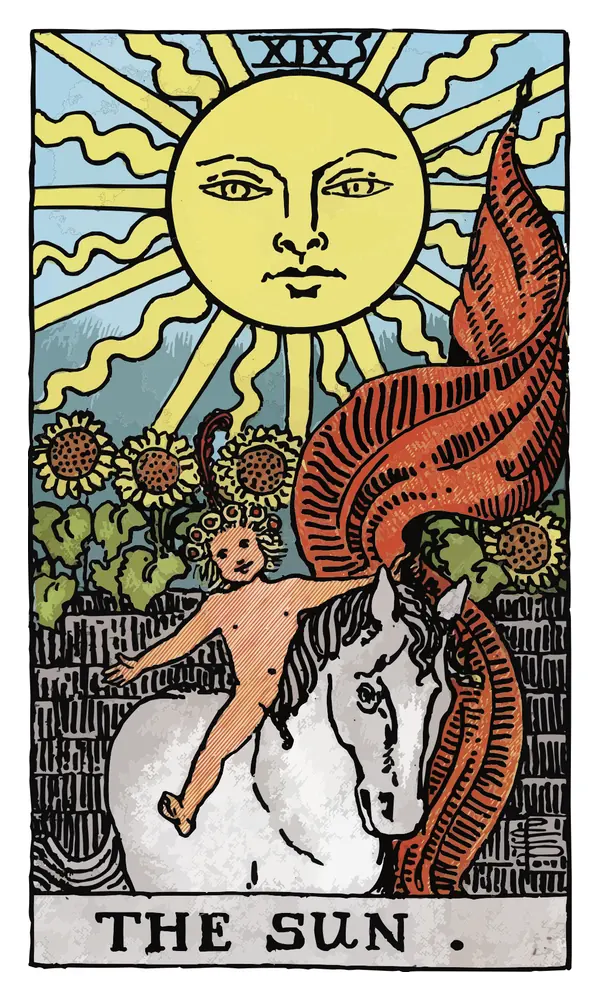
The Sun
The Sun in the Rider-Waite-Smith tradition: a child on a white horse, a bright sun, and sunflowers.
Read about The Sun on Tarot Told Me (opens in a new tab)If you prefer a fully random draw, shuffle all 78 cards and fill the five positions. The framed version simply gives the spread a clear beginning and end.
What does each drawn position ask?
The weight asks what you might release. It does not ask what you must release. Cards that look heavy or sharp can point to a worry, a role, or an old argument you keep rehearsing, and it is up to you whether any of that fits.
The hearth asks what to keep. People often skip this question when they focus on letting go, yet a season of release is easier when you also name what is steady: a routine, a friendship, a piece of work you still care about.
The ember asks for something small. Say you draw a card that suggests rest; the ember might be as simple as going to bed earlier in January. A small, concrete reading is usually more useful than a grand one.
How do you read the five cards together?
Start with the whole line before any single card. Notice the suits and the numbers: a run of cups points the conversation toward feeling, a run of swords toward thought and worry, and many Major Arcana cards suggest that the year touched large themes. These are traditional associations, offered as starting points.
Then look at the movement from position 2 to position 5. Ask whether the weight and the daylight seem to speak to each other, or whether they feel unrelated. Either result is fine, and a mismatch can be as informative as a match.
If a card seems to contradict your own sense of things, treat that as a prompt to look again, not as an instruction. A card knows nothing about your year; it only gives you a picture to answer.
How do you do the spread step by step?
Choose a quiet hour in the evening, ideally after dark, and keep the light low. Remove the Hermit and the Sun from the deck and set them aside, then shuffle the other cards for as long as feels right.
- Place the Hermit on the left as position 1.
- Draw three cards and lay them in positions 2, 3 and 4.
- Place the Sun on the right as position 5.
- Read each position aloud or write one sentence for it.
- Finish by writing one thing you will set down and one thing you will keep.
If you would like a simpler warm-up first, a short layout works well before the full five cards.
Tool on Tarot Told Me
Three-card spread
Try a quick three-card draw to warm up before the solstice spread.
Health, money and legal questions are best taken to a qualified professional. This spread is for reflection and is not a substitute for that advice.
How does it differ from a new year spread?
A new year spread looks ahead at twelve months and tends to ask about goals. The solstice spread is smaller and quieter: it stays with the present evening and asks what you want to put down before moving on. The two can follow each other, with the solstice as the review and January as the planning.
It also differs from moon spreads, which follow a lunar cycle of about a month. The solstice comes once a year, so the spread has a natural weight, and there is no pressure to repeat it.
Frequently asked questions
No. They are a design choice that gives the layout a clear start and finish. You can shuffle all 78 cards and fill the five positions at random if you prefer.
Yes. The solstice is a convenient marker, but nothing in tarot requires a particular date. Any quiet evening in the darkest weeks of winter works, and Southern Hemisphere readers may prefer to use it in June.
Traditional meanings for difficult-looking cards are often about pressure, loss or worry. In this spread they sit in a position that asks what you might release, so they can be read as a description of a weight, not a verdict. If something feels too heavy, it is reasonable to stop and talk to someone you trust or a professional.
No. It is built for looking back and taking stock, and a card cannot know what will happen. Use the images to organize your own thoughts.
Writing helps, because one sentence per position makes the reading concrete. A short note also lets you compare your thoughts with the next solstice, if you choose to repeat the exercise.