A gentle shadow work tarot spread
A five-card layout that treats the shadow as something to look at kindly, with its psychological background and its clear limits.
By TaronicaPublished
In short
- A shadow work tarot spread is a small layout for looking at the habits and feelings you usually avoid, using the cards as prompts rather than verdicts.
- The idea borrows from Carl Jung's psychology, but the tarot version is a modern, informal practice and not therapy.
- This five-card version moves from noticing to one small, kind step, and it names the points where it is wise to stop.
What is a shadow work tarot spread?
A shadow work tarot spread is a layout of cards used to reflect on the parts of yourself that you tend to hide, dislike or push out of view. The cards do not diagnose anything. They act as images to talk to yourself about, in the same way a museum visitor might stand in front of an old painting and ask what it brings up.
The word "shadow" is borrowed from psychology, and the borrowing is loose. Tarot has no official shadow card and no official shadow spread. What exists is a set of modern habits, popular on social platforms, that pair a few tarot positions with questions about avoidance, shame and self-protection.
This article builds one gentle version and explains its choices, so you can judge for yourself whether it suits you.
Where does the idea of the shadow come from?
The shadow is a concept from the Swiss psychiatrist Carl Jung. According to a study guide on Perlego, he introduced the term in 1916 in On the Psychology of the Unconscious, and he counted the shadow among four major archetypes, alongside the self, the persona and the anima or animus.
In that account Jung described a personal shadow and a collective one. The personal shadow is, roughly, what a person has no wish to be: traits, impulses or feelings that do not fit the picture you hold of yourself. The shadow is not only dark material, either. Some descriptions include talents and strengths that a person has never been allowed to claim.
If you want to read further, the Perlego study guide on the Jungian shadow (opens in a new tab) and the Wikipedia entry on Jungian archetypes (opens in a new tab) are reasonable starting points.
Why do readers link the shadow with tarot?
The link is an analogy, not a historical fact. Tarot images are symbolic, and symbols have long been used as mirrors for thought. When a card shows something uncomfortable, people tend to react to it, and that reaction can be interesting to examine.
There is no source known to us that shows a clinical or evidence-based basis for "shadow work" with tarot. It is better understood as a reflective exercise in the spirit of journaling. That is a modest claim, and it keeps the practice honest.
Two things follow from this. First, you can use the spread with curiosity and without any belief in hidden forces. Second, you should expect it to raise questions rather than settle them.
How is this five-card spread built?
The layout moves in a line, from observation to action. Each position is a question you put to yourself, and the card is only a picture to start the answer. The order matters: the spread begins with what you can see and ends with something small and practical, so you do not stay in self-criticism.
| Position | Question for reflection |
|---|---|
| 1 | Which pattern in myself do I notice lately? |
| 2 | What do I tend to push away or hide? |
| 3 | What is that habit trying to protect? |
| 4 | What does it cost me? |
| 5 | What is one small, kind step? |
Positions three and five are the heart of the design. Asking what a habit protects treats it as an attempt at safety rather than a flaw, and asking for one small step keeps the outcome within reach.
Which cards are traditionally linked to shadow themes?
No card belongs to the shadow by rule, but a few are often discussed in this context. The Devil is traditionally read as a picture of attachment, habit and feeling bound. In many decks the chains around the necks of the two figures hang loosely, which readers often take as a hint that the binding is less final than it looks.
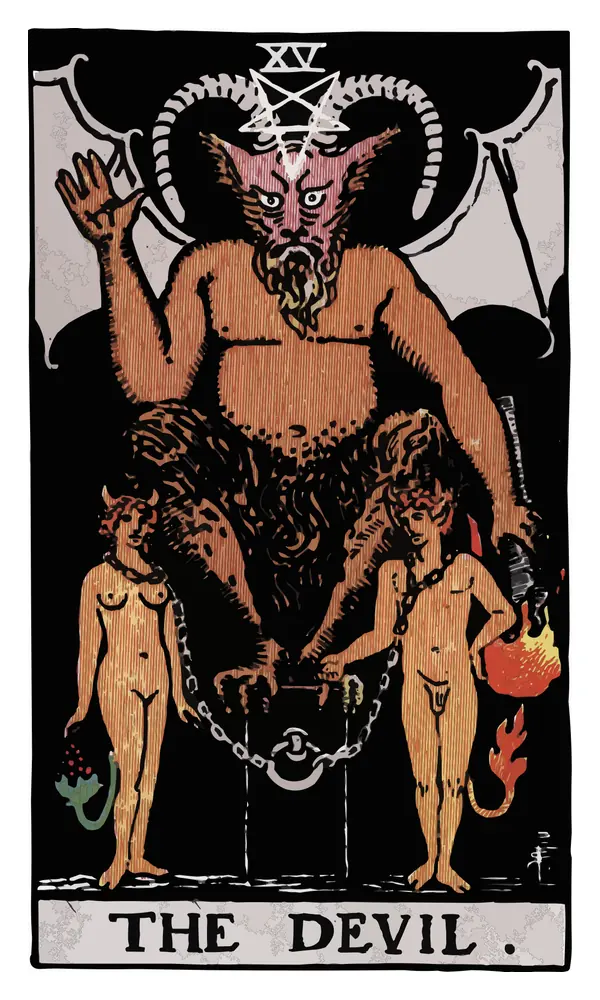
The Devil
The Devil in the Rider-Waite-Smith tradition: two figures chained to a pedestal, with chains loose enough to lift off.
Read about The Devil on Tarot Told Me (opens in a new tab)The Moon is traditionally associated with the unconscious, uncertainty and things seen by half-light. Its dog, wolf and crayfish are often read as instinct rising from below. It suits the second position well, where the question concerns what is hidden.
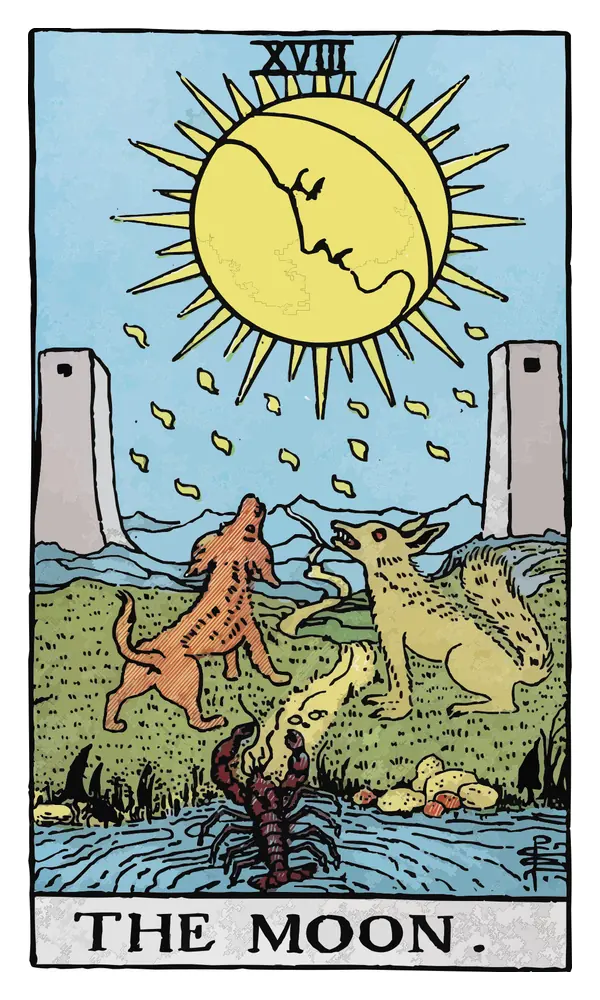
The Moon
The Moon: a path between two towers, a dog and a wolf howling, a crayfish emerging from the water.
Read about The Moon on Tarot Told Me (opens in a new tab)The Hermit is sometimes added to the mix as an image of looking inward with a lamp, slowly and alone.
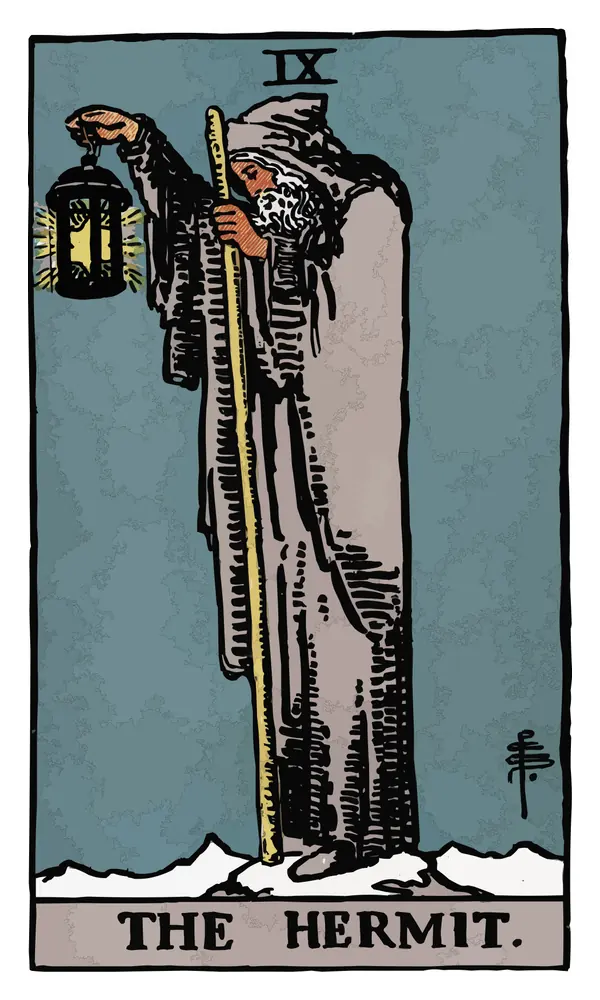
The Hermit
The Hermit holds up a lantern and a staff, an image often tied to quiet self-examination.
Read about The Hermit on Tarot Told Me (opens in a new tab)How do you read a hard card gently?
A card that looks harsh is not a judgment on you. The tradition gives each image many readings, and you are free to choose the ones that help. If a card stirs up discomfort, treat that as information about your reaction, not about your character or your future.
A few habits keep the reading calm:
- Describe what you see before you interpret it: colors, figures, direction of gaze.
- Ask what the image might protect, not only what it exposes.
- Notice your body. If you feel tense, slow down or stop.
- Write one sentence per position instead of a long analysis.
- Allow a card to stay unclear. Not every position needs an answer today.
The aim is to be a fair witness to yourself, not a prosecutor.
What might a sample reading look like?
Say you ask about a tendency to avoid difficult conversations. In the second position, you draw the Moon. You might describe the half-light and the long road, and then notice that you often wait until a situation feels clearer before you speak, even though it rarely becomes clear.
In the third position, the Devil appears. One traditional reading is attachment to a familiar habit, so you might ask what comfort the avoidance gives you. The answer may be something humble, such as not wanting to cause conflict or fear of being disliked.
Notice how the reading stays descriptive. It does not predict how anyone will react, and it does not claim to know what another person thinks. It turns every question back toward you and your own choices.
How do you try the spread step by step?
Choose a quiet time when you are not in the middle of a crisis. Shuffle in whatever way feels natural, lay out five cards in a row, and turn them over one at a time. Spend a few minutes on each position and write a sentence or two before moving on.
When you reach the fifth card, translate it into something you could do in a day or two: sending a message, taking a walk before a hard talk, writing down what you want to say. Keep it small enough to be realistic.
If five cards feel like too much, a shorter layout works as a first step.
Tool on Tarot Told Me
Three-card spread
A three-card draw is a lighter way to practice the same habit of describing first and interpreting second.
Come back to your notes after a few days and see whether the words still ring true. Often the second reading is calmer than the first.
When should you pause or ask a professional?
This spread is a reflection exercise, not a treatment. If it brings up painful memories, intense shame, panic or thoughts of harming yourself, stop and put the cards away. Speaking with a licensed mental health professional is a better path for difficult material than any layout.
The same goes for questions about health, money, legal matters or safety. Tarot cannot advise on these, and a trained person can. If you are in immediate danger or crisis, contact local emergency services or a crisis line in your country.
Stopping is not a failure of the practice. Knowing when a tool no longer helps is part of using it well.
Questions to take with you
- Which feeling do I usually hurry past?
- What does my most familiar habit protect me from?
- What would a smaller, kinder version of the next step look like?
Frequently asked questions
No. Shadow work in tarot is an informal reflection practice, while therapy is delivered by trained professionals using established methods. If you are dealing with trauma, depression or anxiety, a licensed professional is the right place to start.
No. The Devil and the Moon are often mentioned because of their traditional themes of attachment and the unconscious, but any card can be a prompt. The questions you ask matter more than which cards appear.
No. Cards are images, and they know nothing about you. The spread only gives you something to react to and write about, and what you learn comes from your own thinking.
There is no rule. Many people find that an occasional reading, with time to think between sessions, is calmer than frequent ones. If you notice that you feel worse after readings, take a break.
Not necessarily. Several descriptions of the concept include unclaimed strengths as well as disliked traits. This is why the spread includes a question about what a habit protects, and a step toward something constructive.