A tarot spread for making a decision
A six-card layout that sets two paths side by side, with a fear and a value for each. It shows how the spread is built and why the choice stays with you.
By TaronicaPublished
In short
- This tarot spread for decision making puts two paths side by side and attaches a fear and a value to each.
- It is the site's own design and not a traditional spread, and it treats the cards as prompts for reflection.
- The last position hands the choice back to you, because no card can make it.
What is a tarot spread for decision making?
A tarot spread for decision making is a layout that places a choice in front of you and gives each part of it a position. The version described here is the site's own design: two paths, and for each path one fear and one value. It is not a traditional spread, and no historical source stands behind its structure.
The aim is modest. The cards work as prompts that help you put words to what you are weighing. The decision stays with you, before the draw and after it.
Why use two paths instead of a yes or no?
Most real choices are not a single question with two answers. They are two options, each with a price and a reward. A yes-or-no draw flattens that into one verdict, and it quietly invites you to hand the verdict to the deck.
A two-path layout keeps both options alive at the same time. You are not asking which one is right. You are asking what each one asks of you and what each one offers.
That shift is small, but it changes the tone of the session. Instead of waiting for an answer, you are collecting material for your own.
How is the six-card layout arranged?
The spread uses six cards. One sits at the top and one at the bottom, with two columns between them: Path A on the left and Path B on the right.
- Position 1, the crossroads: how the choice looks as you stand in front of it.
- Position 2, the value of Path A: what this option could give you.
- Position 3, the fear of Path A: what worries you about it.
- Position 4, the value of Path B: what the other option could give you.
- Position 5, the fear of Path B: what worries you about that one.
- Position 6, the part that is yours: what remains your own to weigh, whatever you choose.
Read the columns downward first, then compare them across.
What does the fear position do?
Fear is the position people tend to skip, and it is the one that often carries the most information. A fear is not a verdict against a path. It is a note about where you feel exposed.
When you turn over a card in a fear position, read it as a description of a worry and not as a forecast. Say you ask about leaving a steady job for a riskier project, and a heavy, solitary image appears at position 3. You might read it as a prompt: is the worry about money, about isolation, or about being judged?
Some fears point to something worth preparing for. Others turn out to be inherited habits of thought. The spread cannot tell you which; it only gives the fear a shape you can examine.
What does the value position do?
The value position asks what a path would give you if it went reasonably well. It is not a promise of reward. It names what you would be reaching for.
Values are easy to confuse with preferences. You may like one option because it is familiar, while the other touches something you care about more deeply. Placing a card in each value position lets you compare what is on offer, not only what is comfortable.
It also helps to notice when a value card feels thin. If you struggle to say what a path would give you, that is worth knowing before you spend energy on its fears.
How does the Two of Swords fit a decision?
If one card belongs to this spread by theme, it is the Two of Swords. In the Rider-Waite-Smith image, a blindfolded figure sits holding two crossed swords, with water and a crescent moon behind. In the tarot tradition it is read as a standoff, a choice held in balance because the person cannot or will not look.
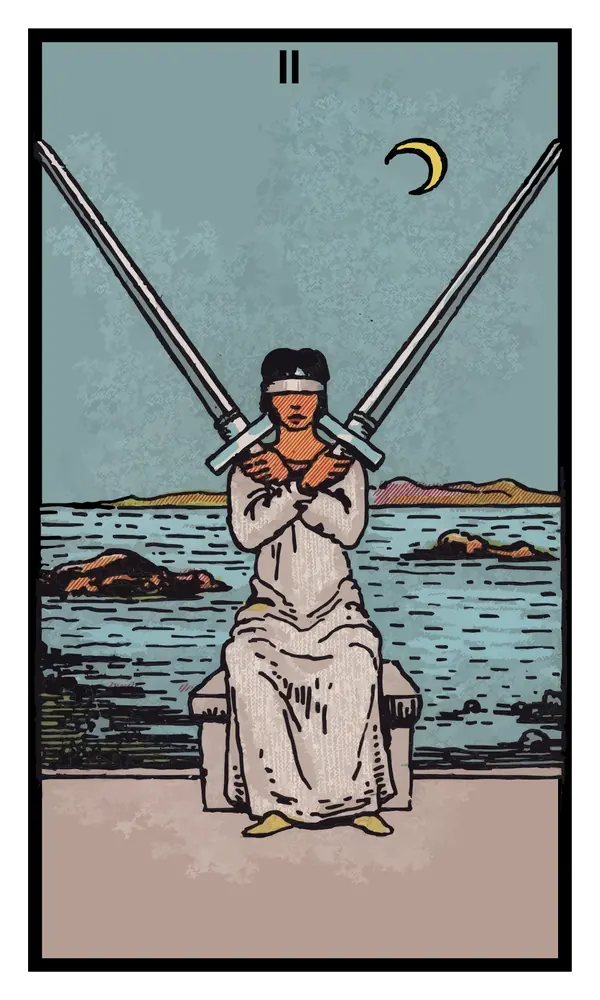
Two of Swords
The Two of Swords in the Rider-Waite-Smith style: a blindfolded figure holding two crossed swords, traditionally read as a choice held in balance.
Read about Two of Swords on Tarot Told Me (opens in a new tab)In the crossroads position, it can be read as a description of the pause itself. Say you draw it there: you might ask what you are not looking at, and whether the blindfold protects you from something or only delays the question. In a fear position, it might point to the fear of choosing at all.
How does The Lovers relate to choice?
The Lovers is often named in discussions of decisions, because the tradition links it with choosing as well as with relationships. Some older decks show a young man standing between two women, which reads easily as a crossroads. Later decks often changed the image, so the choice theme is more explicit in some versions than in others.
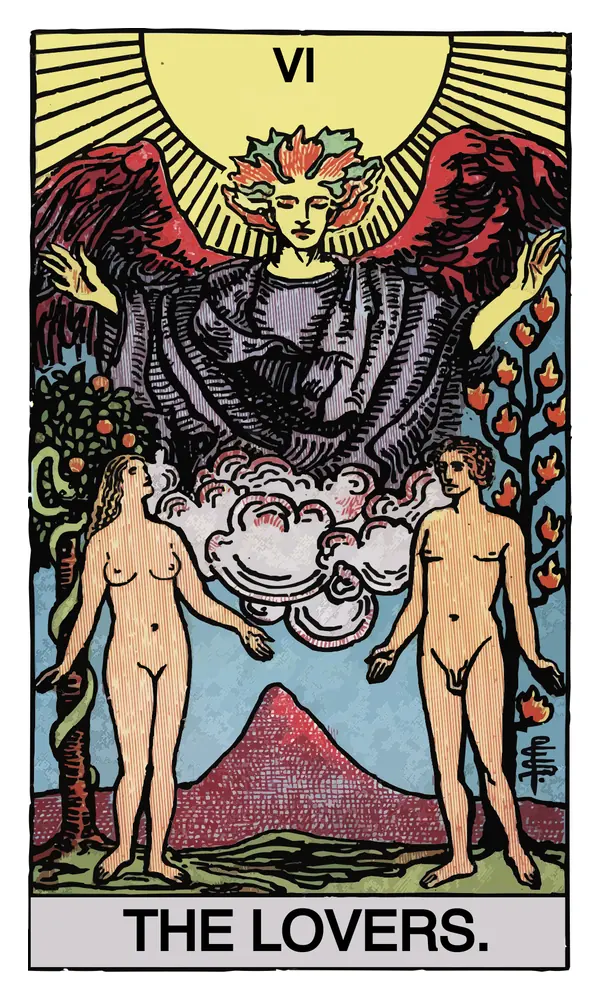
The Lovers
The Lovers, a Major Arcana card traditionally associated with choices that carry weight and with the values behind them.
Read about The Lovers on Tarot Told Me (opens in a new tab)In a value position, it can prompt a question about what you are committing to and why. For a closer look at how it behaves beside other cards, see Lovers vs Two of Cups on this site. Neither card decides anything; they offer a vocabulary.
How do you read the finished spread?
Start with position 1 and say in one sentence what the choice looks like. Then read each column as a short story: the value and the fear of one path, followed by the value and the fear of the other. Only after that compare the columns.
A few questions help the comparison:
- Which fear can be reduced by preparation, and which cannot?
- Which value would you still want if nobody ever noticed?
- Do both columns feel equally detailed, or is one path vague?
Then turn to position 6. It is not an instruction. It is a prompt about what remains yours to weigh, and what you would need to know or ask someone before you decide.
If a card seems unrelated to its position, treat that as information too. Your reaction to a mismatch often reveals what you expected to see.
How to lay out the spread step by step?
Begin before the draw. Write the two options in plain words, one line each. If you cannot describe an option in a line, the first job may be to clarify it, not to draw cards.
Shuffle in whatever way you usually do, and deal the six cards in the order above, turning each one only when you reach its position. Write a sentence or two for each card before moving on. This slows the process and keeps you from reading the whole layout as a single verdict.
If you prefer a shorter format, a three-card draw can hold one option and its fear and value in a compact row.
Tool on Tarot Told Me
Three-card spread
A three-card draw you can use for one option at a time, before or after the six-card layout.
For Tarot Told Me (opens in a new tab) is a reflective tarot app from the team behind this site.
Where the choice involves health, money, legal matters or safety, treat the spread as a way to organize your questions and take the decision itself to a qualified professional.
Questions to ask before you draw
- What are the two options, stated in one plain line each?
- Which fear about each option is mine, and which one belongs to someone else's expectations?
- What would I want from this decision even if no one ever knew about it?
Frequently asked questions
No. The two-path layout with a fear and a value for each is the design of this site. Traditional spreads such as the Celtic Cross have their own histories, and this one makes no claim to belong among them.
No. A card is a printed image and it carries no knowledge of your situation. What the spread can do is help you describe what you are weighing, and the choice remains yours.
Run the spread for the two options that feel strongest, then repeat it with the winner and the next option. Doing it in pairs keeps each comparison readable. Alternatively, write the options down first and see whether some of them can be merged.
A better step is to ask why you dislike it. Strong reactions usually say something about a fear or a hope. If you redraw until you get a comfortable result, the spread stops being a prompt and becomes a search for approval.
No. They are discussed here because their traditional themes of stalemate and choice fit the topic. Any card can appear in any position, and each is read through the question you brought.