Wheel of Fortune and Death together
A turn and an ending sit side by side in the Major Arcana. Here is how the two cards are built, where they come from, and how readers combine them.
By TaronicaPublished
In short
- The wheel of fortune and death pair sets a cycle (card X) beside an ending (card XIII) in the Major Arcana.
- Reading the two together is a modern habit; no historical source gives the pair a fixed meaning.
- Traditionally the Wheel stands for turning and chance and Death for transformation, so the pair invites one question: what is turning, and what is closing?
What is the wheel of fortune and death pairing?
The wheel of fortune and death pairing is a combination of two Major Arcana cards read next to each other in a spread. One belongs to the image of a turning wheel, the other to the image of a figure that cuts down whatever stands in its path. Readers who use the pair usually do so to talk about change that has both a motion and an edge.
It helps to be clear about what kind of pairing this is. Nothing in the early history of tarot assigns a joint meaning to these two cards. The combination is a convention of modern reading, built from what each card is traditionally said to show.
That makes it a good exercise in how tarot is constructed. Each card carries its own symbols, number and place in the sequence, and a pair gets its flavor from how those layers meet.
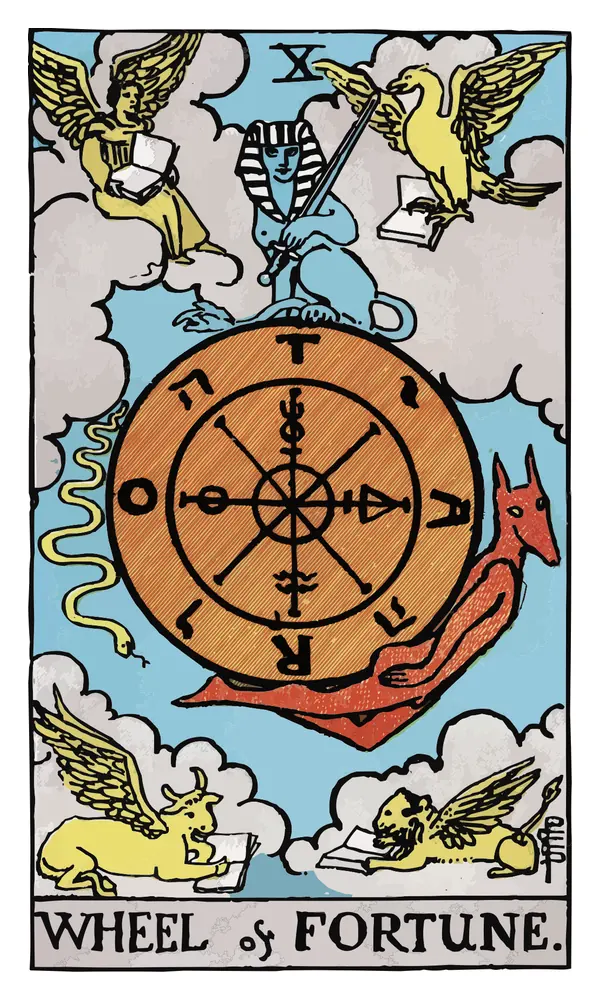
Wheel of Fortune
The Wheel of Fortune in the Rider-Waite-Smith deck: a wheel with a sphinx, a snake and a jackal-headed figure, and four winged creatures in the corners.
Read about Wheel of Fortune on Tarot Told Me (opens in a new tab)Where do the two cards sit in the Major Arcana?
The Wheel of Fortune is the tenth trump in most decks, and Death is card XIII. Between them lie Justice (XI) and the Hanged Man (XII) in the numbering most modern decks follow. Some older decks order the middle cards differently, so the gap is not universal.
Numbers give a second layer. Ten is often described as a completed round, a point where the counting starts again at one. Thirteen is the first step past a full twelve, which is why it is so often tied to thresholds. These are numerological habits rather than rules, and different authors lean on them to different degrees.
There is also a gentle symmetry in the placement. The Wheel closes the first row of ten trumps, and Death opens a stretch that leads toward Temperance and the later cards. Neither card is an endpoint of the sequence, which is worth remembering when Death is mistaken for a final card.
What does the Wheel show in the Rider-Waite-Smith deck?
In the Rider-Waite-Smith deck, the Wheel is a large turning circle marked with alchemical symbols. Around it sit a sphinx, a snake and a jackal-headed figure, and in the four corners appear winged creatures holding books. Other decks arrange the scene differently, so these details belong to one tradition among several.
Arthur Edward Waite's 1910 Pictorial Key to the Tarot lists words such as destiny, fortune, success, elevation, luck and felicity for the card. The list leans toward good fortune, yet the image itself shows figures rising and falling. That tension is the heart of the card: the wheel does not favor anyone, it simply turns.
Readers often connect the Wheel with cycles, timing and the limits of control. A careful reader keeps that as a description of the imagery, not as a statement about what will happen to anyone.
What does Death show in the same deck?
Death is card XIII, and the Rider-Waite-Smith version shows a skeletal rider in armor on a white horse, carrying a black banner with a white rose. People of different ranks stand or lie before the horse. In the distance, a sun rises between two pillars.
Waite's own commentary reads the card as transformation, rebirth, renewal and a change of consciousness, rather than literal death. He points to the sun of immortality shining between the two pillars on the horizon. That reading has shaped most modern descriptions of the card.
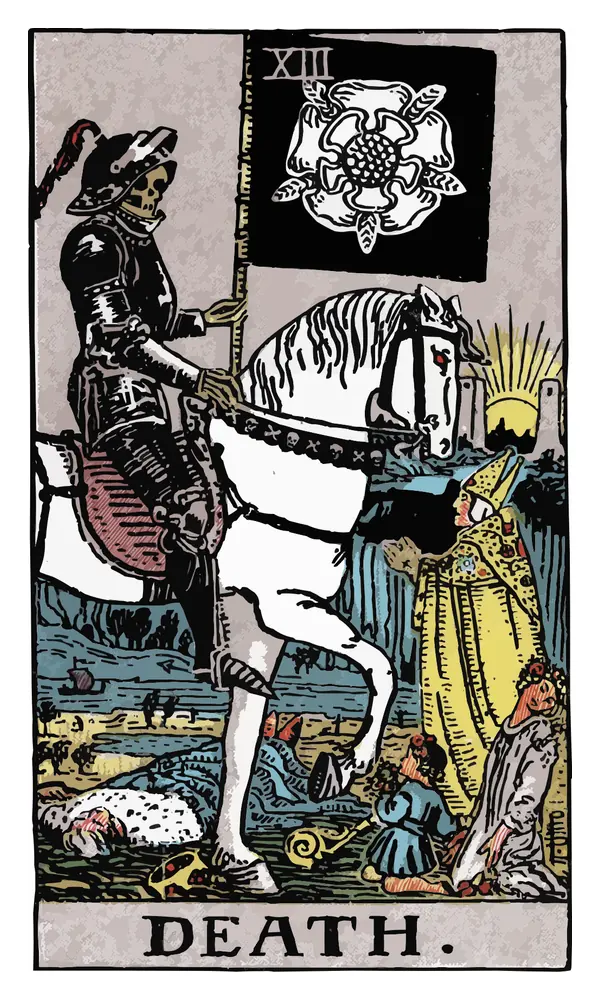
Death
Death in the Rider-Waite-Smith deck: an armored skeleton on a white horse, a black banner with a white rose, and a sun between two pillars in the distance.
Read about Death on Tarot Told Me (opens in a new tab)Some decks even retitle the card "Rebirth" or "Death-Rebirth", which shows how far the tradition has moved from the literal reading. If you want to see how Death behaves beside other heavy cards, the site's pieces on Death and the Tower, and on Death and the Lovers, take up those pairings.
Where do these two images come from historically?
The Wheel draws on the medieval image of the Rota Fortunae, the wheel of the goddess Fortuna. Versions of it appear in tarot imagery from the fifteenth century. In that older picture, figures climb, sit at the top and tumble down, which is a lesson about the instability of worldly position.
Death has a different path. The Tarot de Marseille and the Visconti-Sforza deck leave the name off this card, which is why it is sometimes called the card with no name. The usual figure is the Grim Reaper, a skeleton often shown with a scythe.
So the two cards come from separate visual traditions. One is about fortune and position, the other about mortality and what remains after it. Putting them together is a way of joining two old pictures of time: the circular and the final.
How do a turn and an ending differ?
A turn and an ending are not the same kind of change, and the pair is useful because it lets you separate them. A turn keeps the structure and changes where you stand within it. An ending removes part of the structure.
Readers sometimes sort the contrast like this:
- The Wheel describes motion that returns; Death describes a point that does not return in the same form.
- The Wheel is shown as impersonal and mechanical; Death is shown as a figure that meets everyone, regardless of rank.
- The Wheel's figures are caught in the movement; Death's scene includes a sun on the horizon, a hint of what follows.
- The Wheel is commonly tied to timing and chance; Death is commonly tied to transformation and release.
None of this is fixed. It is a vocabulary readers borrow so that two cards in a row do not collapse into one vague idea of "change".
How might the two cards be read together?
There are two common ways to read the pair, and the order matters to many readers. When the Wheel comes first, the description often runs: a cycle turns, and something reaches its edge. When Death comes first, it runs: something closes, and a new rotation begins.
Say you ask about a long stretch of work in one field and draw the Wheel and then Death. A reader might note the image of a cycle that has run its course and ask which parts of the routine are ending, and which will carry over. That is a prompt for reflection, not a verdict about your job.
Say you ask about a friendship and draw Death and then the Wheel. You might ask what had to close before the relationship could settle into a different rhythm. The cards do not know the answer; they supply two images to hold the question against.
A wheel keeps turning; an ending decides what the next turn is made of.
If a question touches health, money, law or safety, the cards are not the right guide. A qualified professional is.
How can you study the pair on your own?
The simplest practice is to compare the two images, not to chase an outcome. Lay out the Wheel and Death from one deck and look at them in turn, then together. Write down what is moving in each picture and what is still.
A short routine:
- Note the numbers (X and XIII) and what you associate with each.
- List the symbols in each card, such as the sphinx, the banner, the pillars.
- Write one sentence on what turns and one on what closes in a situation you already know well.
- Check whether your two sentences describe the same event or different ones.
For a quick draw to practice with, a three-card spread gives the pair a neighbor to talk to.
Tool on Tarot Told Me
Three-card spread
Draw three cards and see whether the Wheel or Death appears, and where it sits among the others.
If you use a different deck, compare how it draws both cards. The details change a great deal from deck to deck, and the differences are often the most instructive part.
What should you not read into the pair?
A few cautions keep the combination honest. The pair has no ancient rule behind it, so any strong claim that it "always" signals something should be treated with suspicion. Reversed positions, love readings and career readings of this pair are also matters of individual reader preference, not settled tradition.
Death is rarely a literal prediction in the tarot tradition, and the Wheel is not a promise of luck. Both cards are images, and an image does not decide anything for you.
It is also worth resisting the urge to make the pair dramatic. A turn can be mild and an ending can be small, such as a habit, a role or a plan you quietly set down. The cards can carry that scale just as well as a large one.
Frequently asked questions
No traditional source gives this pair a fixed meaning. It is a modern reading convention, built from what each card is traditionally said to show. Readers differ in how they use it, so treat any single account as one view.
In the tarot tradition, Death is generally read as transformation or the end of a phase, not as a literal event. Waite's commentary stresses rebirth and renewal. A pair is a prompt for reflection, not a forecast.
The Wheel of Fortune is X, the tenth trump, and Death is XIII in most modern decks. Some older decks order the trumps differently, so the numbers can vary. Check your own deck if the order matters to you.
The Tarot de Marseille and the Visconti-Sforza deck omit the name on this card, so it is called the card with no name. Some later decks use titles such as Rebirth instead. The reasons are debated, and no single answer is certain.
Many readers say so. Wheel first is often described as a cycle reaching its edge, and Death first as an ending that opens a new turn. This is a matter of convention and personal preference rather than a rule.
Yes. A third card can show what sits between the turn and the ending, or what follows. The site's overview of tarot card combinations explains how to read neighbors in a spread.