The Hermit and the Lovers together: solitude and closeness
The Hermit and the Lovers are two cards about how we stand alone and how we stand with someone. Here is how the tradition builds each card and how to read them side by side.
By TaronicaPublished
In short
- The hermit and lovers tarot pairing sets one figure who withdraws against two figures who meet.
- No old tradition gives this pair a fixed meaning, so any reading comes from combining what each card traditionally stands for.
- The most useful question is not which card wins, but how time alone and time with someone relate in your own situation.
What is the Hermit and Lovers tarot pairing?
The hermit and lovers tarot pairing is a combination of two Major Arcana cards that sit at opposite ends of a familiar tension: being on your own and being with another person. It is not an official spread or a named tradition. It is a reading that appears when these two cards fall next to each other and a reader asks how they speak to one another.
That honesty matters. We found no reliable source that gives a standard combined meaning for the Hermit and the Lovers. What follows is interpretation built from the individual cards, their numbers, their images and their astrological links, and it is offered as a way of looking, not as a rule.
- The Hermit
- The Lovers
Think of the pair as a small conversation. One card asks what happens when a person turns inward. The other asks what happens when a person turns toward someone else. Placed together, they invite you to hold both questions at once.
What does each card show on its own?
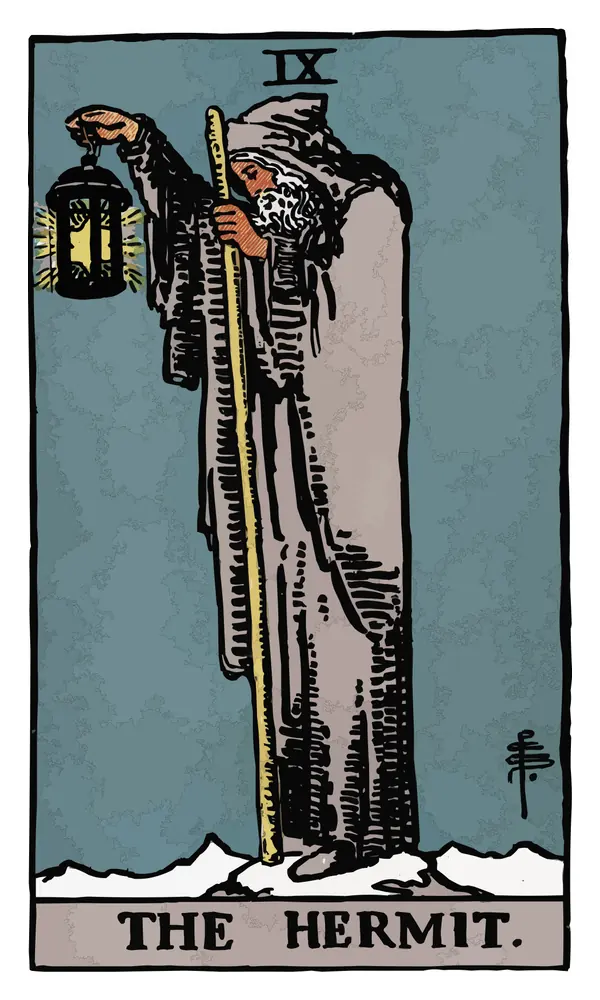
The Hermit is card IX in most traditional decks. In the Rider–Waite version, drawn by Pamela Colman Smith, an old man stands on a mountain peak. He holds a staff in one hand and a lit lantern in the other, and inside the lantern is a six-pointed star.
The Hermit
The Hermit in the Rider–Waite deck: an old figure on a peak with a staff and a lantern holding a six-pointed star.
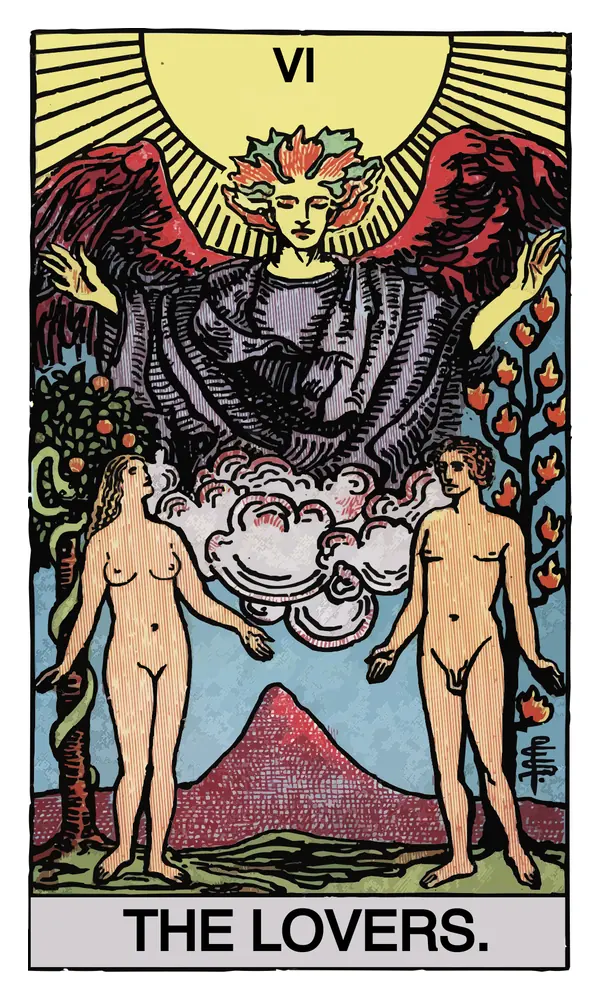
Read about The Hermit on Tarot Told Me (opens in a new tab)The Lovers is card VI. Older decks often show a couple receiving a blessing from a noble or a cleric, sometimes with a third figure between them. The Rider–Waite version changes the scene to Adam and Eve in Eden beneath an angel, which some writers identify as Raphael.
The Lovers
The Lovers in the Rider–Waite deck: two figures in a garden under a winged angel.
Read about The Lovers on Tarot Told Me (opens in a new tab)Waite's Pictorial Key to the Tarot summarizes the Lovers in four words: "Attraction, love, beauty, trials overcome." In some traditions the card also stands for relationships and for choices, and that second reading matters for the pairing below.
How do the numbers 9 and 6 sit together?
Numbers give a quiet structure to this pair. In the numerological habits of tarot, nine comes near the end of a single-digit run. It is often read as a stage of gathering and completing before a cycle turns over.
Six sits near the middle. It is traditionally linked with balance, exchange and the weighing of options, which suits a card that depicts a pair and, in some decks, a decision.
So one card comes late in a sequence and the other comes earlier. If you like to read the Major Arcana as a path, the Hermit follows the Lovers by three steps, and you could say that a person arrives at solitude after having passed through closeness. That is a way of reading the order of the deck, not a claim that life follows it.
Closeness and solitude are not rivals; they are two ways of paying attention.
What do Gemini and Virgo add?
Astrological correspondences give the two cards another point of contact. The Hermit is linked to Virgo, whose ruling planet is Mercury. The Lovers is linked to Gemini, particularly since Waite cut the figures from three to two, which strengthened that association.
Both signs are ruled by Mercury, the planet of thought, speech and exchange. That is a neat detail for this pair, because it suggests two different uses of the same mental energy. Gemini looks outward and talks; Virgo looks inward and sorts.
This does not mean one card is sociable and the other is not. It means the tradition, through Mercury, gives them a common root. A reader can use that as a hint that the cards are less opposed than they first appear.
Is it solitude against partnership, or both?
The obvious reading is a contrast. The Hermit stands for being with yourself, the Lovers for being with someone. If you want a tidy frame, that is the one, and it is the angle most people reach for first.
A more careful reading notices what each card is actually doing. The Hermit in most imagery is not simply isolated; he carries a lamp, which is a light others could follow. The Lovers are not simply merged; the figures stand apart, each with their own gaze, and in many decks a choice or a blessing frames the scene.
So the pair can be read as a question about proportion rather than about opposites. Say you ask whether you are spending enough time alone while in a new relationship. The two cards might prompt you to look at what each kind of time gives you, and what you tend to lose when one crowds out the other.
How does the order of the cards change the reading?
In a spread, position gives the cards a direction. There is no authority that fixes these readings, so treat the following as options, not rules.
When the Hermit comes first and the Lovers second, a reader might see a movement from inward reflection toward connection. The Hermit's lantern has been lit, and the next step is to share what it showed.
When the Lovers come first and the Hermit second, the movement may run the other way: after closeness, a need for quiet, for sorting what was felt or chosen. This is not a loss; in the tradition the Hermit is a figure of deliberate withdrawal, not of abandonment.
When the cards sit side by side with no clear order, such as in a two-card draw about a single situation, they can be read as two needs that exist at the same time. The reading then asks how both can have room.
What do the two images share visually?
It helps to set the pictures next to each other. The Hermit is one figure on a height, in grey and muted tones, looking down at the path. The Lovers are two figures in a garden, with an angel above and a mountain behind.
Notice that the Lovers deck image includes a mountain in the distance, while the Hermit stands on a mountain. The landscape links them. One card shows the person at the summit, the other shows the valley and what grows there.
Both images also hold a source of light. The Hermit's is a lantern with a star; the Lovers' is the angel and the sun above. In both cases the light is something received or carried, not something the figures create alone. That shared motif is why many readers feel the cards belong in the same conversation. For more on how images carry ideas, see our overview of tarot symbolism.
How to read the Hermit and the Lovers in a spread?
Start with a plain question about balance, not about outcome. Say you ask how your time alone and your time with a partner fit together at the moment. Pull two cards, or three if you want a middle one, and look at them before reaching for any meaning.
Then work through four small steps:
- Describe what you see: who is alone, who is paired, where the light comes from.
- Note the order and what it suggests about direction.
- Compare the numbers and the astrological links described above.
- Write one sentence that joins the cards without naming a winner.
A three-card layout gives the pair a third voice, which often resolves the tension by showing what connects them.
Tool on Tarot Told Me
Three-card spread
Try a three-card draw and see how the Hermit and the Lovers speak to a third card in the middle.
If the question touches on health, money, legal matters or safety, take it to a qualified professional. Tarot can organize your thinking, but it cannot replace advice in those areas.
What mistakes are common with this pair?
The first mistake is reading the pair as a verdict. A card knows nothing about you, and two cards together decide nothing. They offer a frame, and the reader decides whether the frame is useful.
The second is treating the Hermit as the cold card and the Lovers as the warm one. The Hermit's lantern is a sign of care in many readings, and the Lovers' scene includes trials as well as attraction. Flattening either card loses the point of putting them together.
The third is guessing what another person feels or will do. If the Lovers appear in a question about someone else, turn the question back to yourself: what do you want from closeness, and what do you need from time alone? That is a question you can answer, and the cards only help you ask it clearly.
The fourth is stating the pairing as established lore. Because we found no standard tradition for it, it is best described as an interpretive reading that you can test against your own experience.
Questions to hold beside the two cards
- When do you feel most like yourself: alone, or with someone?
- What does a quiet hour give you that company does not?
- What does closeness give you that solitude cannot?
- Where in your week is there room for both?
Frequently asked questions
No reliable source we found gives a standard combined meaning. The pairing is interpretive, built from each card's own traditional associations: the Hermit with solitude and inner light, the Lovers with attraction, relationships and choices.
Neither card outranks the other. Both are Major Arcana cards, and the tradition does not give them a hierarchy, so a reading is more useful when it holds both without ranking them.
Not necessarily. In the tarot tradition the Hermit is read as withdrawal, reflection and searching, which can happen inside or outside a relationship. The card describes a stance, not a relationship status.
Yes. In some traditions the Lovers stand for choices and values as well as for partnerships, so the card can speak to any decision that asks you to weigh what you care about.
Pairs that set inward and outward movement against each other, such as cards about retreat and connection, can be read in a similar way. Our guide to tarot card combinations explains how to approach any two-card pair.