Three of Swords and the Lovers together
What happens when the tarot's picture of heartbreak meets its picture of choice? This guide explains the imagery, numbers and suits behind the pair.
By TaronicaPublished
In short
- The three of swords and lovers pair puts a classic image of heartache next to a classic image of choice.
- Read together, the cards are traditionally taken as a question about what a person does after a wound, not as a verdict on a relationship.
- This article explains the imagery, numbers and suits behind the pair, and offers a calm way to study it.
What is the Three of Swords and the Lovers pairing?
The three of swords and lovers combination joins one Minor Arcana card of sorrow with one Major Arcana card that tradition ties to relationships and decisions. It is not an old, fixed formula. It is an interpretive pairing, and this blog offers it as a way to study how the two pictures speak to each other.
The short version is this: the Three of Swords shows a wound, and the Lovers shows a fork. When they land side by side, readers often describe the pair as pain and choice meeting in the same place. Whether that description helps you depends on the question you bring to it.
Nothing in the cards knows your situation. What they offer is a vocabulary, a set of images that people have used for centuries to talk about hurt and about deciding.
What does the Three of Swords show?
In the Rider–Waite deck, drawn by Pamela Colman Smith, the card shows a red heart pierced by three swords against a gray sky of cloud and falling rain. There is no figure at all. The image is stripped down to the wound itself, and that bareness is part of why the card is so easy to recognize.
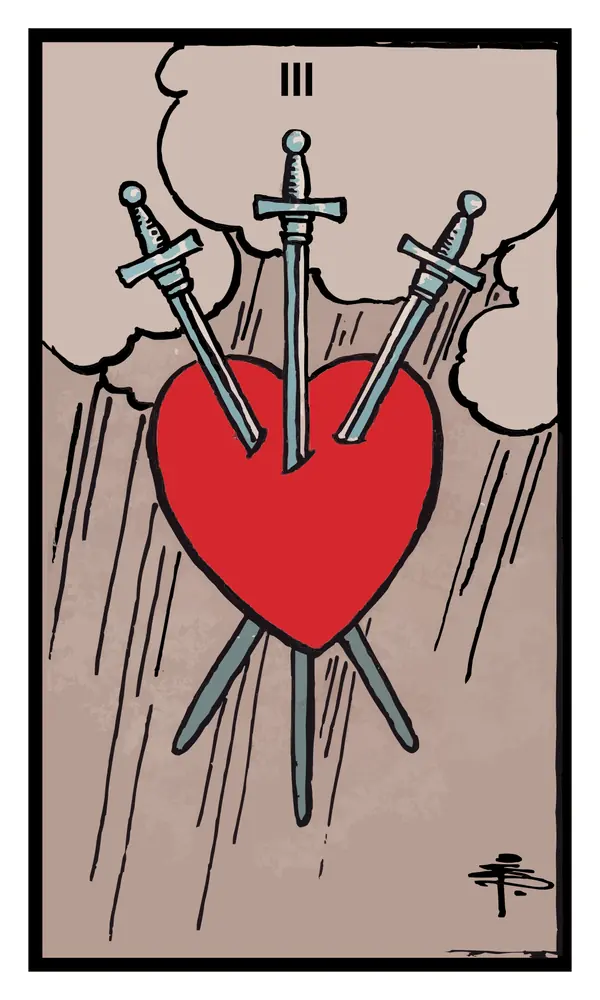
Three of Swords
The Three of Swords in the Rider–Waite tradition: a heart, three blades, and a rain-filled sky with no people in the scene.
Read about Three of Swords on Tarot Told Me (opens in a new tab)In the tarot tradition the card is read as grief, separation or a painful truth finally spoken. Note what the picture leaves out: it does not show what comes after. There is no healing scene and no cause, only the moment of injury.
Swords as a suit is linked to thought, language and conflict. A heart pierced by blades is therefore often taken as pain that arrives through words, realizations or a clear but unwelcome understanding.
What does the Lovers show?
The Lovers is a Major Arcana card, one of the twenty-two trumps that later occult writers gathered under that name. In the Rider–Waite version two nude figures stand beneath a winged angel, with a tree behind each of them and a mountain in the distance. Many commentators describe the pair as Adam and Eve, and the angel is commonly identified as Raphael.
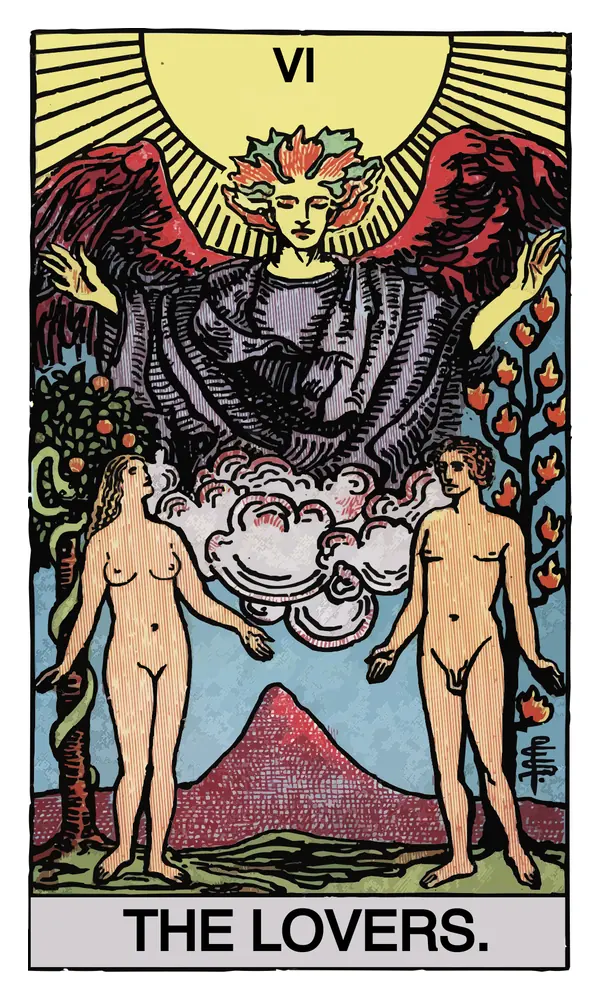
The Lovers
The Lovers in the Rider–Waite tradition: two figures, an angel overhead, a tree behind each figure and a mountain between them in the distance.
Read about The Lovers on Tarot Told Me (opens in a new tab)Older decks tell a somewhat different story. In many Marseilles-style versions a young man stands between two women, with a small Cupid-like figure above, which is why the card has long been connected with a choice at a crossroads. The Visconti-Sforza tarot from around 1460 holds some of the oldest painted trumps, and it shows the card in a very different, more courtly manner.
So the Lovers is not only about romance. In the tarot tradition it is just as much about values, alignment and the act of choosing.
Why do these two cards read well together?
They sit on opposite sides of the same event. The Three of Swords is what has already cut, while the Lovers is what must now be decided. One looks back at a wound and the other looks at a fork.
That contrast is why readers often describe the pair as a question rather than a statement. Say you ask about a relationship that recently ended badly and draw these two. A thoughtful reading would not announce what will happen. It might simply notice that the hurt is real, and that a decision about trust, distance or reconciliation is still open.
There is also a quieter overlap. Both cards deal with closeness: one with the cost of it, the other with the commitment of it. Put together, they can prompt the reader to ask what the pain is teaching about what they actually value.
How does the order of the cards change the reading?
In a two-card line, position tells a small story. Neither order is a rule, but each one suggests a different emphasis, and it helps to name that emphasis out loud before interpreting.
| Order | Common emphasis |
|---|---|
| Three of Swords, then the Lovers | A wound comes first, and a choice follows from it |
| The Lovers, then the Three of Swords | A choice is on the table, and its cost is being felt |
| Side by side in a larger spread | Hurt and decision are tied to the same theme |
The first order is the gentler one, since it places the choice after the pain. The second can read as a warning about a decision made without looking at its price, though it is better held as a question than a prediction.
In a bigger layout, neighboring cards matter more than order. A third card nearby can shift the pair toward grief, toward communication or toward a practical step.
How does this pair differ from the Cups cards?
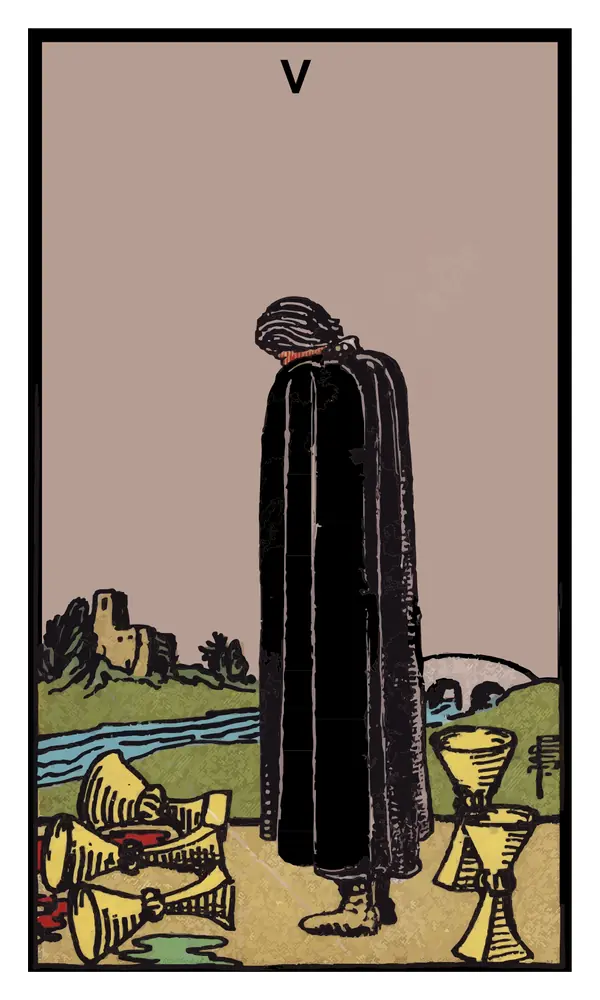
Cups is the suit of feeling, so it is natural to compare. The Rider–Waite Five of Cups shows a hooded figure mourning spilled cups, and the Three of Cups shows dancing figures raising their cups together. Both are emotional, yet neither is built like the Three of Swords.
- Five of Cups
- Three of Cups
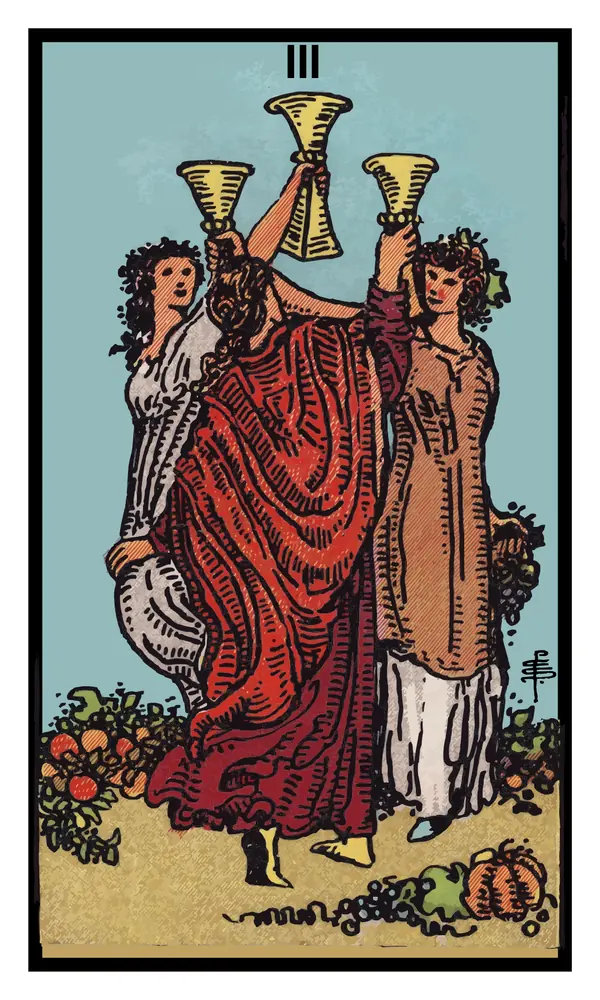
The Five of Cups still shows a person in the scene, looking down, with some cups still standing behind. The Three of Swords has no one in it at all. That is why swords pain is often read as sharper and more mental: it comes from a fact or a sentence, while cups sorrow is more about longing and mood.
The Lovers, for its part, is not a Cups card, and that matters. It is a trump, a larger theme, so it frames the smaller scene of the Swords card rather than sitting beside it as an equal.
What do numbers and suits add to the pair?
The number three is traditionally linked with a first result of two things meeting: something is made, expressed or revealed. In Swords, what is revealed is often a hard truth. Three blades in one heart can be taken as the point where a situation becomes undeniable.
The Lovers is numbered VI in the Rider–Waite order, and six is often tied to balance and exchange. That is a loose association, not a rule, and it is useful mainly for the contrast it offers. Three is about the moment of cutting, while six is about weighing two sides.
Suits do the rest of the work. Swords belongs to air, thought and language, and the Lovers carries no suit at all. A common way to put it is that the Swords card names the injury, while the Major Arcana card names the larger question behind it.
How can you study the pair in a spread?
Treat the pairing as an exercise in noticing rather than answering. Lay both cards out, look at the images for a minute, and write down what you see before you reach for any meaning. Then ask two plain questions: what hurts here, and what is being chosen?
If you want a structure, a simple past, present and future line works well, because it lets the wound and the fork land in separate places. Try it with the tool below, and keep the questions about your own part in the situation.
Tool on Tarot Told Me
Three-card spread
A three-card spread is a simple frame for placing hurt and choice in separate positions.
A few habits keep the reading grounded:
- Describe the pictures before interpreting them.
- Write the question as something you can act on, not something another person will do.
- Note which card draws your eye first, and why.
- Come back to the notes a few days later and see what still stands.
What should you keep in mind?
The pair can be heavy, and it is fine to treat it lightly. If a situation involves ongoing distress, safety concerns, or a major legal or financial decision, a professional is a better guide than any card pair. Tarot can help you put words to a question, but it cannot weigh your circumstances for you.
It also helps to remember that a card knows nothing. Any reading comes from the images, the tradition behind them and the thinking you bring to the table. If the combination stirs something strong, that is worth noticing, and it is also worth putting down for a while.
Finally, avoid turning the pair into a story about someone else. You cannot read another person's mind from two cards, but you can ask what you want to protect and what you are ready to decide.
Frequently asked questions
Not in itself. The Three of Swords is traditionally a painful card, but the Lovers adds the idea of choice and values. Many readers see the pair as honest rather than bleak.
No card pair can say that. The Three of Swords is associated with heartache and the Lovers with relationships, so the combination is often linked to those themes, but it is better used to ask a question than to answer one.
Reversed readings vary a great deal from reader to reader. Some take it as a choice that is hard to face or a mismatch of values, but it is a matter of method, not a rule, so decide in advance how you will read reversals.
You can use it as a prompt for thinking, particularly when a decision follows a painful event. For decisions about health, money or legal matters, consult a professional rather than relying on cards.
No fixed historical reading of this pair is known to us. It is a modern interpretive pairing built from the long-standing images of each card.
Sources
- Wikipedia - The Lovers (opens in a new tab)
- Wikipedia - Rider–Waite Tarot (opens in a new tab)
- Wikipedia - Visconti-Sforza Tarot (opens in a new tab)
- Arthur Edward Waite, The Pictorial Key to the Tarot