Tarot court cards explained: a simple 4×4 key
Sixteen figures, four ranks and four suits. Here is one grid that turns the Pages, Knights, Queens and Kings into a readable system.
By TaronicaPublished
In short
- The sixteen tarot court cards form a 4×4 grid: four ranks across four suits.
- The rank describes a manner or role, and the suit describes the area of life where it shows.
- Read this way, a court card becomes a question about how someone is acting, not a verdict.
What are tarot court cards?
In most decks, tarot court cards are the sixteen figures of the Minor Arcana: a Page, a Knight, a Queen and a King in each of four suits. A full deck has 78 cards, and its 56 Minor cards split into four suits, each running from Ace to 10 and then adding those four courts.
The numbered cards tend to show situations. The courts show figures. In the tarot tradition they are read as people, as roles, or as ways of acting, which is exactly why they feel slippery: the same card may point to someone you know, to a side of yourself, or to a mood you are in.
This guide offers one simple key instead of sixteen separate definitions. It does not give single-card meanings. It explains how the set is built, so that you can work out any court card from two pieces of information.
Why do the courts form a 4×4 grid?
Four ranks multiplied by four suits gives sixteen. Picture a table with the ranks running down the side and the suits across the top. Every court card sits on exactly one crossing, and no two cards share the same one.
That layout is worth holding in mind because it tells you what to ask. Instead of memorizing sixteen portraits, you ask two smaller questions: which rank is this, and which suit is it? The answers combine into a description that is easy to say out loud.
A note on honesty: the grid is a teaching device, not an ancient rule. The deck itself is simply a list of cards, and the habit of reading it as a table is a modern way of organizing the material. It works because the structure underneath really is regular.
What do the four ranks describe?
The rank is the how. It speaks about stage, posture and style of engagement, and it is similar from suit to suit. Readers differ in the exact wording, but the broad pattern is widely shared.
The Page is traditionally the learner or messenger, someone at the start of a path, curious and still trying things out. The Knight is movement: the figure is usually shown on a horse, and the rank is read as pursuit, momentum and sometimes single-mindedness. The Queen and the King are typically shown seated. The Queen is often read as mastery turned inward, with a focus on care, intuition or depth. The King is often read as mastery turned outward, with a focus on authority, responsibility and decisions.
| Rank | Common reading | Question it raises |
|---|---|---|
| Page | Learning, curiosity, a message | What am I just beginning to explore? |
| Knight | Motion, pursuit, drive | Where am I charging ahead, and how fast? |
| Queen | Inner mastery, receptivity | What do I already hold well, close to home? |
| King | Outer mastery, responsibility | How do I use authority and make choices? |
These are tendencies, not laws. A deck's artwork can pull a card in another direction, and the table is a starting point for your own reading.
What does each suit add?
The suit is the where. It names the domain in which the rank is operating. A common modern assignment ties the suits to the four elements: Wands to Fire, Cups to Water, Swords to Air and Pentacles to Earth. Elemental assignments do vary between traditions, so treat this as one widely used scheme and not the only one.
In practice, readers often summarize the suits like this:
- Wands: energy, ambition, creative drive and action.
- Cups: feeling, relationships, imagination and mood.
- Swords: thought, speech, conflict and decisions.
- Pentacles: the body, work, resources and everyday practicalities.
Such lists are shorthand. They cannot cover everything a suit can show, but they are enough to tell you which area of life a court card is probably speaking about. When a question touches health, money or legal matters, a card can add a thought for reflection, yet the practical answer belongs to a qualified professional.
How do you read a card with the grid key?
Say the rank, then the suit, then join them. The result is a short phrase, such as "a beginner in matters of feeling" or "a driven mover in matters of action." Four examples show the method.
The Page of Cups pairs the learner with the suit of feeling. Traditionally it is read as an openness to emotion, a gentle curiosity, or a tender message. Say you draw it while thinking about a friendship: the grid invites you to ask where you are still a beginner at expressing what you feel.
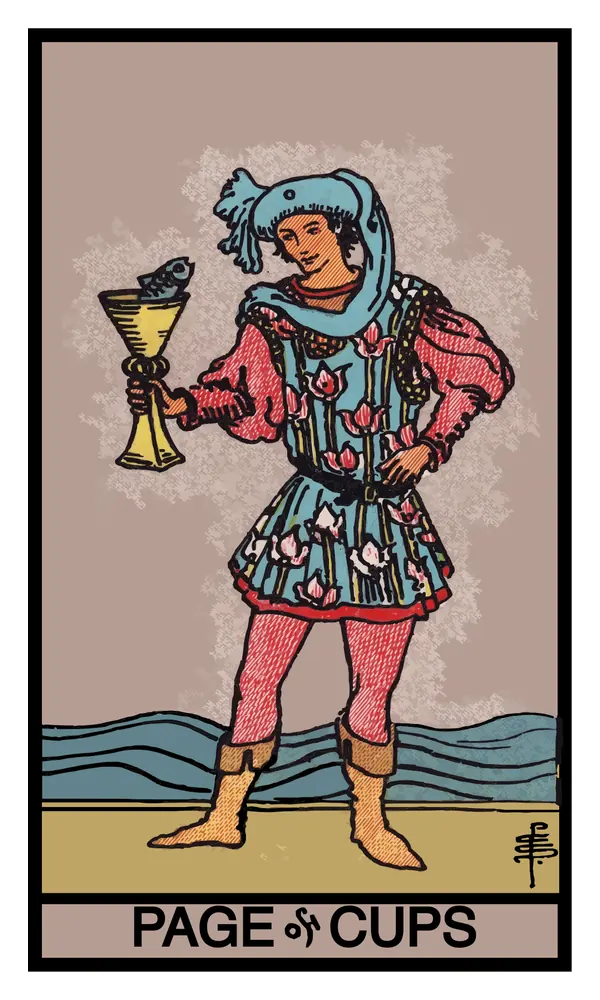
Page of Cups
The Page of Cups: the learner rank in the suit of feeling, often shown holding a cup with a fish inside.
Read about Page of Cups on Tarot Told Me (opens in a new tab)The Knight of Wands pairs motion with the suit of energy and action. In the tarot tradition it is read as enthusiasm and a readiness to set off, with the usual caution that speed is not the same as direction. Say you draw it about a new project: the key asks where you are running forward and whether you have chosen the road.
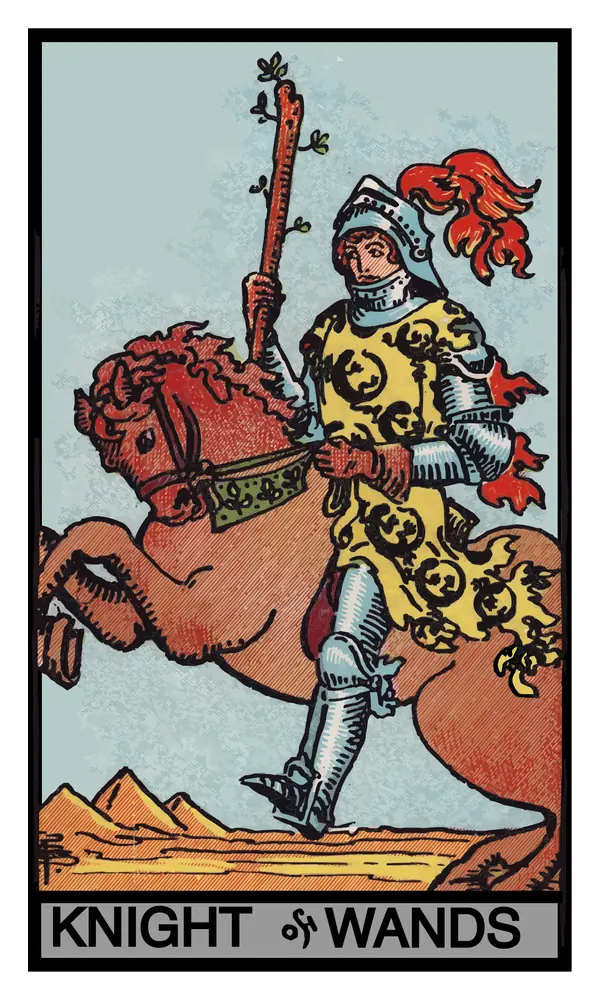
Knight of Wands
The Knight of Wands: the pursuit rank in the suit of action, shown on a horse in a desert landscape.
Read about Knight of Wands on Tarot Told Me (opens in a new tab)The Queen of Swords joins inward mastery with the suit of thought. It is traditionally read as clear perception, directness and a cool kind of honesty. Say you draw it during an argument: you might ask what you see clearly here, and how you can say it without sharpening it into a blade.
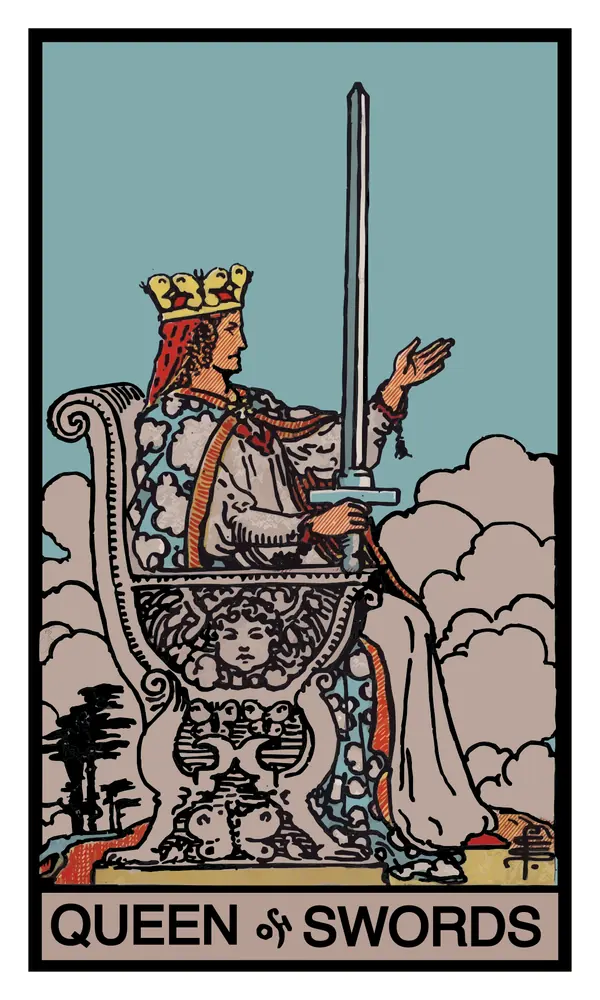
Queen of Swords
The Queen of Swords: the seated, inward rank in the suit of thought, holding a raised sword.
Read about Queen of Swords on Tarot Told Me (opens in a new tab)The King of Pentacles joins outward authority with the suit of resources. Readers commonly connect it with steadiness, provision and practical judgment. Say you draw it over a work question: the grid asks how you handle responsibility and what you are building to last.
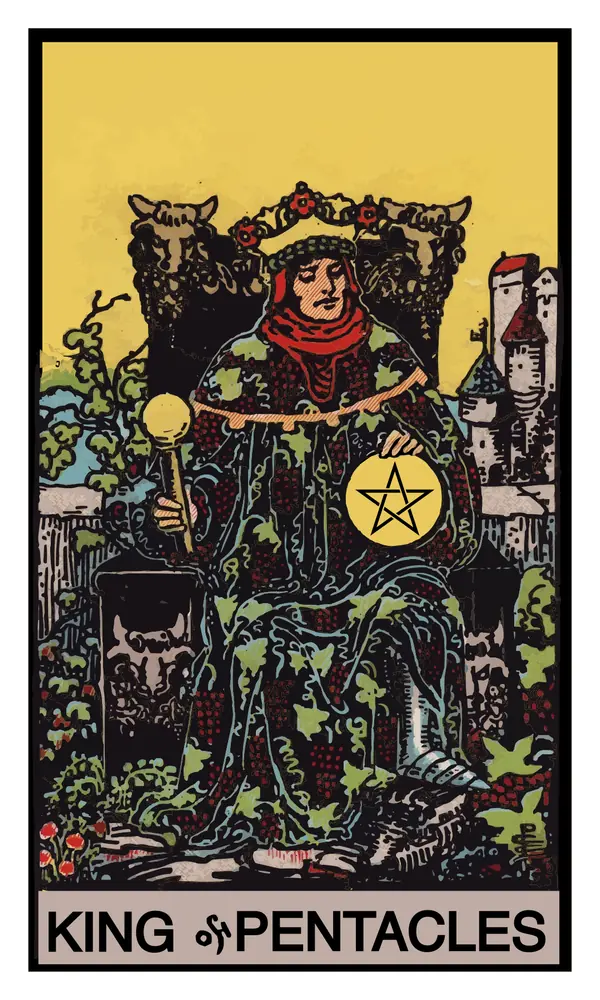
King of Pentacles
The King of Pentacles: the outward, authoritative rank in the suit of resources and the material world.
Read about King of Pentacles on Tarot Told Me (opens in a new tab)Where do the court cards come from?
The court cards came into tarot from playing cards, and the earliest chain of ancestors points to the Mamluk decks. According to the Tarot History blog, the Mamluk suits were Coins, Polo Sticks, Cups and Swords, and those decks carried three male court figures: a King and two Lieutenants. In most early European decks these became the Page, the Knight and the King.
Tarot then added the Queen as a fourth court card, while most decks of the period kept the three-male structure. Why the Queens were added is unclear, and the sources do not record a firm reason. It is wiser to say "we do not know" than to repeat a neat story.
In ordinary playing cards the picture cards are called face cards, and the court cards of tarot are their relatives. In the tarot card game, which predates the divinatory use, the courts rank in the order Page, Knight, Queen, King. The reading key above has a long structural background, even though the reading habits are far more recent.
Do other decks name the courts differently?
Yes, and it is the main reason the grid can seem to break. Names and ranks change between decks, but the count stays at sixteen. The grid survives; the labels move.
The best-known example is the Thoth Tarot, designed by Aleister Crowley and painted by Frieda Harris. One review page says it was begun in 1938, completed in 1943 and published by US Games in 1978. Its courts are the Knight, Queen, Prince and Princess, and its suits are Wands, Cups, Swords and Disks.
The important detail is that the Thoth Knight takes the place of the King, so this is a rename and not an extra card. If you learned on a Rider-Waite-Smith style deck, where the King and Queen are seated and the Knight rides a horse, the Thoth courts can feel confusing at first. The practical advice is to map each deck's titles onto the four positions of the grid before you read: learner, mover, inward master, outward master.
For decks in other traditions, such as Marseille-style ones, check the naming in the deck's own booklet. Court titles differ from deck to deck, and the grid helps only if you place each title in its proper slot.
How to use the grid in a spread?
When a court card lands in a spread, a short routine keeps you from guessing. It takes a minute and works with any deck.
- Name the rank first: learner, mover, inward master or outward master.
- Name the suit and its area of life: action, feeling, thought or resources.
- Join the two into one phrase, as in the examples above.
- Ask whether the card is describing a person around you, a role you are playing, or a mood. All three can be valid, and you decide which fits.
- Look at the neighboring cards to see which area of life they share, and let that shape the reading.
- Write one sentence that begins "I could ask myself..." and keep it open.
A card cannot tell you what another person thinks or plans, so if a court card seems to describe someone else, turn it back to yourself: what do you notice about how you respond to that manner? A simple way to practice is a short spread where you can watch the court card in context.
Tool on Tarot Told Me
Three-card spread
Try a three-card spread and read any court card that appears with the rank-and-suit key.
Tarot Told Me (opens in a new tab) is a reflective tarot app from the team behind this site.
Why do court cards feel harder than the rest?
The numbered cards can lean on a scene: a fallen tower, a crowded table, a bridge. The courts show a single figure with fewer events around it, so the reader has to decide what the figure stands for. That open question is the source of most of the difficulty.
There is also the matter of titles. King and Queen sound like gender and age, which tempts people to match a card to someone's appearance. Many modern readers treat the titles as roles and energies instead, and the grid supports that approach, because a rank describes a manner that anyone of any age or gender can take on.
Finally, the courts invite stereotypes, so a gentle habit helps: read the card as a description of a way of acting at one moment, not a fixed trait. People change their manner many times in a week. Treating a court card as a snapshot keeps it useful and keeps it fair.
Frequently asked questions
A standard 78-card deck has sixteen: four ranks (Page, Knight, Queen and King) in each of four suits. Some decks rename the ranks, as the Thoth Tarot does, but the total stays sixteen.
Not necessarily. In the tarot tradition they are often read as people, but many readers also treat them as roles, attitudes or ways of acting that appear in the situation. Which reading fits is up to you and the question in front of you.
Traditionally the Page is the learner or messenger, at the start of something, while the Knight is shown in motion and is read as pursuit and drive. Both belong to the same suit, so the domain stays the same and only the manner changes.
No. The titles come from a historical court structure, and many modern readers treat them as roles open to anyone. The grid key helps because it asks about manner and domain instead of appearance.
In the Thoth Tarot the courts are Knight, Queen, Prince and Princess, and the Knight stands where the King stands in many other decks. It is a renaming of the same four positions, so the 4×4 grid still applies once you match the titles.