Hand gestures in tarot cards: a close look at the hands
Raised palms, pointing arms and hands reaching from clouds are part of how tarot images tell their story. Here is what is actually drawn, and how far a careful reader can take it.
By TaronicaPublished
In short
- The hand gestures tarot artists drew are small, deliberate poses that carry part of a card's story without a single word.
- Three Major Arcana cards show this clearly: one with an arm raised and another lowered, one with a blessing hand, and one with a raised palm.
- Some readings of these hands can be seen in the picture itself, while others are later interpretation, and it helps to keep the two apart.
What are hand gestures in tarot art?
The hand gestures tarot artists drew are poses of the fingers, wrist or arm that a figure holds on a card. A raised palm, a pointing arm, a hand closed around a staff: each is part of the picture rather than decoration. Because most people meet tarot through images, the hands often do work that a card's title cannot.
This article looks at a few of them up close, mainly in the Rider-Waite-Smith deck, the one most English-language readers learn from. It does not give single-card meanings. The question here is narrower: what is actually drawn, where a pose may come from, and how far a reader can responsibly go from there.
Why do the hands matter in the Rider-Waite-Smith deck?
The Rider-Waite-Smith deck, usually dated to 1909, was designed under the direction of Arthur Edward Waite and illustrated by Pamela Colman Smith. The Newberry Library describes it as building on Golden Dawn correspondences while blending Christian, alchemical and Kabbalistic imagery, with folkloric and popular references added by Smith.
In a deck of scenes, figures have to be doing something, and hands are how figures do things. A hand holds, offers, points, blesses, refuses or reaches. That makes the hands one of the quickest places to look when you want to understand how a picture was put together.
It also explains why the same few gestures return across the deck. A raised hand is a visual shorthand older than tarot: it appears in religious painting, in courtroom imagery and in ceremonial portraits. Smith and Waite did not invent the vocabulary, they chose from it.
What do the Magician's two arms show?
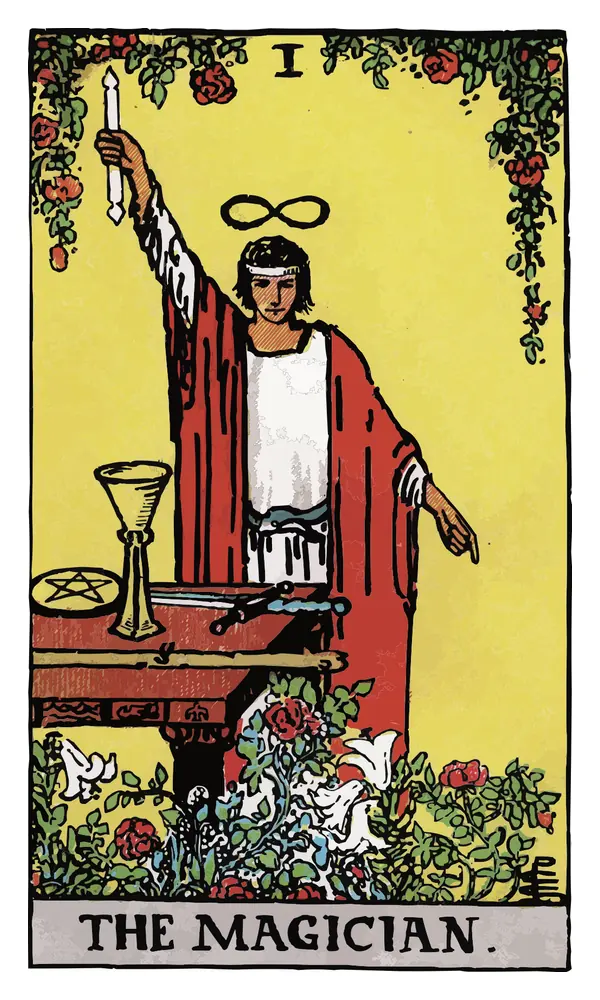
In the Rider-Waite-Smith version, one of the Magician's arms is raised upward holding a wand, while the other points toward the ground. The figure stands behind a table that carries emblems of the four suits, and the pose is the first thing the eye reads: a line running from the sky to the earth, with the body in the middle.
The Magician
The Magician in the Rider-Waite-Smith deck: one arm lifted with a wand, the other pointing down, with the table of suit emblems in front.
Read about The Magician on Tarot Told Me (opens in a new tab)Some readers connect this pose to the occult motto "as above, so below." The Newberry Library links that motto to the theory of correspondences that shaped the deck. It is worth stating plainly that the link is an interpretation: neither Waite nor Smith left a documented statement tying this particular pose to the motto.
The pose does something simpler as well. A figure who connects two levels with his own body is, visually, a go-between. That reading needs nothing outside the image, and it is a good example of a gesture that can be described before it is explained.
How is the Hierophant's raised hand drawn?
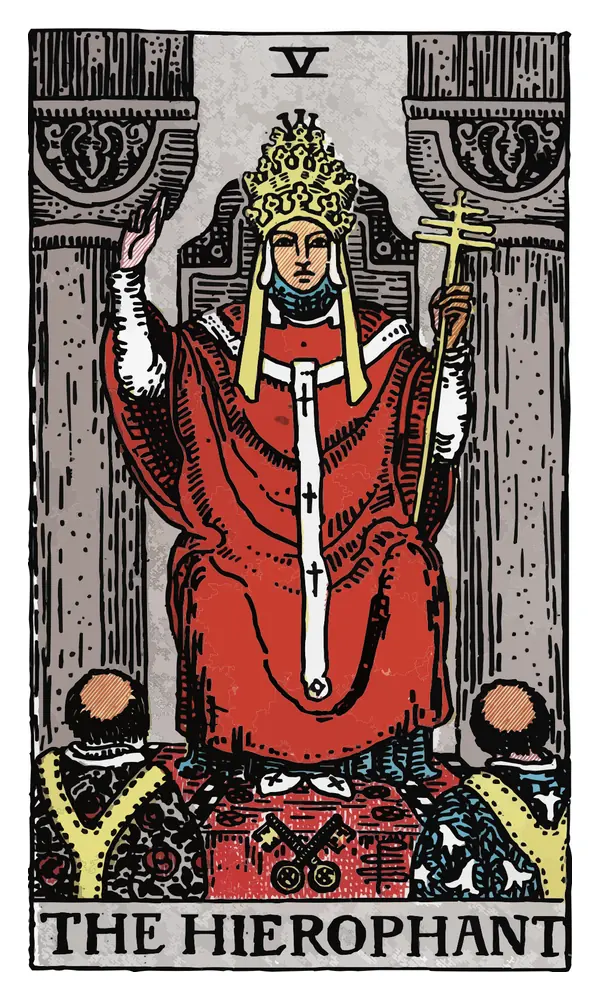
The Hierophant sits between two pillars in the Rider-Waite-Smith image, holding a staff topped with a triple cross in one hand. The other hand is raised, with two fingers extended and two folded, in the posture of a blessing. Two figures in front of him receive the scene.
The Hierophant
The Hierophant in the Rider-Waite-Smith deck: a seated figure with a triple-cross staff and a raised hand giving a blessing.
Read about The Hierophant on Tarot Told Me (opens in a new tab)The two-finger blessing is familiar from Christian religious art, which is why the card is so often described as ecclesiastical. In the tarot tradition, the Hierophant is read as a figure of teaching and established practice, and the hand supports that reading: it is a formal, public gesture, not a private one.
Notice also what the other hand does. It grips the staff, a held object, while the blessing hand is empty and open to the viewer. One hand carries the institution, the other addresses the people in front of it. This is a visual observation, and it is easy to check against your own copy of the deck.
What does the Devil's raised palm echo?
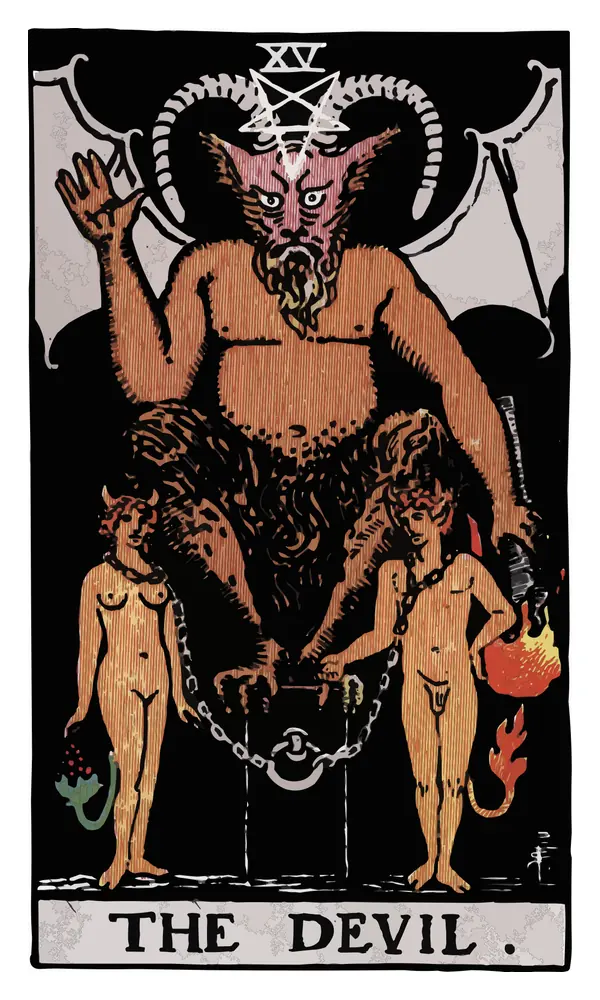
The Devil in the same deck raises his right hand with the palm facing outward, while the other hand holds a torch pointing downward. Below him stand two figures with chains around their necks. Many commentators observe that the raised hand resembles the Hierophant's, and the resemblance looks intentional to many readers.
The Devil
The Devil in the Rider-Waite-Smith deck: a winged figure with a raised right palm and a downward torch above two chained figures.
Read about The Devil on Tarot Told Me (opens in a new tab)There is also a likely ancestor. The nineteenth-century occultist Eliphas Lévi drew a figure often called Baphomet, with one arm raised and one lowered, and this image is commonly cited as a source for the card. If that is right, the Devil shares an arm position with the Magician as well, which is a nice example of one pose being reused for very different ends.
The comparison with the Hierophant is the more useful one. Place the two cards side by side and the same raised hand appears on a blessing figure and on a bound scene. A reader can draw several conclusions from that, but the drawing itself only offers the parallel.
How do the Aces use a hand from a cloud?
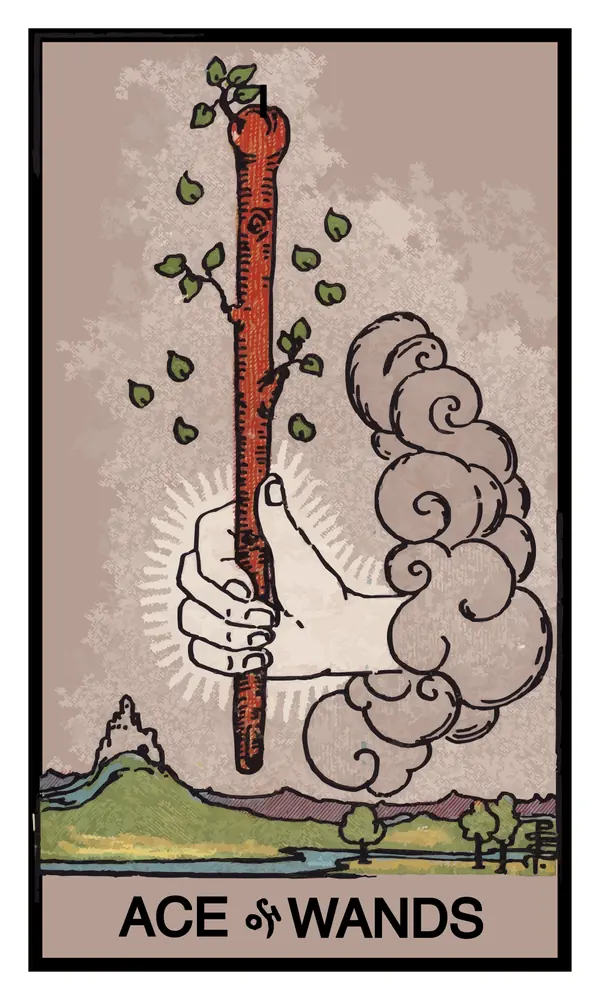
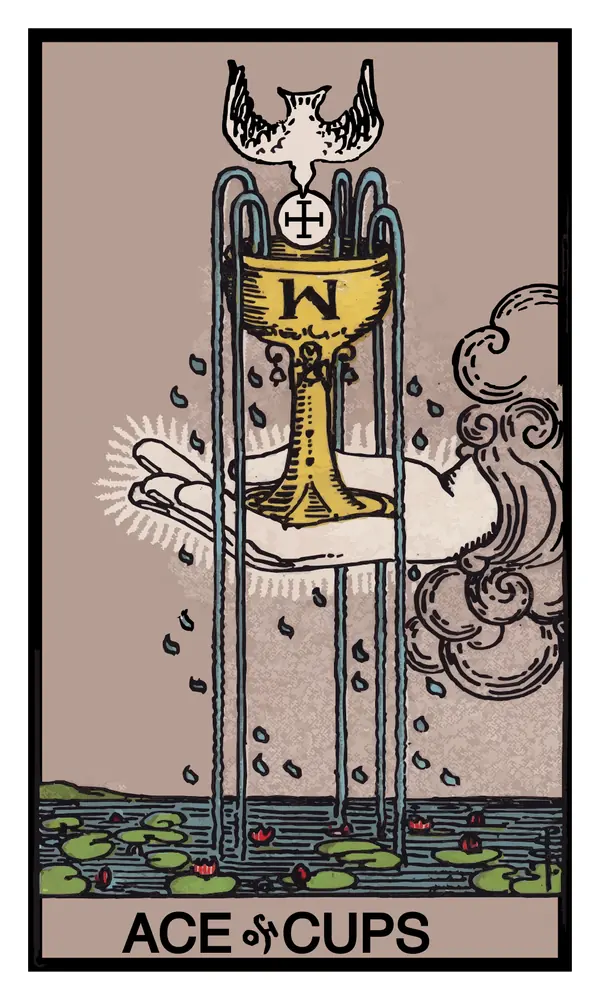
The four Aces of the Rider-Waite-Smith deck follow a different convention: instead of a full figure, a single hand emerges from a cloud and offers one object. There is a wand, a cup, a sword and a pentacle, depending on the suit. The hand has no body and no face, so the object is all that remains.
- Ace of Wands
- Ace of Cups
- Ace of Swords
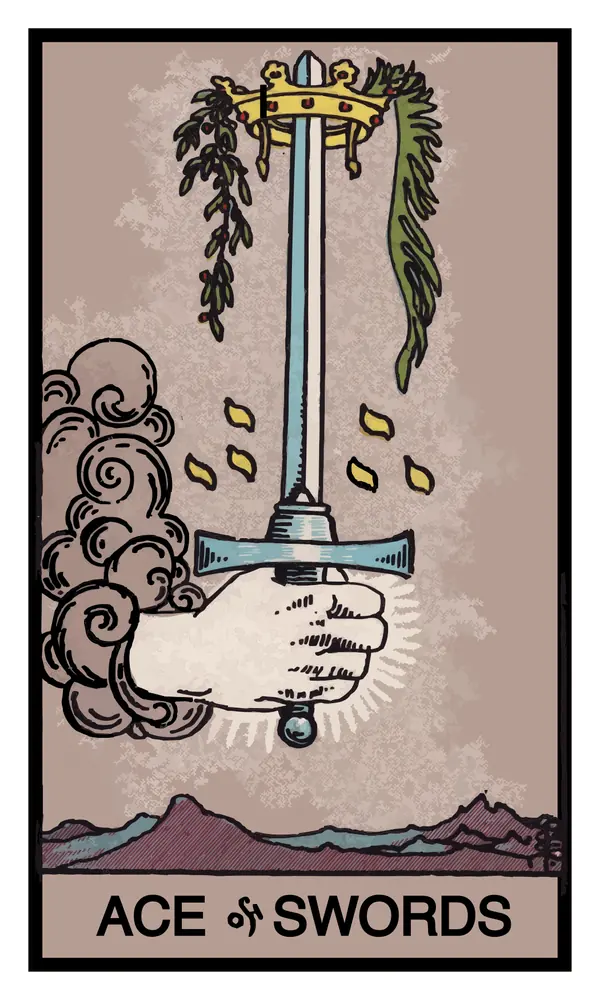
This is a useful contrast with the Magician or the Hierophant. In those cards the hands belong to a character, so they are read together with a face, clothing and setting. In the Aces the hand is almost a symbol of itself: it gives, and what it gives defines the suit.
A hand from a cloud also has a long history in religious art, where it was used to indicate something coming from beyond the scene. Whether Smith meant exactly that is not documented in the sources used here, so it is best treated as a plausible parallel.
Which gestures are documented and which are interpreted?
Three kinds of statement mix easily when people discuss tarot hands. The first is what is drawn: an arm raised, two fingers extended, a palm turned outward. Anyone with the card can verify it. The second is what the iconography historically means in other art, such as the blessing gesture. The third is what a modern reader sees in the pose.
A gesture can be described first and explained afterwards, and the order matters.
Waite's own commentary, The Pictorial Key to the Tarot, is the nearest thing to a primary source for the deck, but it does not explain every pose, and it was written for a different audience than today's readers. Where it is silent, a claim about a hand rests on tradition or on the reader's own judgment, and it is fair to label it that way.
The same caution applies to the popular idea that every hand in the deck was placed to encode a secret. Some probably were chosen with care, since Waite and Smith were working inside an occult milieu. But "probably" is the honest word, and a calm reader can enjoy the imagery without needing certainty.
How to study the hands on a card step by step?
You do not need special training to look at hands. A short routine is enough, and it works with any deck, whether it follows the Rider-Waite-Smith design or not.
- Name what each hand does in plain words: holds, points, offers, rests, blesses.
- Note which hand is raised and which is lowered, and whether the figure faces you or turns away.
- Check what the hand touches: an object, another figure, empty air.
- Compare with a second card from the same deck that has a similar pose.
- Only then ask what the pose might suggest, and write it down as a possibility, not a verdict.
Say you draw three cards for a question about a decision and two of them show raised hands. You might notice the parallel, then look at what each hand is doing before deciding what it adds to your thinking.
Tool on Tarot Told Me
Three-card spread
Draw three cards and use the routine above to describe the hands in each one before you read anything into them.
What can a close look at hands not tell you?
Hands are a clue, not a code. A raised palm on one card does not carry a fixed message across the whole deck, because the meaning depends on the surrounding scene, on the suit and number, and on the deck's tradition. A different deck may draw the same figure with its hands in a very different position.
They also say nothing about your life or about what any other person is thinking. A card knows nothing and decides nothing. If you ask a question about health, money or a legal matter, the images can help you organize your thoughts, but the decision belongs with you and with a qualified professional where one is needed.
What close attention does offer is a slower way of reading. When you describe a hand before interpreting it, you tend to notice more of the card: the objects, the colors and the architecture around it. That habit is useful whatever deck you use.
Questions for your own deck
- Which card in your deck has the most expressive hands, and what exactly are they doing?
- Do any two cards repeat the same gesture in different scenes?
- Which of your readings of a hand comes from the image, and which from something you read elsewhere?
Frequently asked questions
No. The poses described here belong to the Rider-Waite-Smith design. Other decks, including older Marseille-style ones, draw the same figures with different hands or may show no figure at all on certain cards, so always check the deck in front of you.
The sources used for this article do not document her intentions for each pose. She worked under Waite's direction and added folkloric and popular references, according to the Newberry Library. Claims that every hand was a deliberate code are best treated as interpretation.
In the Rider-Waite-Smith image the raised hand follows the blessing gesture familiar from Christian art, with two fingers extended. That is why many commentators describe the card as ceremonial. The drawing itself shows the pose, while the meaning attached to it comes from tradition.
Some readers see it that way and the idea fits the correspondences that shaped the deck. However, the link is an interpretation and not something Waite or Smith documented for this card, so it is fair to hold it as a reading, not a fact.
The drawing does not change, only the way you view it. Some readers treat reversed cards differently, and others do not use reversals at all. A calm approach is to describe the hands first and decide afterward whether the orientation adds anything for you.