Tarot court cards and the 16 MBTI types
Sixteen personality types and sixteen court cards invite a match. Here is one clear scheme, how it is built, and where it stops being reliable.
By TaronicaPublished
In short
- Matching mbti tarot court cards means pairing the 16 personality types with the 16 Pages, Knights, Queens, and Kings, and no official version of that pairing exists.
- The scheme in this article uses the suit for a group of types and the rank for introversion or extraversion, so every choice is visible.
- Treat it as a vocabulary for describing characters, not as a test result or a verdict on who you are.
What are mbti tarot court cards?
Mbti tarot court cards are a community habit rather than a tradition: readers line up the sixteen Myers-Briggs types against the sixteen court cards, because both sets come in a tidy four-by-four shape. Sources that do this, such as blog posts and forum threads, usually assign the cards by suit element, by rank, and sometimes by astrological sign.
The habit is popular because court cards are the hardest part of the deck to read. They can stand for a situation, a person, or a way of acting, and a personality framework gives them a familiar handle.
That convenience has a cost. There is no single canonical mapping, and different authors assign the same card to different types. Anything you read here, including the table below, is one interpretive scheme among several.
What is the MBTI and where does it come from?
The Myers-Briggs Type Indicator was developed by Katharine Cook Briggs and her daughter Isabel Briggs Myers. It builds on Carl Jung's 1921 theory of psychological types. Myers turned those ideas into a questionnaire during the Second World War, and an early version from around 1942 carried the name Briggs-Myers Type Indicator.
The result is a four-letter code. Each letter records a preference within a pair: introversion or extraversion, sensing or intuition, thinking or feeling, judging or perceiving. Four pairs give sixteen combinations.
It helps to know what the framework is not. Neither Briggs nor Myers was a trained psychologist, and Jung built his types from clinical observation rather than controlled studies. The MBTI is better understood as a descriptive language than as a measurement instrument.
How are the 16 court cards built?
Every tarot deck has four suits, and each suit has four court cards: Page, Knight, Queen, and King. Four times four gives sixteen, which is exactly the number of MBTI types. That coincidence is the whole reason the pairing exists.
The suits carry the second set of ideas. Wands are linked with fire, Cups with water, Swords with air, and Pentacles with earth. These links are conventions of the Western tarot tradition, not facts about the cards, but most modern decks follow them.
The ranks are usually described as a progression. The Page is often read as the learner or messenger, the Knight as the one in motion, the Queen as the one who has absorbed the suit inwardly, and the King as the one who commands it outwardly. A mapping scheme has to decide which of these stages should line up with which letters.
Where do the court cards come from historically?
The earliest playing cards that resemble tarot suits came through the Mamluk deck. Its suits held ten number cards and three court cards, named Malik, Na'ib Malik, and Thani Na'ib: a king and two lieutenants, all male figures.
European decks adapted this pattern. In the tarot card game, the court ranking runs Page, Knight, Queen, King, which gave later occult tarot its four-rank court. One theory holds that the Pages were added as a second feminine figure to balance the courts, but that remains a theory and not an established fact.
The point for our topic is that the court cards were never designed as personality types. They began as ranks in a game. Reading them as characters came much later, and pairing them with a twentieth-century questionnaire is later still.
How can 16 types be matched to 16 cards?
Any scheme needs two rules: one for the suit and one for the rank. Many published versions borrow the four temperament groups used in popular MBTI writing, then assign one group to each suit by comparing the group's character with the suit's element.
The scheme used here is deliberately simple. Sensing types who prefer perceiving (the action-oriented group) go to Wands, intuitive feeling types go to Cups, intuitive thinking types go to Swords, and sensing judging types go to Pentacles. The logic is loose by design: fire for restless activity, water for feeling and imagination, air for analysis, earth for duty and upkeep.
For rank, Pages and Queens receive the introverted types, and Knights and Kings receive the extraverted ones. Within each suit, the Page and Knight share the same remaining letters, as do the Queen and King. You may disagree with any of these choices, and that is a reasonable reaction.
How do four sample pairings read?
Say you want to see how the scheme behaves in practice. Take the Page of Cups first: in this table it sits with INFP, an introverted type in the imaginative group, which echoes the Page's traditional image of a young person gazing at a fish rising from a cup.
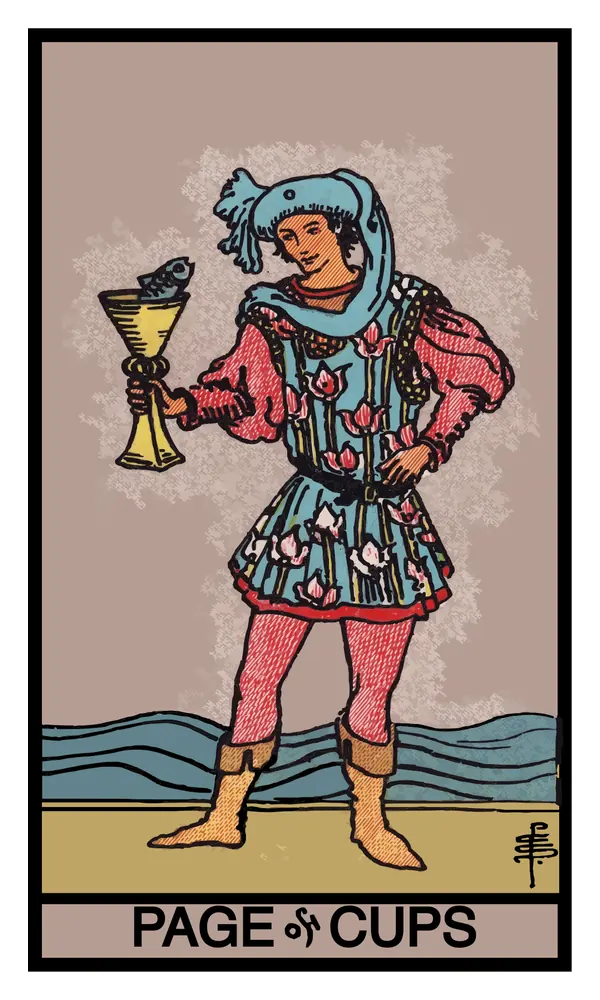
Page of Cups
The Page of Cups, a young figure holding a cup with a fish emerging from it, paired here with INFP.
Read about Page of Cups on Tarot Told Me (opens in a new tab)The Knight of Wands is paired with ESFP. The Knight is traditionally shown in motion, and the extraverted, action-minded type fits that single image, though the fit is partly a matter of taste.
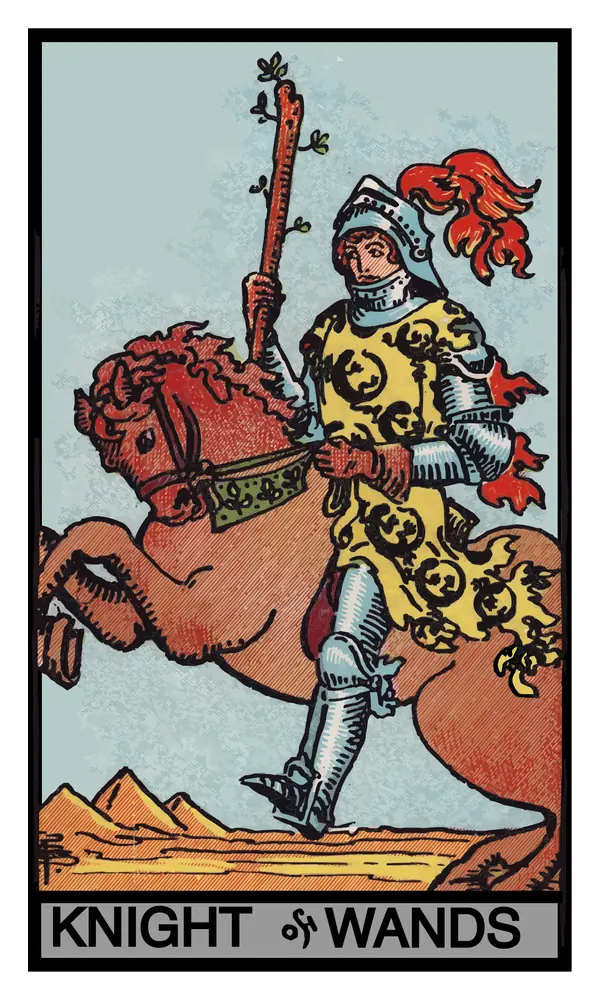
Knight of Wands
The Knight of Wands on a rearing horse, paired here with ESFP.
Read about Knight of Wands on Tarot Told Me (opens in a new tab)The Queen of Swords lands on INTJ, an introverted analytical type. The Queen's raised sword and level gaze are often described as clarity and independence, which is a comfortable match for that profile.
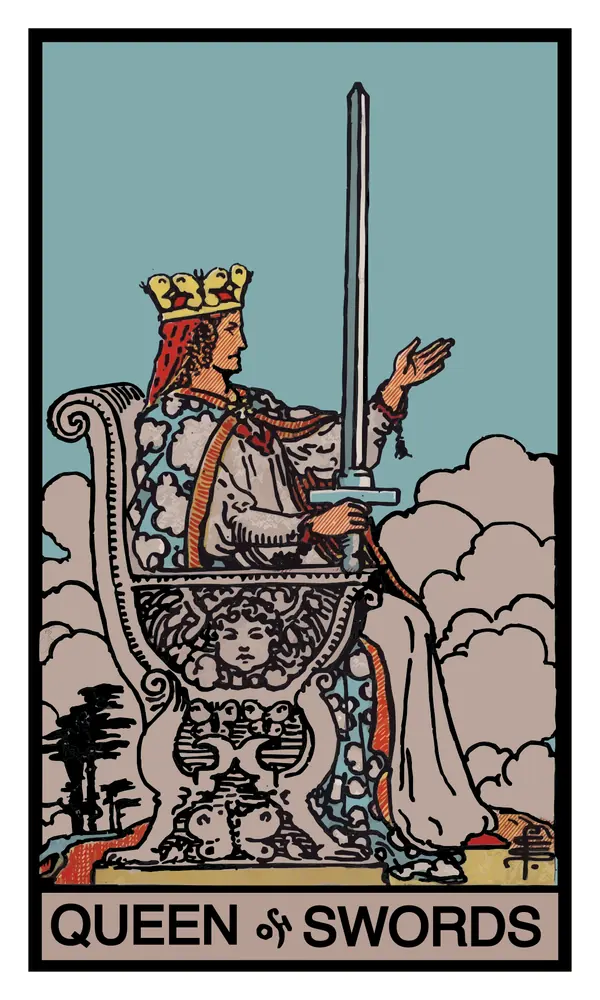
Queen of Swords
The Queen of Swords, seated with a raised sword, paired here with INTJ.
Read about Queen of Swords on Tarot Told Me (opens in a new tab)Finally, the King of Pentacles goes to ESTJ: an extraverted type focused on structure and responsibility, set beside a figure traditionally linked with material stewardship.
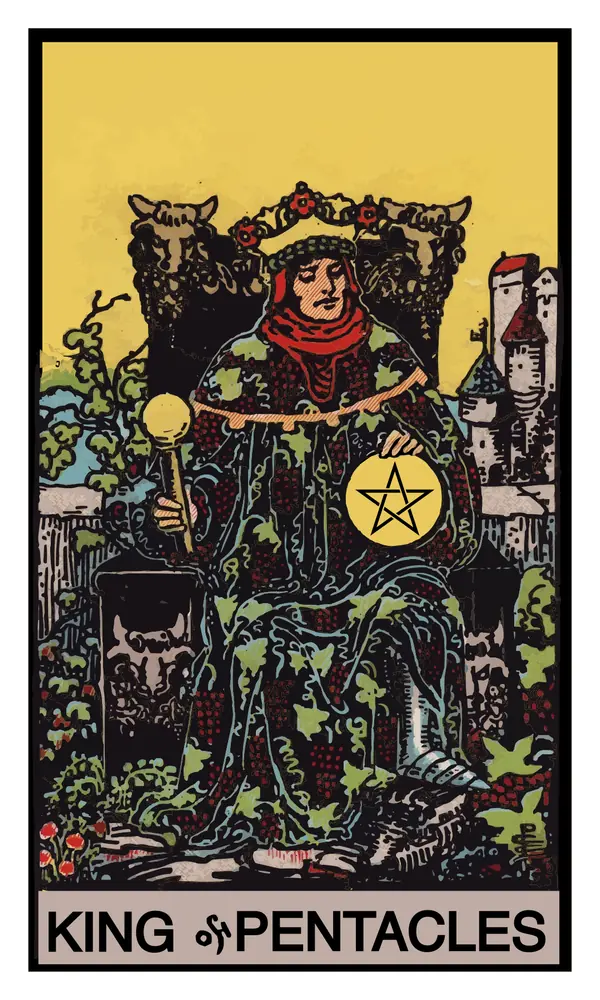
King of Pentacles
The King of Pentacles surrounded by symbols of abundance, paired here with ESTJ.
Read about King of Pentacles on Tarot Told Me (opens in a new tab)Notice how each pairing leans on one visible detail of the card. That is the method's strength and its weakness: it works as storytelling, and it is easy to bend toward whichever answer you already expected.
How reliable is the MBTI, and does it matter here?
It matters somewhat. The publisher's own page on validity and reliability acknowledges that critics claim the questionnaire's either-or scoring is unreliable over time in test-retest studies. A recent article in the PMC archive makes a similar point, saying the MBTI has low test-retest reliability and forces continuous traits into two boxes.
There is a counter-view. One Psychology Today opinion piece argues the MBTI is no less valid or reliable than other personality tests. Reasonable people disagree, and you do not need to settle it to read this article.
What follows for tarot is modest. If a person's type can shift between sittings, then a card fixed to that type is fragile. That is a good reason to use the table as a conversation starter and not as a label.
How can you use the table without boxing yourself in?
Start from the card and not from your type. Pick a court card, read its image, and ask which of its qualities you recognize in a person or in yourself on a given day. Only afterward glance at the table to see which type the scheme attached to it.
If you already know your four letters, look at your card as one candidate rather than as an answer. Then look at the three neighbors in the same suit and ask whether any of them fits better. A mismatch is useful information about the scheme.
A simple three-card draw can serve as a low-stakes experiment: choose a situation, then note which court card appears and how it differs from the table's suggestion.
Tool on Tarot Told Me
Three-card spread
Try a three-card draw and compare any court card that appears with the table below.
Keep in mind that nobody else's type is yours to assign. Describe your own behavior, and leave other people's inner lives to them.
Where does this scheme stop working?
It stops working wherever a card is asked to carry more than an image can hold. A court card can describe a mood, a role in a story, or a person, and a four-letter type covers only a slice of any of those.
It also stops working when the table is treated as fixed. Another author may put the Queen of Swords with a different type, and neither version is wrong in a way the cards could settle. Hold the pairings loosely and keep reading the pictures.
| Suit and group | Letters shared | Types (Page, Knight, Queen, King) |
|---|---|---|
| Wands, fire | S and P | ISFP, ESFP, ISTP, ESTP |
| Cups, water | N and F | INFP, ENFP, INFJ, ENFJ |
| Swords, air | N and T | INTP, ENTP, INTJ, ENTJ |
| Pentacles, earth | S and J | ISFJ, ESFJ, ISTJ, ESTJ |
Frequently asked questions
No. The sources that match the types to the cards are community and blog writings, and the authors assign the cards differently. Any chart, including the one here, is an interpretive scheme.
There are 16 MBTI types and 16 court cards, four ranks in each of four suits. The match in count is a coincidence of structure, and it says nothing about the cards having been designed for personality.
No. A type is a questionnaire result, and a card is an image with a long set of associations. Many readers find that they recognize themselves in more than one court card depending on context.
In this scheme each type has exactly one card, but other schemes allow overlaps or assign by astrological sign or by element instead. Both approaches are common in community writing.
No. Personality frameworks and tarot are reflective tools, not guides for health, money, legal, or safety choices. Those questions belong with a qualified professional.