How to choose your first tarot deck
Six plain questions about artwork, tradition, size, card stock, guidebook and budget will narrow a crowded shelf to a few decks that fit you.
By TaronicaPublished
In short
- Your first tarot deck works best when it is easy to read at a glance, comfortable to hold and supported by a clear guidebook.
- Six questions cover the choice: artwork, tradition, clarity, size and card stock, guidebook, and budget.
- No deck is the correct one, but the Rider–Waite–Smith family is a common starting point because so much teaching material assumes it.
What is a first tarot deck, and what should it do?
A first tarot deck is the set of 78 cards you learn the system on, and its job is to make learning easier rather than to be perfect. It should be readable, comfortable and well documented, so your attention goes to how tarot is built instead of to deciphering the cards. Everything beyond that is taste.
Tarot decks share a skeleton: 22 Major Arcana and 56 Minor Arcana in four suits. They differ in how that skeleton is drawn, named and explained. A deck can follow one tradition closely or reshape it, and the difference shows up fastest in the numbered cards of the suits.
The checklist below has six questions. You do not need a firm answer to every one of them. Two or three clear preferences are often enough to turn a full shop shelf into a handful of candidates.
Question 1: do you want a scene or a pattern on every card?
The numbered Minor cards, from two to ten, are where decks differ most. In the Waite–Smith tradition each of them carries a small illustrated scene, so a card shows people, objects and a mood. In many Marseille-style decks the same cards show the suit symbols arranged in a pattern, much like playing cards, and the reader works from count and layout.
Neither approach is better in itself. Scenes give you images to describe and remember, which many learners find friendly. Patterns ask you to rely on numbers, suits and the court and Major cards, which some people find clean and others find bare.
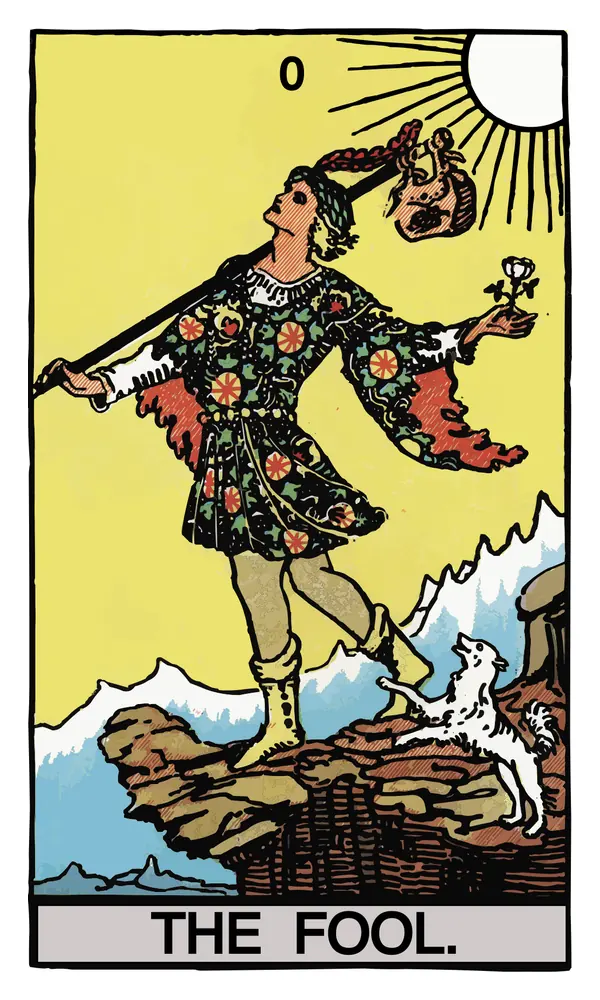
The Fool
The Fool in the Waite–Smith tradition: a figure at a cliff edge with a small dog, a typical example of a scene you can describe in your own words.
Read about The Fool on Tarot Told Me (opens in a new tab)Say you remember stories better than lists. A scene-based deck would probably feel natural, because each card gives you a situation to put into words. Say instead you like structure and symmetry. A pattern-based deck may suit you, and the numbers themselves become the lesson.
Question 2: which tradition should the deck follow?
Most decks on sale descend from a few families, and knowing the three classic ones helps you read product descriptions. The Rider–Waite–Smith deck was commissioned by Arthur Edward Waite from the artist Pamela Colman Smith and published by William Rider & Son in 1909. It is also called Waite–Smith, a name that credits the artist, and it is the model for a very large number of modern decks. You can read more in the Wikipedia article on Pamela Colman Smith (opens in a new tab).
The Tarot de Marseille has roots in the 15th century and spread from Italy into France. Its Minor cards are mostly pattern-based, and the family is valued for its old woodcut look. The Wikipedia entry on the Tarot of Marseilles (opens in a new tab) gives a fuller account.
The Thoth Tarot was designed by Aleister Crowley and painted by Lady Frieda Harris, and it was published in 1969. It is dense with astrological and esoteric references, which attracts some readers and slows others down.
| Family | Minor cards | Character |
|---|---|---|
| Rider–Waite–Smith | Illustrated scenes | Widely taught, easy to find guides |
| Tarot de Marseille | Mostly suit patterns | Historical, graphic, minimal |
| Thoth | Titled, richly symbolic | Esoteric, layered, demanding |
If you are unsure, a Waite–Smith-style deck is the lowest-friction choice. Books, courses and spread diagrams usually assume it, so you will spend less time translating.
Question 3: is the artwork clear enough to read at a glance?
Beautiful and readable are not always the same thing. Some modern decks use abstract shapes, very dark palettes or tiny hand lettering that look striking on a screen and are tiring across a table. Before you buy, look at how each card holds up when it is small and you are tired.
A few things are worth checking in the preview images. Are the figures distinct from the background? Are the card titles and numbers printed where you can see them? Are the suits easy to tell apart without reading a caption?
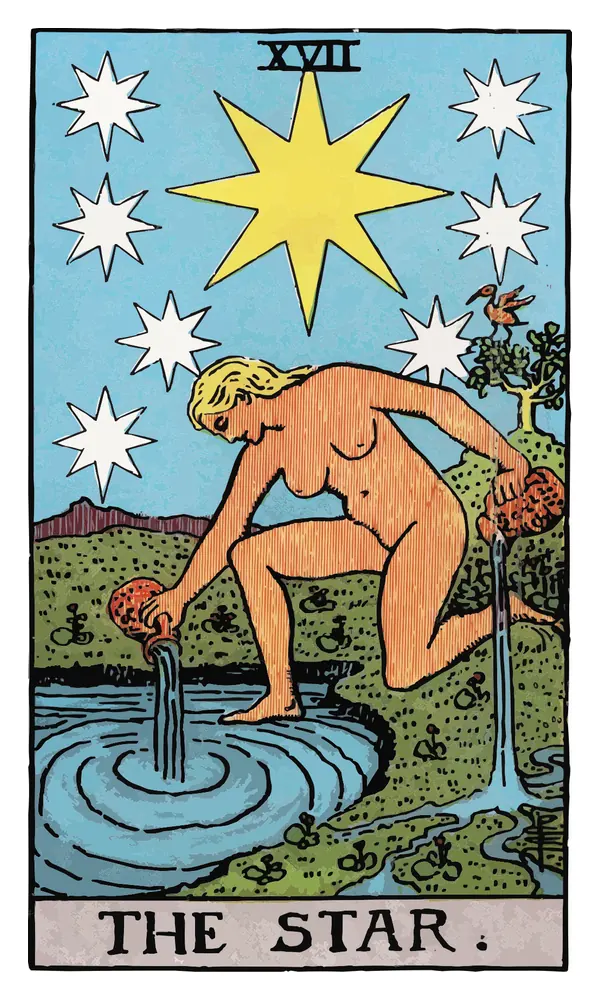
The Star
The Star: a good test card, since its figure, water and stars should stay clear even when the image is small.
Read about The Star on Tarot Told Me (opens in a new tab)Cards with many fine details, like a night sky full of stars, are a handy test. If the detail turns to mud in a thumbnail, it may do the same in print. Colors matter too, and the way a palette is built is covered in our overview of tarot color meanings.
Question 4: what size and card stock suit your hands?
The standard tarot card is larger than a poker card, and many decks are noticeably big. If your hands are small, or you like to shuffle in the overhand style, a large deck may be awkward. Many publishers also sell a smaller edition of popular decks, so it is worth reading the dimensions on the product page.
Card stock is the other physical factor. Thin stock bends easily and shows wear quickly, while very thick stock can be stiff to shuffle. A matte or lightly coated finish is usually easier to handle than a glossy one that sticks together.
Edges matter more than they seem. Gilded edges look elegant but can feel tacky at first, and borderless cards show wear sooner than those with a white margin. None of this changes what the cards mean in the tradition, but it changes whether you pick the deck up at all.
Question 5: does it come with a useful guidebook?
A guidebook is the quiet reason many people stay with a deck. A good one explains the structure of the deck, such as the suits, the numbers and the court cards, and not only a list of single-card phrases. It should also tell you what the artist or designer chose to change from tradition.
Check whether the booklet is a pamphlet of a few lines or a real book. Small booklets are fine if you plan to study from a separate reference. If you want one source, look for a deck sold with a full guide, or plan to buy a standalone book on the same tradition.
For the Waite–Smith deck, a well-known companion is Waite's own The Pictorial Key to the Tarot, which is discussed on Wikipedia (opens in a new tab). Reading the original is optional, but it shows how the tradition describes itself.
Question 6: what budget makes sense?
Prices vary widely, from inexpensive mass-market editions to limited artist editions. A sensible rule is to spend enough for sturdy card stock and a readable print, and no more until you know your tastes. Prices change often, so compare current listings rather than relying on a figure from an article.
Be careful with unofficial copies sold at very low prices. They can have blurry printing, wrong colors or missing cards, and they undercut the artists whose work the deck is built on. If you want a classic design, buy from a recognized publisher or a seller who names the edition.
If the budget is tight, remember that a deck is a tool for learning, not a trophy. A plain, sturdy edition of a standard deck often teaches more than an expensive collector's piece you are afraid to handle.
How to test a deck before you buy it?
You can test most decks without spending anything. A few small checks will show whether a deck fits your habits, and they take only a short evening.
- Look at full-card images of at least ten cards, including some Minor cards from different suits.
- Check the size and weight on the product page against a card you already own.
- Read a sample of the guidebook, if the publisher offers one.
- Look for flip-through videos and notice whether the details stay clear.
- Draw a few cards from a free digital layout and note which images you can describe easily.
Tool on Tarot Told Me
Three-card spread
Draw a free three-card layout and notice whether the images give you something to describe. This helps you see which style of artwork you find readable.
Tarot Told Me (opens in a new tab) is a reflective tarot app from the team behind this site.
What if your first deck turns out to be the wrong one?
That is common and not a problem. Many readers own several decks, and their first one often becomes the reference they return to for comparison. What you learn about structure, such as suits, numbers and court ranks, carries over to every deck in the same tradition.
If a deck feels wrong after a few weeks, ask what exactly bothers you. It may be the size, the artwork or the lack of a guide, and each of those has a simple fix. You can then pick a second deck with a clearer idea of what you want.
Questions to ask before you choose
- Do I remember images or patterns more easily?
- How much detail can I read comfortably on a small card?
- Do I want one tradition with many guides, or a style I like even if guides are scarce?
- What size and weight will I actually shuffle?
Frequently asked questions
It is the most common recommendation, because its illustrated Minor cards and the large amount of teaching material built around it lower the learning curve. That does not make it the best for everyone. A person who likes pattern-based cards may be happier with a Marseille-style deck.
A guidebook helps most when it explains how the deck is structured, not only a phrase for each card. If the booklet is short, you can pair the deck with a separate book on the same tradition.
Not in itself. Check that all 78 cards are present, that the edges are not badly worn and that the cards shuffle smoothly. Beliefs about gifted or bought decks are customs, not rules of the tradition.
Choose the size you can shuffle comfortably. Large cards show more detail, while small cards are easier to handle in small hands. Many popular decks come in both sizes.
Yes, if the style appeals to you. Expect to lean more on a reference book, because the Thoth deck is very symbolic and the Marseille Minor cards have no scenes to describe.