Tarot symbolism: a beginner's guide to reading the pictures
Tarot symbolism is a visual language of figures, objects, colors and numbers. Here is how to read it on Rider–Waite–Smith cards, one step at a time.
By TaronicaPublished
In short
- Beginners can treat tarot symbolism as the visual vocabulary of a deck: figures, objects, colors, numbers and gestures that repeat from card to card.
- In the Rider–Waite–Smith deck, Pamela Colman Smith drew the pictures to A. E. Waite's instructions, and his Pictorial Key describes many of them.
- Read the picture first, check a trusted source second, and treat any single symbol as a clue rather than a verdict.
What is tarot symbolism?
Tarot symbolism is the set of images, colors, numbers and gestures that a deck uses to carry ideas, together with the habit of reading them as a language rather than as decoration. A card is not a word with one fixed definition. It is a small scene in which each object may point somewhere.
This guide uses the Rider–Waite–Smith deck, because it is the most widely used model and because almost every card shows a full scene. Many later decks borrow its layout, so learning its pictures helps with others too. We do not list single-card meanings here. The aim is to teach you how to look.
Where do Rider–Waite–Smith symbols come from?
The deck was first published by William Rider & Son in 1909. It follows the instructions of A. E. Waite and was illustrated by Pamela Colman Smith. Both were members of the Hermetic Order of the Golden Dawn, an occult society, which is one reason the deck draws on esoteric imagery.
You will see the deck under several names: Waite–Smith, Rider–Waite–Smith or Rider Tarot. After a centennial edition in 2009 put Smith's name first, some readers began saying Smith-Waite to credit the artist. Both forms point to the same pictures.
Waite explained his intentions in The Pictorial Key to the Tarot, published in 1910 and dated 1911. It followed an unillustrated 1909 text. The full text is free to read at Sacred Texts (opens in a new tab). Treat it as Waite's own account, not as the final word, since later readers have added many layers of their own.
One feature matters a great deal for beginners. Smith drew allegorical scenes on the Minor Arcana, while earlier decks, with a few rare exceptions, used simple pip designs there. In those older decks, counting cups or swords was the main visual clue. Here, the picture itself does much of the talking.
How do you read a card as a picture?
A steady order of looking keeps you from jumping to a memorized meaning. Say you pull a card you have never studied. Before reaching for a book, try the following.
- Take in the whole scene: who is present, what are they doing, and which way do they face?
- Note the setting: indoors or outdoors, day or night, water, hills, buildings.
- Look at what the figures hold or stand beside.
- Notice which colors dominate and which appear only once.
- Count what can be counted: figures, stars, cups, steps.
- Only then ask what the tradition has said about the card.
The order matters because the first four steps are observation, and observation can be checked by anyone holding the same card. The last step is interpretation, which depends on a source and on you. Keeping the two apart makes it easier to say, honestly, what the picture shows and what you are adding.
What does the Magician's table show?
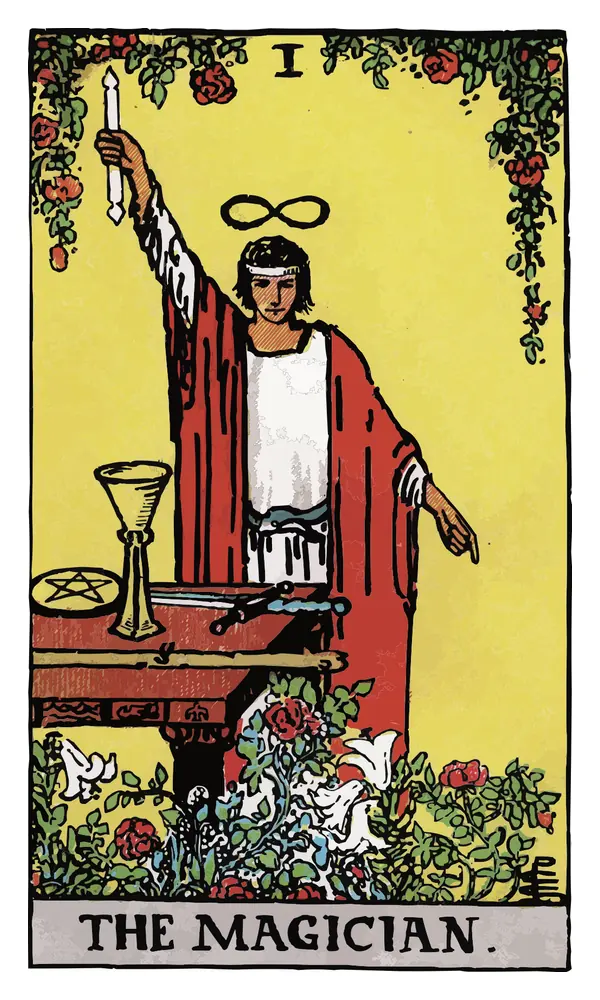
The Magician is a good first card to study, because its objects are laid out almost like a diagram.
The Magician
The Magician in the Rider–Waite–Smith deck: a raised wand, a table with four objects, and flowers below.
Read about The Magician on Tarot Told Me (opens in a new tab)On the table lie a cup, a sword, a wand and a pentacle. They match the four suits of the Minor Arcana, so the scene can be read as the whole deck's toolkit placed within reach of one figure. Above the head floats a horizontal figure-eight, often called a lemniscate, a shape long linked with endlessness.
The pose is also a symbol. One arm points upward holding a wand, the other points down at the ground, and the tradition often reads this as a link between above and below. Roses and lilies fill the garden in front, and in the Pictorial Key tradition they are commonly read as passion and purity. Here, the figure-eight and the gesture are the details to learn from: they show how a pose and a single shape can carry an idea.
What can the Star's figure and water show?
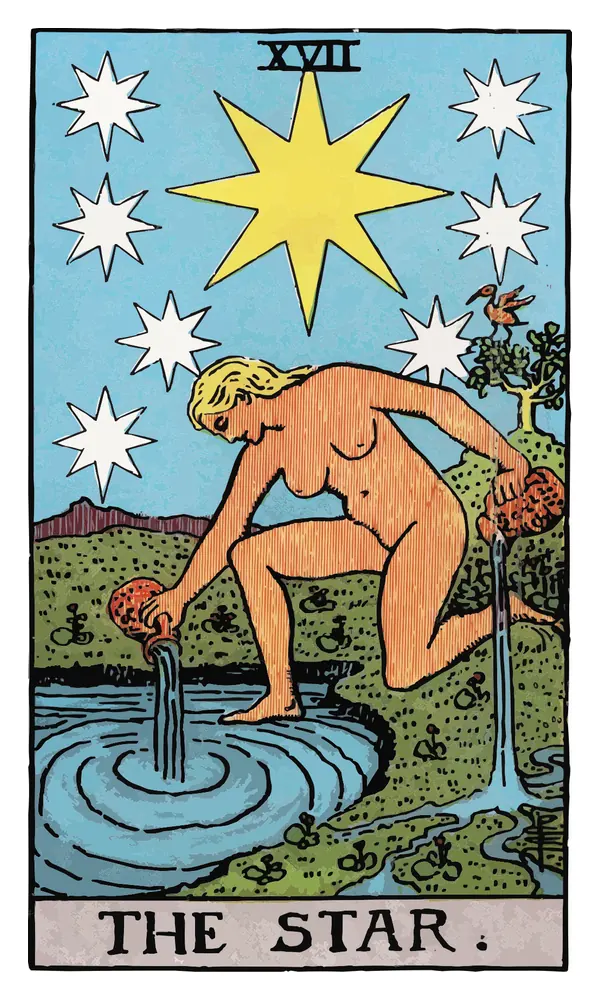
The Star shows a woman kneeling at the edge of a pool, pouring water from two jugs. One stream falls on the land and the other returns to the water. A reader can notice the doubled gesture first, then ask what a doubled gesture usually suggests: balance, exchange, or something going back and forth.
The Star
The Star: a kneeling figure with two jugs, a large star with smaller ones above, and a bird in a tree behind.
Read about The Star on Tarot Told Me (opens in a new tab)The sky holds one large star surrounded by seven smaller ones. The numbers are worth noting, because tarot decks use counting as a quiet code. Eight points and eight stars can be seen as a pattern, and the tradition often links stars with hope and guidance. In the background a bird perches in a tree, which Waite's circle associated with the ibis.
Say you notice the figure is unclothed and the landscape is open. You might ask what is missing, since there are no buildings, no crowd and no tools. That absence is also part of the image, and reading it is as valid as reading what is drawn.
What does the World's wreath frame?
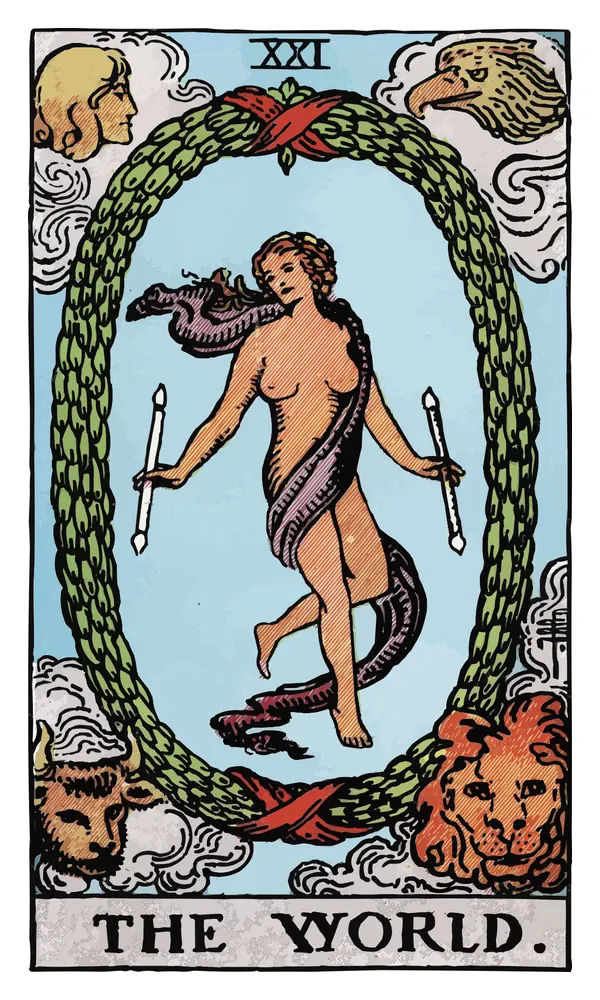
The World places a dancing figure inside a large wreath. The figure holds a wand in each hand, and a ribbon winds around the body. A wreath is an enclosing shape, and many readers see it as a frame that marks a finished cycle.
The World
The World: a dancing figure inside a wreath, with four winged and horned creatures in the corners of the card.
Read about The World on Tarot Told Me (opens in a new tab)In the four corners sit an angel, an eagle, a bull and a lion. These four creatures appear in older Christian art, and they also show up on another Major Arcana card, which makes them a good example of a symbol that travels. Many readers connect them with the four suits or with the four fixed signs of the zodiac. Both links are traditions of reading, not facts printed on the card.
The lesson here is about layers. The wreath, the dance, the corner figures and the ribbon each sit at a different level of the picture, and you can read them one by one before putting them together.
Do colors and numbers carry fixed meanings?
Not in any documented, universal way. Readers often link yellow with intellect or white with purity, and these associations can help you start a conversation with a card. They are interpretation, though, and a different tradition may give the same color a different role. A color is best read in its context: what surrounds it, and how much of the card it fills.
Numbers work in a similar manner. The deck is built on a sequence from ace to ten in four suits, followed by court cards, and the Major Arcana run from zero to twenty-one. Counting objects inside a picture can echo the card's own number, as with the stars of the Star. Whether that echo is intended or accidental is often open to debate.
Symbols & colors
Tarot color meanings: what the palette of the cards suggests
Yellow, blue, red, green, white and black each carry traditional associations in tarot art. Here is how those associations work, with examples from the cards.
· Taronica
For a closer look at hues, see our guide to color associations. For poses, the article on hands and gestures shows how a small movement changes a scene.
Symbols & colors
Hand gestures in tarot cards: a close look at the hands
Raised palms, pointing arms and hands reaching from clouds are part of how tarot images tell their story. Here is what is actually drawn, and how far a careful reader can take it.
· Taronica
How to practice reading symbols step by step?
Practice works best with one card at a time and a short written note. Pick a card, describe the picture in plain words, and list five objects you can see. Then check what the Pictorial Key says about it and mark where your observations and Waite's description overlap or differ.
- Draw or copy the scene from memory, then compare it with the card.
- Write one sentence about the setting and one about the posture.
- Read the matching passage in a reliable source.
- Note one symbol you had not noticed.
- Wait a day and look again.
A short spread can also be a way to compare several scenes side by side. Three cards give you three pictures to describe and connect.
Tool on Tarot Told Me
Three-card spread
Draw a three-card spread and describe each picture before you look up any meaning.
Tarot Told Me (opens in a new tab) is a reflective tarot app from the team behind this site.
Which mistakes should beginners avoid?
The first is treating a symbol as a code with one answer. A lion can suggest courage in one scene and danger in another, and a card that shows the same object twice may be doing something different each time. Keep your reading tied to the whole picture.
The second is mixing sources without noticing. A claim from a modern blog, a claim from Waite and your own impression are three separate things. Label them as you write, and your notes will stay useful months later.
The third is over-reading. Not every flower or cloud is a message, and some details may simply be Smith's way of filling a scene. If a detail does not seem to matter, it is fine to leave it as scenery.
Finally, avoid asking a picture to settle questions about health, money or legal matters. A tarot image can prompt reflection, but those topics belong with a qualified professional.
Frequently asked questions
No. Many decks share a core of images, but each artist makes choices. Decks that follow the Rider–Waite–Smith pattern look similar, while older and newer decks may use different scenes or only simple pips.
Waite gave instructions and Smith illustrated them. How much each of them decided on individual cards is hard to state with confidence, so it is safest to say the pictures came from their collaboration.
No. You can begin with what you see: figures, settings, objects and colors. Astrological and Kabbalistic links are traditions that many readers add later, and they are optional.
The Pictorial Key to the Tarot is the primary source for his own explanations, and its text is free online. Keep in mind that it records his view, not a single agreed reading.
Repetition builds a shared vocabulary. When roses, lions, wands or water return on different cards, comparing the scenes can show how the same object changes with its surroundings.